The AI Discovery Journey: How Supplement Brands Can Earn a Place in AI Answers

October 28, 2026 |

Consumers are using AI to explore health questions and compare options. Supplement brands can improve the chances of being surfaced and cited by publishing clear, credible, well-supported information.

At a Glance

  • AI tools are becoming one part of how some consumers explore health and wellness questions.
  • People may use AI to explain unfamiliar topics, compare ingredient forms, or organize information before making decisions.
  • Clear product details, credible evidence, and consistent information can make a brand’s content easier to assess and cite.
  • A citation may introduce a brand even when the consumer does not click through to its website.
  • AI discovery is one step in a broader trust journey that also depends on education, evidence, transparency, and product experience.

AI Is Becoming Part of Health & Wellness Research

Consumers have more ways to explore health and wellness questions than ever. Alongside search engines, social media, clinicians, retailers, and brand websites, some now use AI tools to summarize unfamiliar topics or help compare options.

A 2025 McKinsey survey found that 22% of consumers reported using large language models for health and wellness topics; among Gen Z respondents, the figure was 26%.

The finding indicates that AI is part of some consumers’ wellness research, while leaving room for other sources and behaviors to remain important.

For supplement brands, this creates a new consideration point. A consumer may encounter information about an ingredient, product, or category in an AI-generated answer before visiting a brand’s website.

The practical question is how to make reliable product information easier for people — and the systems they use — to find, understand, and cite.

From Consumer Questions to Brand Consideration

This process is what we call The AI Discovery Journey: the path from a consumer’s question through exploration, source checking, product comparison, and brand evaluation.

AI may support one or more steps, but the journey can also include conventional search, professional guidance, retailer information, and direct brand research.

A Pew Research Center analysis of 68,879 Google searches by 900 U.S. adults in March 2025 found that users clicked a source linked in a Google AI summary in about 1% of visits to pages with a summary.

The finding illustrates why website traffic alone may not capture every discovery moment. It describes observed Google searches in that study; it should not be read as a measure of every AI tool or supplement-related search.

Build for Clarity, Credibility, & Relevance

Brands cannot dictate what an AI system will show. They can, however, strengthen the information available for consumers and search systems to evaluate.

Accurate product pages, clearly explained ingredients and amounts, relevant evidence, and consistent details across labels and listings help establish a more dependable foundation.

This article explores why consumers turn to AI for health and wellness questions, what makes brand information useful and citeable, and how companies can strengthen their presence across a changing discovery landscape.

It also connects AI discovery to The Trust Stack, where an initial encounter can lead to education, evidence, transparency, and an experience that reinforces confidence.

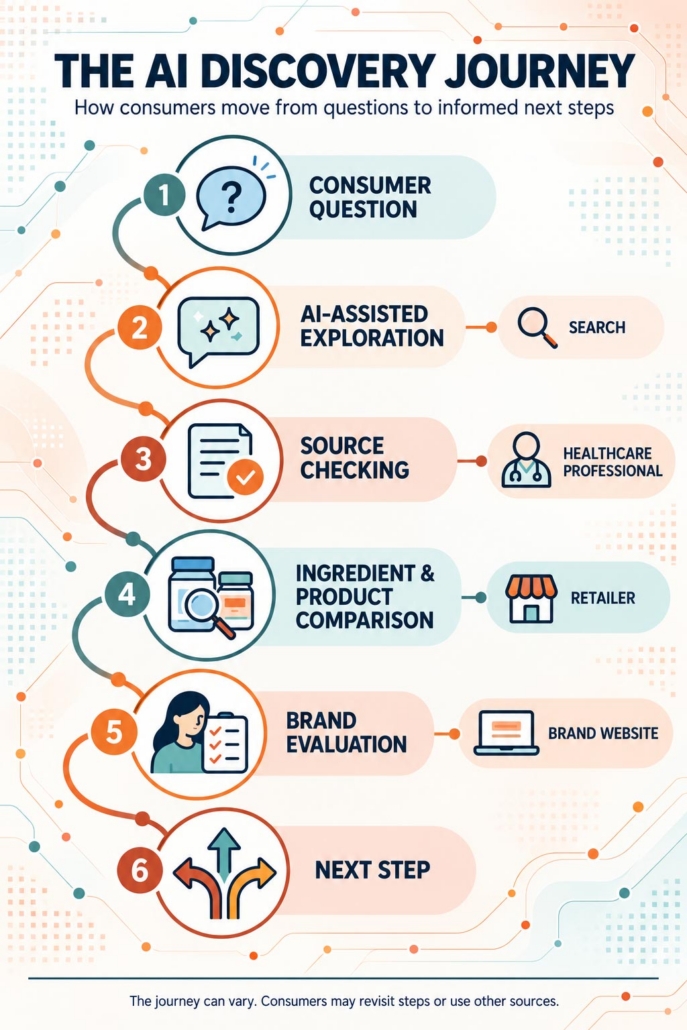
INFOGRAPHIC: The Consumer AI Discovery Journey

What Is the AI Discovery Journey?

The AI Discovery Journey describes how a consumer may move from a health or wellness question to exploring information, checking sources, comparing products, and deciding what to do next — with AI supporting one or more steps.

A typical journey might look like this:

Consumer question → AI-assisted exploration → source checking → ingredient and product comparison → brand evaluation → next step

For example, someone interested in supporting healthy sleep might ask an AI tool to explain magnesium forms, look for research about particular ingredients, or identify questions to discuss with a healthcare professional. They may then check product labels, visit brand websites, consult a clinician, or compare options at a retailer.

The journey is not always linear. Consumers may return to an earlier question, consult several sources at once, or skip steps.

AI is one possible touchpoint within a broader information environment that includes search engines, social platforms, healthcare professionals, retailers, and brand content.

For supplement brands, understanding this journey means looking beyond the product page visit. Consumers may encounter information about a category, ingredient, or brand while researching elsewhere.

Clear and credible information can help them evaluate what they find and decide where to look next.

Why Consumers Turn to AI for Health & Wellness Questions

AI tools can make it easier to begin researching an unfamiliar topic. A consumer might use a conversational prompt to get an overview, translate technical language, or organize questions before deciding what sources to consult.

Common uses include:

  • Getting oriented: Asking for a plain-language introduction to an ingredient or wellness topic.
  • Understanding terminology: Requesting explanations of ingredient forms, study terms, or label information.
  • Comparing options: Exploring how products or ingredients differ, while checking the details against reliable sources.
  • Organizing research: Summarizing information or generating follow-up questions.
  • Preparing for a conversation: Creating questions to bring to a healthcare professional.

These uses reflect convenience and accessibility. A conversational tool can respond to a specific question and help a person decide what to investigate next. However, an AI-generated answer is not automatically accurate, complete, or appropriate for an individual’s health situation.

Consumers should be able to trace important information to credible sources, and personal health decisions may call for advice from a qualified professional.

Why Being Cited Matters Even Without a Click

A consumer can encounter a brand’s information in an AI-generated answer without visiting the brand’s website. That makes a citation a distinct kind of discovery: it can expose a consumer to a source or product during research, even if it does not produce an immediate website session.

Pew Research Center’s analysis of 68,879 Google searches by 900 U.S. adults in March 2025 found that users clicked a traditional search result in 8% of visits when an AI summary appeared, compared with 15% when no summary appeared.

Users clicked a source linked within the AI summary in about 1% of visits to pages with a summary. These results describe observed Google searches in that study, not all AI platforms or supplement searches.

For brands, this suggests that referral traffic may not capture every way consumers encounter information. A useful strategy considers both whether people visit the site and whether the brand’s information is accurately represented where consumers research.

That distinction matters. A citation is not itself a recommendation or endorsement, and it does not guarantee that a consumer will choose the product. It is one possible entry point in a journey that continues through source evaluation, product comparison, and the trust-building steps described in The Trust Stack.

AI systems need information they can locate, interpret, and connect to a source. Supplement brands can support that process by publishing product information that is specific, consistent, and verifiable.

Start with the product fundamentals: identify each ingredient clearly, state its form and amount per serving, and explain the product’s intended use in language that matches the label.

When discussing research, link to relevant sources and explain what the evidence does — and does not — show. Keep statements about testing, certifications, sourcing, and manufacturing aligned with documentation the brand can substantiate.

What Makes a Brand’s Information Useful to Cite?

Clarity also means avoiding claims that blur distinct ideas. For example, a study on an ingredient does not automatically establish that a finished product produces the same result.

The formulation, dose, population, and study conditions all affect how findings should be interpreted.

A useful product information foundation includes:

  • Ingredient identity, form, and amount
  • Serving size and directions
  • Intended use and appropriately qualified claims
  • Relevant research, with links to sources
  • Important evidence limitations
  • Testing and quality information the brand can document
  • Applicable cautions and label details

When this information is clear and consistent, consumers have a stronger basis for evaluation, and automated systems have better material to interpret.

Build Strong Product & Ingredient Pages

A brand’s website can serve as a dependable source of truth for consumers, retailers, healthcare professionals, and search systems. To do that well, product and ingredient pages need to answer the questions people bring to research—not just repeat front-label language.

Make the Product Page a Complete, Accurate Reference

A useful product page explains what the product is, what it contains, and how it is intended to be used. Include the complete ingredient names, forms, and amounts per serving, along with serving directions and relevant label information. Keep this information aligned with the Supplement Facts panel and current packaging.

Explain the product’s purpose in clear language. If the product is designed to support a specific benefit, describe that intended use without extending beyond the claims the brand can substantiate. Distinguish the product’s purpose from broader claims about an ingredient. Evidence about one ingredient does not automatically establish that a particular finished formula provides the same result.

When discussing quality, testing, sourcing, or manufacturing, use precise statements the company can document. Explain what a term means where needed. For example, “tested” is more informative when the brand explains what was tested and what the statement refers to. Specific, supportable details help readers evaluate the information.

Connect Ingredient Evidence to the Finished Formula

Ingredient pages can provide a deeper explanation of an ingredient’s identity, forms, proposed mechanisms, research, and limitations.

Product pages can then link to relevant ingredient information and explain how the actual formula relates to that evidence.

Make the connection concrete. Identify the ingredient form used in the product and its amount per serving. If a cited study used a different form, dose, population, or duration, explain that distinction instead of implying the study directly tested the finished product. This context helps readers understand what can reasonably be inferred from the evidence.

When research is emerging, mixed, or limited, say so. A clear explanation of uncertainty can be more useful than a confident summary that leaves out important limitations.

Make Pages Easy to Navigate & Verify

Organize information so readers can find details quickly. Use descriptive headings, short sections, and links to original research or other relevant sources. Where appropriate, identify the author or reviewer and give the date of the most recent substantive update.

Internal links can connect related product pages, ingredient explainers, quality information, and educational articles. These connections help readers follow a topic without searching the site from scratch. They also provide clearer relationships between the company’s products and its supporting information.

Finally, review key product details across the website, packaging, Supplement Facts panels, and retailer listings. Ingredient names, amounts, serving instructions, and claims should not conflict. When information changes, update the relevant pages and materials so consumers can identify the current version.

The goal is not to make every page longer. It is to create a reliable reference that gives consumers enough information to understand and evaluate the product.

Answer the Questions Consumers Actually Ask

Consumers often begin with a specific question rather than a product category. They may want to understand an ingredient, compare two forms, or assess whether a product fits a goal. Content that addresses those questions directly can help consumers make sense of the available information.

Start With the Consumer’s Question

Useful questions may include:

  • What is this ingredient, and what does the research say?
  • Which form does this product contain?
  • How much does one serving provide?
  • What are the limitations of the available evidence?
  • How does this product differ from other options?
  • What factors should someone discuss with a healthcare professional?

These questions can inform ingredient explainers, product FAQs, comparison guides, and educational articles. They can also reveal where a brand’s current materials leave gaps.

If a product page lists an ingredient but does not identify its form or amount, for example, a consumer may need to look elsewhere to evaluate it.

Give a Direct Answer, Then Add the Context

A strong section begins with a clear response to the question. It then explains relevant details, such as the ingredient form, amount, study population, or limits of the research. This structure helps readers understand the main point without losing the context needed to interpret it.

For example, a comparison of ingredient forms should explain the specific differences being discussed and the evidence behind them. Avoid declaring one form universally “best” when the answer depends on the intended use, formulation, available research, and other practical factors.

Likewise, an explanation of clinical evidence should identify what was studied. Note whether research examined the ingredient itself or a finished product, and whether the dose and population resemble the product’s intended use. If the evidence does not establish a definitive conclusion, state that clearly.

Use Structure to Make Content Easier to Follow

Organize each page around a main topic, with descriptive headings that tell readers what each section covers. Use concise paragraphs, meaningful subheadings, and lists when they make details easier to scan. Link claims to the sources that support them, and ensure the visible content matches any structured data used on the page.

FAQs can be useful when they answer genuine questions that the main text does not fully address. They should add clarity, not repeat the same information in slightly different wording. Similarly, avoid producing many near-duplicate pages for small variations of a search query. A smaller set of well-developed, distinct resources is easier for readers to use and maintain.

Treat Education as Part of the Product Experience

Educational content supports consumers before and after purchase.

Before buying, it can help them understand a formulation and compare options. After purchase, clear directions and realistic explanations can help them use the product as intended and understand what the available evidence can support.

This is where content connects naturally to The Trust Stack. Discovery may bring a consumer to a question. Education helps them understand the answer; evidence helps them assess it; and transparent product information supports their next decision.

Strengthen Credibility Across Sources

A clear product page is an important foundation, but consumers may encounter brand information in many places: on a package, a retailer’s website, an ingredient supplier’s materials, an educational article, or a search result. When key details align across those sources, consumers can more easily understand what the product contains and evaluate the claims around it.

Start by identifying the information that should remain consistent: product names, ingredient forms and amounts, serving directions, intended use, and quality statements. Establish an internal source of truth for these details, then use it to guide updates to product pages, labels, retailer listings, and sales materials. When a formulation or label changes, review each place where the previous information appears.

Credibility also depends on the quality of the supporting information. Link research summaries to relevant sources, distinguish ingredient research from finished-product evidence, and explain important limitations. Describe testing, certifications, sourcing, and manufacturing practices accurately, using statements the company can document. Avoid broad assurances that do not tell readers what was verified.

Brands can also make expertise easier to assess. Identify qualified authors or reviewers when appropriate, provide useful background about their expertise, and keep educational content current. These steps help consumers judge who created the information and how it relates to the product.

The goal is not to repeat the same message everywhere. Each channel serves a different purpose. The goal is to make sure the underlying facts are accurate and compatible wherever consumers encounter them.

Make Content Accessible to Search Systems

Useful content needs a sound technical foundation. Search systems must be able to access and understand a page before it can be considered for display or citation. Google’s guidance for its AI search features points site owners to established SEO fundamentals: allow crawling, make pages findable through internal links, provide important information in text, and ensure structured data matches what users can see. Google says there is no special markup required for these features.

For supplement brands, this means checking both the page itself and the paths that lead to it. Product and ingredient information should appear in crawlable page text, not only inside an image or a document that is difficult to access.

Important pages should connect to related content through clear internal links. Headings should describe the section that follows, and page titles should help users understand what the page covers.

Structured data can clarify details for eligible search features, but it should reflect the visible page accurately. It does not replace complete product information or establish the credibility of a claim. Keep relevant business and product details current, and use tools such as Google Search Console to monitor indexing and diagnose technical issues.

These practices improve the conditions for discovery; they do not guarantee that a page will be indexed, shown, or cited. Google notes that even pages meeting its technical requirements and best practices may not be served in search features.

Measure Discovery Beyond Website Clicks

Website traffic remains useful, but it may not capture every way a consumer encounters a brand. Someone might see a product or ingredient mentioned in an AI-generated answer, then later search for the brand by name, visit a retailer, or ask a healthcare professional about the product.

Brands can monitor several signals together:

  • Referral traffic: Visits from search engines and AI platforms, where analytics tools identify the source.
  • Branded searches: Changes in searches for the company, product names, or distinctive ingredients.
  • Qualified inquiries: Questions from prospective customers that suggest prior research or familiarity with the brand.
  • Product-page engagement: Visits, time on page, and interactions with relevant educational content.
  • AI citations: Whether and how a brand’s pages appear in answers to a consistent set of relevant questions.

Citation checks should use a defined list of prompts, platforms, and review dates. Record the wording of the question, whether a citation appeared, which page was cited, and whether the information was represented accurately.

Repeat checks over time to look for patterns. Since answers can differ by query, platform, and date, treat these checks as directional rather than a complete measure of visibility.

The aim is to understand how discovery may be changing and whether brand information is reaching consumers in useful ways. No single metric tells the whole story.

Connect the AI Discovery Journey to The Trust Stack

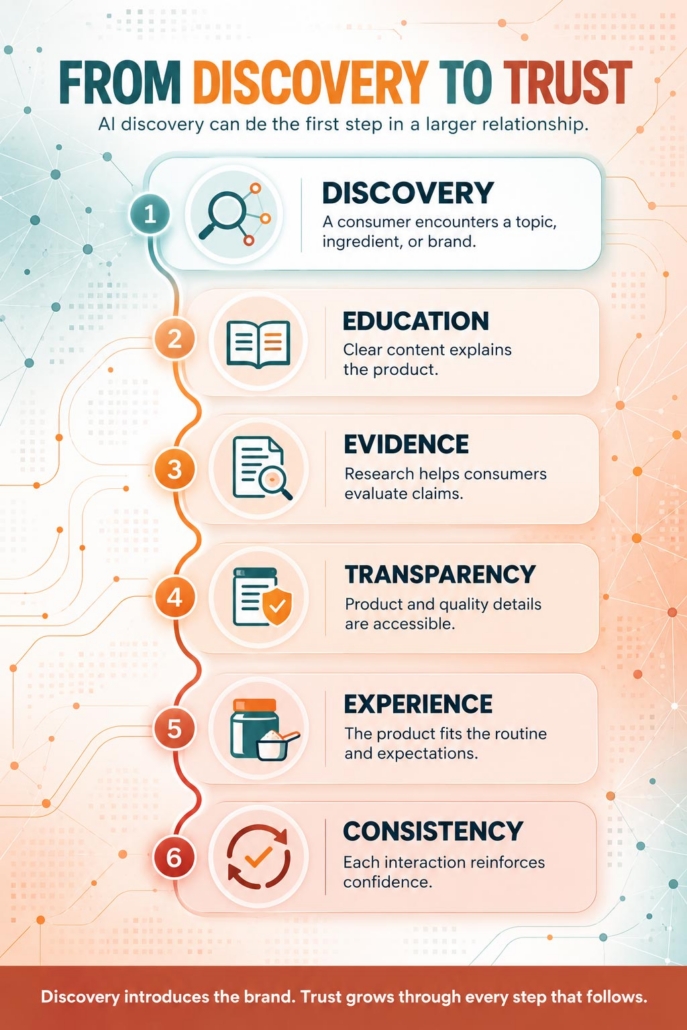
The AI Discovery Journey describes how a consumer may encounter and explore information. The Trust Stack shows how confidence can develop as the consumer evaluates that information and experiences the product.

The connection can be summarized this way:

Discovery → Education → Evidence → Transparency → Experience → Consistency

An AI answer or search result may introduce a consumer to a topic, ingredient, or brand. Clear educational content can help explain the product. Relevant evidence gives consumers a basis for evaluating claims, while transparent information helps them understand what the product contains and how quality is supported. The product experience then shapes whether the brand earns continued confidence.

This is why AI visibility alone is not a complete strategy. A mention may prompt interest, but the information behind it — and the product itself — must support the next steps.

Brands can strengthen that foundation by keeping product details accurate, making evidence accessible, answering real questions, and delivering a consistent experience across the customer journey.

The opportunity is to help consumers move from a question to a better-informed evaluation. When discovery leads to clear education, evidence, transparency, and a dependable product experience, it becomes the first step in a stronger relationship.

INFOGRAPHIC: From Discovery To Trust

NEXT UP: The Trust Stack – How Brands Build Confidence Across the Consumer Journey

Consumers rarely decide whether to trust a supplement based on one detail. They may first encounter a product in an AI answer, search result, social post, or retailer listing. Then they look for evidence that the brand’s claims, ingredients, quality practices, and product information hold together.

The Trust Stack brings these signals into one practical framework. It shows how clear information, credible evidence, transparent quality practices, consistent communication, and a reliable product experience can work together to support consumer confidence.

For supplement brands, strengthening these foundations can also make product information easier for people and AI systems to understand and evaluate.

Frequently Asked Questions

The AI Discovery Journey is the process through which a consumer may use AI to explore a health or wellness question, check sources, compare ingredients or products, and decide what to do next. AI may support one step or several, alongside search engines, healthcare professionals, retailers, social media, and brand websites.

Consumers may use AI to get an overview of an unfamiliar topic, understand technical terms, compare options, organize research, or prepare questions for a healthcare professional. AI can be convenient, but its answers may be incomplete or inaccurate, so important claims should be checked against reliable sources.

Brands can strengthen the quality and accessibility of their public information. Maintain accurate product pages, state ingredient forms and amounts clearly, connect claims to relevant evidence, explain limitations, and keep details consistent across the website, labels, and retailer listings. Make sure key pages are crawlable and linked from relevant parts of the site. These practices support discovery but cannot ensure citation.

No. Schema markup can help describe page content to search systems, but it does not guarantee citation in an AI answer. Use structured data that accurately reflects visible page content and supports established search purposes. Clear, credible information and access to the page remain important foundations.

Brands can publish FAQs when they answer real consumer questions and add useful information to a page. FAQ schema should reflect the questions and answers visible to readers. It is not a shortcut to AI citations, and platform support for FAQ markup varies.

Brands should clearly provide product and ingredient names, forms and amounts per serving, directions, intended use, relevant evidence and its limitations, and quality statements they can substantiate. Applicable cautions and label details should also be accessible and consistent with current packaging.

The AI Discovery Journey describes how consumers may encounter and investigate information. The Trust Stack describes how discovery can lead to education, evidence, transparency, product experience, and consistency. AI may help with initial discovery, while the brand’s information and product experience shape what happens next.

Use a mix of signals, including referral traffic, branded search trends, qualified inquiries, product-page engagement, and citation checks across a consistent set of questions. Citation results can vary by platform, query, and time, so treat them as directional and evaluate patterns rather than relying on a single check.

References

Chapekis, A., & Lieb, A. (2025, July 22). Google users are less likely to click on links when an AI summary appears in the results. Pew Research Center.

Google Search Central. (2025, December 10). AI features and your website. Google for Developers.

Google Search Central. (2026, October 1). Google Search’s guidance on using generative AI content on your website. Google for Developers.

McKinsey & Company. (2026). State of the consumer 2026: Four key trends to watch for.

OpenAI. (n.d.). Publishers and developers: FAQ. OpenAI Help Center.

Related Postings

Golden pear-colored craving control gummy supplements featuring saffron and chromium
a team of scientists and business professionals discussing a supplement product
a trade show attendee discussing nutraceutical formulation at the Intermountain Nutrition exhibitor booth at SupplySide Global 2026