How Supplement Brands Can Win the Self-Directed Health Consumer

September 30, 2026 |

Consumers are researching ingredients, comparing evidence, tracking personal data, and building wellness routines across categories. For supplement brands, the challenge is no longer simply getting noticed. It is creating products that are relevant, credible, enjoyable to use, and ready to evolve as consumer expectations change.

At a Glance

  • Self-directed health consumers often arrive with a specific goal, question, ingredient preference, or product hypothesis.
  • Consumers increasingly evaluate supplements by outcomes, evidence, transparency, format, and personal fit.
  • AI, wearables, podcasts, social platforms, and online communities are influencing product discovery before consumers reach a brand website.
  • Brands are competing for a broader wellness budget that includes supplements, functional foods, beauty, fitness, diagnostics, and health services.
  • The brands most likely to earn repeat purchase will connect formulation intelligence, clear education, sensory performance, and consistent quality.

How the Self-Directed Health Consumer Is Changing Supplement Product Development

Supplement brands are managing pressure from several directions at once.

Consumers want new solutions quickly. Retailers want differentiated products. Marketing teams need clear stories. Executives need commercially viable launches. At the same time, regulatory, quality, sourcing, stability, flavor, packaging, and manufacturing requirements still demand careful work.

The pressure isn’t coming from a shortage of ideas. The industry has more ideas than ever. The challenge is deciding which ideas deserve investment and turning them into products that can deliver consistently.

NIQ’s new Health and Wellness Consumer Trends Report describes today’s health and wellness consumer as increasingly self-directed, intentional, and informed. These consumers are evaluating products by functional benefits, ingredient transparency, and personal fit rather than relying on brand familiarity alone. Their decisions increasingly occur at the attribute and outcome level.

What This Means for Supplement Brands

A product can’t depend on a broad category label such as “energy,” “immune support,” or “healthy aging.” Those categories still provide useful context, but they don’t fully explain why a consumer should choose one product over another.

Consumers may also ask:

  • What specific outcome is this product designed to support?
  • Why were these ingredients selected?
  • Is the dose meaningful?
  • Is the evidence relevant to this form and serving size?
  • Where is the product made?
  • How is it tested?
  • Will the format fit a daily routine?
  • Can the label be understood without additional research?

The answers need to exist before the product reaches the shelf. They should shape the concept, formulation, claims strategy, content plan, packaging, and manufacturing process from the beginning.

The Commercial Opportunity for Supplement Brands

The commercial opportunity is substantial. Circana reports that the U.S. consumer healthcare market reached $107 billion in 2025 after growing 3%. The broader market is being shaped by prevention, daily wellness routines, nutrition, personal care, social commerce, and AI-enabled discovery.

Consumer healthcare is broader than dietary supplements, but the direction is clear: more people are allocating attention and spending toward proactive health management.

McKinsey’s wellness research similarly reports that 84% of U.S. consumers consider wellness an important or top priority. Its findings describe wellness as a daily, personalized practice spanning functional nutrition, healthy aging, weight management, mental health, sleep, and fitness.

For supplement brands, this creates both opportunity and strain.

The opportunity lies in developing more relevant products for clearly defined needs. The strain comes from the growing distance between what consumers expect and what brands can responsibly deliver within a limited development timeline.

That distance is where many product development problems begin. Teams may rush toward a trending ingredient without defining the intended outcome. They may choose a dose that fits the target cost but weakens the product story. They may select a format before considering stability, taste, serving size, or adherence. They may begin marketing before the evidence, claims, and manufacturing plan are aligned.

Winning with the self-directed consumer requires a connected development process.

Marketing can’t repair a weak formulation. A promising formula can’t overcome poor taste or confusing instructions. A strong product can’t build trust if its evidence, testing, and sourcing information remain difficult to find.

The product has to work as a complete system.

Consumers Arrive With a Hypothesis

The self-directed health consumer often approaches a supplement brand with a hypothesis.

They may believe that a particular ingredient can help with sleep, focus, recovery, gut health, metabolic health, or healthy aging. They may have developed that belief through a podcast, an online community, an AI tool, a wearable device, a practitioner, or their own experience.

Expanded Self-Research

ECRM’s vitamin and supplement analysis describes consumers entering retail with clear hypotheses, specific ingredient demands, and higher expectations for quality, convenience, and transparency. It also describes an expanding self-research process involving podcasts, scientific content, wearables, social platforms, and generative AI.

That means the consumer may already have questions before encountering your brand:

  • “Is magnesium glycinate the right form for my goal?”
  • “Should I take creatine every day?”
  • “What should I look for in a GLP-1 support product?”
  • “Is this probiotic strain relevant to the outcome I want?”
  • “Does this product contain a clinically meaningful amount?”
  • “Can I combine it with the other products in my routine?”

Beyond Product Education: Helping the Consumer Evaluate the Supplement

The brand’s role is no longer limited to presenting a product. It must help the consumer evaluate the product.

That requires a stronger connection between product development and education.

Consumer expectation Product development response
“I want a specific result.” Define the intended outcome and audience before selecting ingredients.
“I want to understand the formula.” Explain the function, form, dose, and rationale for each key ingredient.
“I want evidence.” Match claims and education to relevant research and appropriate substantiation.
“I want something I will use consistently.” Treat flavor, texture, format, serving size, and convenience as core requirements.
“I want confidence in the product.” Make testing, sourcing, certifications, and manufacturing standards easier to understand.

This also changes how brands should think about content. A product page cannot carry the entire burden. Consumers may encounter the brand through a search result, a retailer listing, a social post, an AI answer, a review, or a comparison article.

McKinsey reports that 22% of consumers use large language models for health and wellness topics. It also finds that AI, social media, and other digital channels are reshaping how people discover and evaluate products.

Brands therefore need a consistent information system. The ingredient explanation on the website should align with the Supplement Facts panel, retailer listing, educational article, sales presentation, and customer support response.

Inconsistency creates confusion. Confusion weakens trust.

Clear, accurate information gives both consumers and AI systems a better basis for evaluating the product.

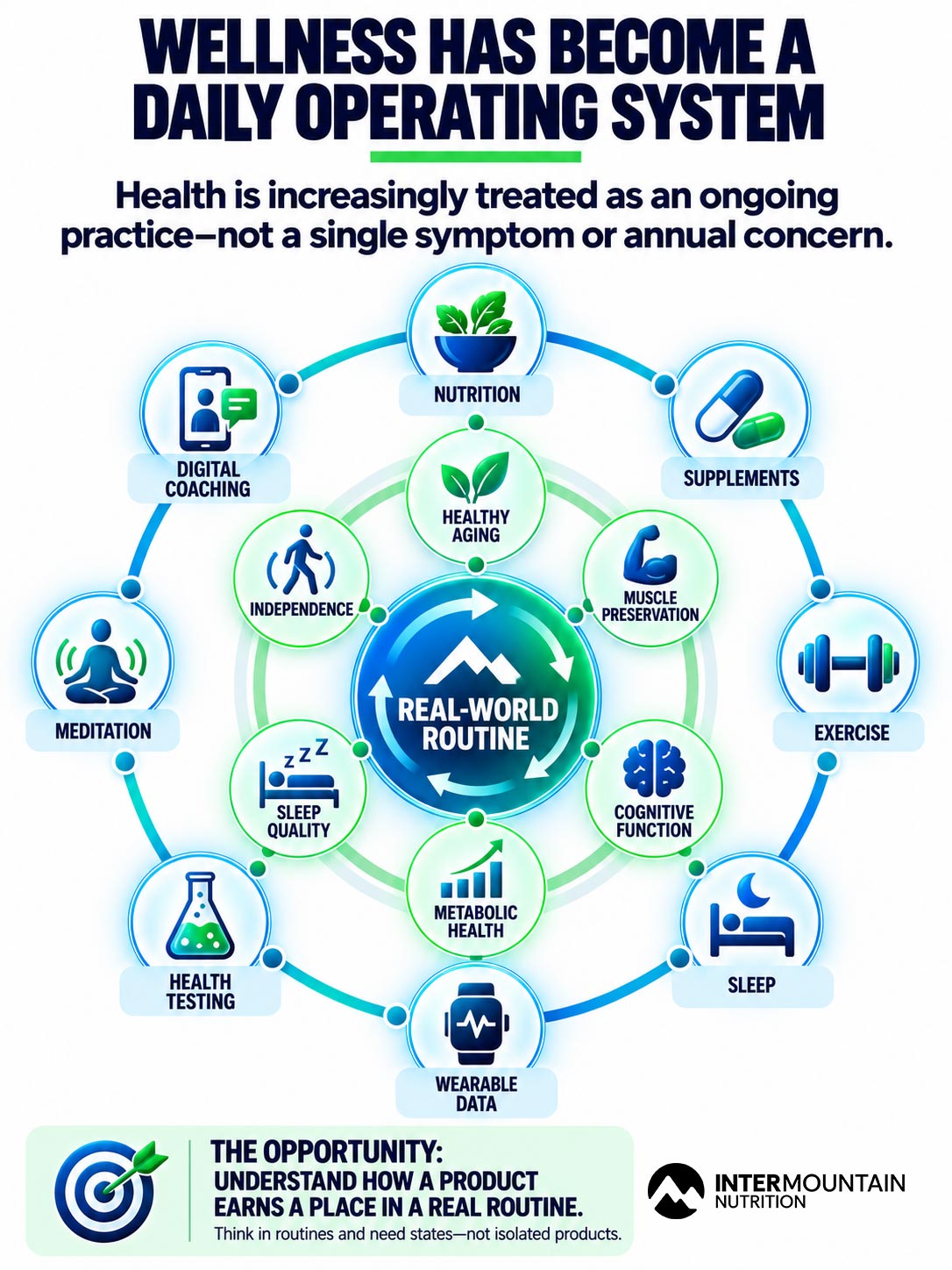
INFOGRAPHIC: Wellness Has Become A Daily Operating System

Wellness Has Become a Daily Operating System

Consumers are increasingly treating health as an ongoing practice rather than a response to a single symptom or annual concern.

Their routines may include nutrition, supplements, exercise, sleep tracking, strength training, meditation, wearable data, health testing, and digital coaching. These activities influence one another. A consumer focused on healthy aging may also care about muscle preservation, cognitive function, metabolic health, sleep quality, and independence.

This is why supplement brands should think in terms of routines and need states, not isolated products.

A consumer may use:

  • protein and creatine as part of a morning or training routine
  • electrolytes and hydration powders during the day
  • a focus or stress formula during work
  • fiber, probiotics, or digestive support with meals
  • magnesium or a non-melatonin sleep product in the evening

The opportunity is not to encourage unnecessary stacking. It is to understand how a product earns a place in a real routine.

Fit the Product to the Moment

McKinsey identifies functional nutrition, healthy aging, weight management, mental health, and mindfulness as significant wellness growth areas. It also reports that consumers want products that meet specific needs and deliver value through quality, efficacy, availability, and ease of use.

That creates a higher standard for formulation.

A product must make sense within the consumer’s day. The serving size must be manageable. The format must be practical. The flavor must support repeat use. The formula must deliver a clear reason to exist.

For product developers, this means asking questions beyond “Which ingredients are trending?”

A better set of questions is:

  • What moment in the consumer’s day does this product serve?
  • What other products may be used alongside it?
  • What friction could prevent consistent use?
  • Does the format support the intended dose?
  • Can the product deliver a satisfying experience at a commercially viable cost?

These questions move product development closer to the consumer’s actual behavior.

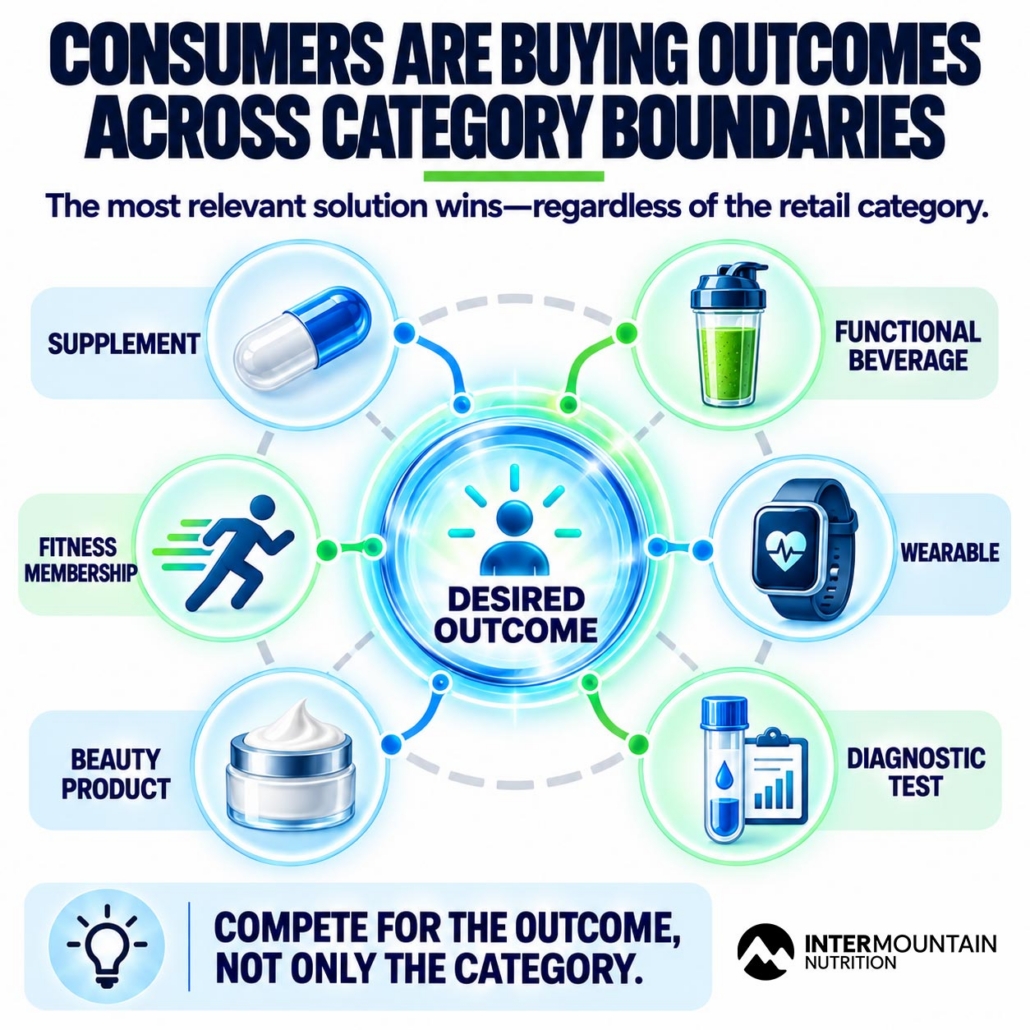
INFOGRAPHIC: Consumers Are Buying Outcomes Across Category Boundaries

Consumers Are Buying Outcomes Across Category Boundaries

The self-directed consumer does not always think in traditional retail categories.

They may compare a supplement with a functional beverage, a fitness membership, a wearable, a beauty product, a diagnostic test, or a health service. The purchase decision depends on which option appears most relevant to the outcome they want.

The boundaries between beauty, health, and wellness are also becoming less distinct. CNBC reported on a CEW and AlixPartners survey in which nearly 100% of respondents viewed those areas as one consumer budget rather than three separate categories. The report also described consumers as increasingly knowledgeable about products and interested in science-backed solutions.

The Merging of Beauty, Health, and Wellness Categories

NRF’s analysis of the 2026 Hot 25 Retailers reaches a similar conclusion from the retail side: wellness now extends across healthcare, beauty, grocery, sporting goods, discount retail, and specialty retail.

For supplement brands, this means relevance must be earned at the level of the consumer’s goal.

A cognitive support product may compete with a coffee alternative, a productivity app, a sleep intervention, or a wearable. A healthy aging product may compete with strength training, protein products, diagnostics, skincare, or a longevity program.

The brand does not need to enter every category. However, it does need to understand the broader solution set the consumer is considering.

That understanding can guide better decisions about:

  • product positioning
  • ingredient combinations
  • format and flavor
  • education
  • partnerships
  • retail placement
  • portfolio development

The question is no longer whether a product fits neatly into a supplement category.

The question is whether it gives the consumer a credible, useful, and repeatable way to pursue a meaningful outcome.

The Consumer Decision Journey Is Becoming More Complex

Supplement discovery no longer follows a simple path from shelf to purchase.

A consumer may first encounter an ingredient through a podcast, a social post, an online community, a wearable device, a retailer search result, or an AI-generated answer.

Each channel shapes expectations before the brand enters the conversation.

NIQ reports that consumers are using online sources, AI, wearable technology, and other digital tools for health product discovery, guidance, and purchase. ECRM also describes consumers conducting extensive self-research before they enter a retail environment, often arriving with specific ingredient preferences and product expectations.

The result is a more fragmented decision journey. A consumer may discover a product on one platform, evaluate the ingredients on another, read reviews through a retailer, and ask an AI tool to compare alternatives.

Discovery Can Happen Before the Brand Is Seen

AI is becoming part of that early research process. McKinsey reports that 22% of consumers use large language models for health and wellness topics. Among Gen Z consumers, the figure rises to 26%.

This creates a new challenge for supplement brands. Product information must be clear enough for consumers to understand and consistent enough for digital systems to interpret.

Inaccurate or incomplete information can create confusion around:

  • ingredient forms
  • serving sizes
  • intended benefits
  • product comparisons
  • usage instructions
  • testing and quality standards

The product may be well formulated, yet still be misunderstood if the available information is inconsistent. That can affect search visibility, retailer conversion, customer support, and long-term trust.

Product Information Is Part of Product Development

Clear education should begin during product development. It shouldn’t be added after the formula is complete.

Brand and product teams should be able to explain:

  • what consumer need the product addresses
  • why the ingredients were selected
  • why the forms and doses are appropriate
  • how the product fits a daily routine
  • what evidence supports the positioning
  • how quality and consistency are verified

This information can then support product pages, retailer listings, FAQs, sales materials, packaging, social content, and AI-readable resources.

The process also helps identify weaknesses earlier. If the formula is difficult to explain, the positioning may be too broad. If the dose requires a serving size that feels impractical, the format may need to change. If the evidence doesn’t support the proposed benefit, the concept may require a different claim or a different formulation.

In this environment, content isn’t separate from product strategy. It helps reveal whether the product is clear, credible, and commercially ready.

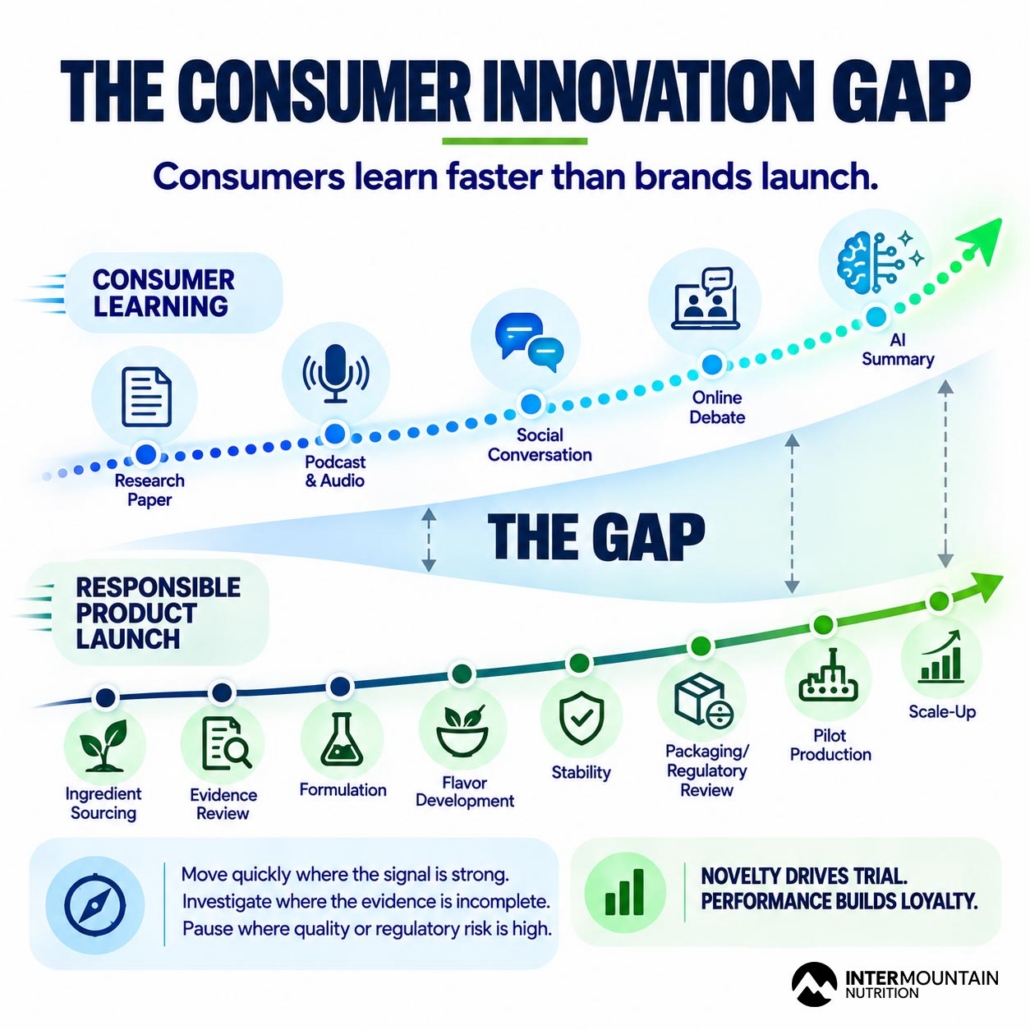
The Consumer Innovation Gap

Consumers learn faster than brands launch.

A new ingredient or health concept can move from a research paper to a podcast, social conversation, online debate, and AI summary within weeks.

Meanwhile, a responsible supplement launch may require ingredient sourcing, evidence review, formulation, flavor development, stability work, packaging, regulatory review, pilot production, and scale-up.

That widening distance is the Consumer Innovation Gap.

The gap doesn’t mean that product development should skip necessary quality or regulatory steps. It means that brands need better systems for deciding where to move quickly, where to investigate further, and where to pause.

ECRM describes a shortened path between digital popularity and retail demand. Its analysis also notes that novelty can drive trial, while long-term loyalty depends on efficacy and product performance.

INFOGRAPHIC: The Consumer Innovation Gap
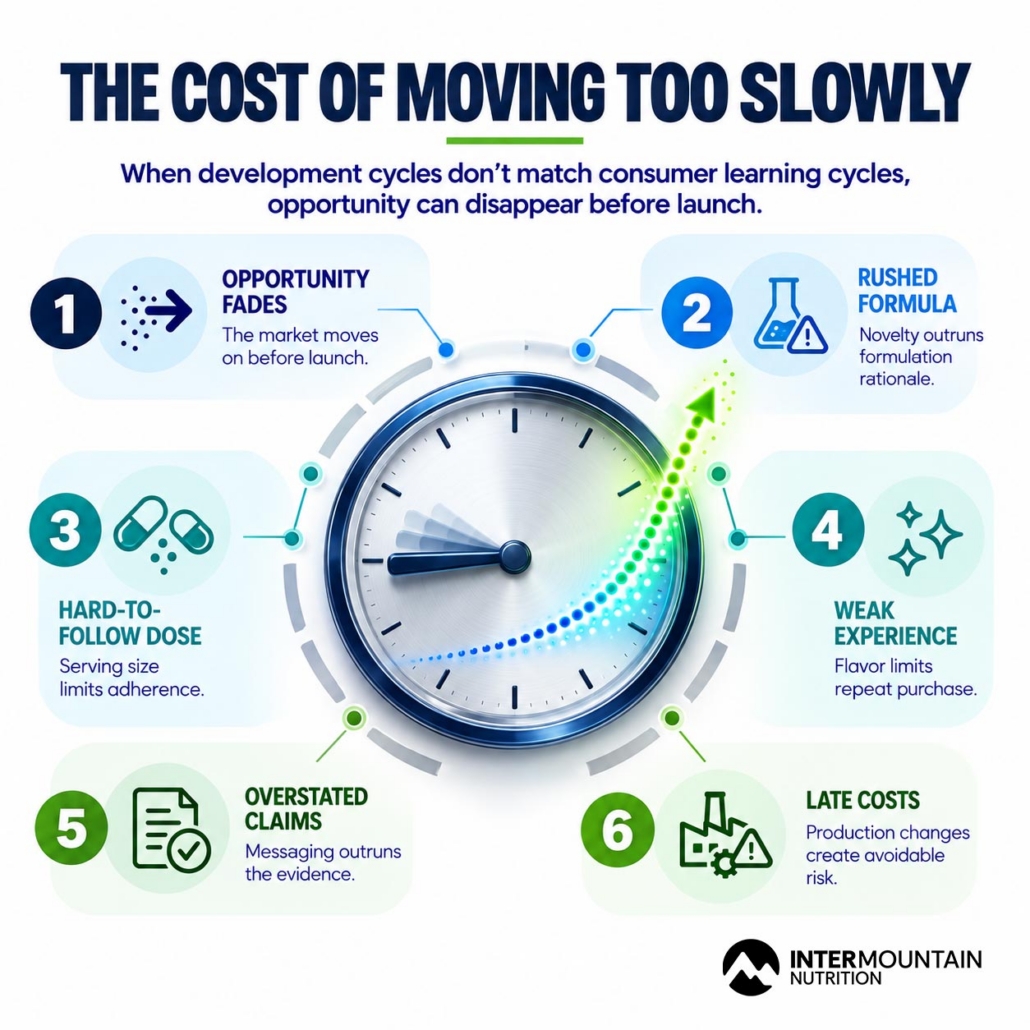
INFOGRAPHIC: The Cost Of Moving Too Slowly

The Cost of Moving Too Slowly

When development cycles don’t match consumer learning cycles, several problems can follow.

A promising opportunity may lose momentum before launch. A brand may release a rushed formula that lacks a clear rationale. Marketing may build a story around an ingredient before R&D has confirmed its dose, sensory profile, stability, or manufacturability.

The result can be:

  • a product that arrives after the market has moved on
  • a formula that relies on novelty more than meaningful performance
  • a serving size that consumers find difficult to follow
  • a flavor experience that limits repeat purchase
  • messaging that overstates the evidence
  • production changes that create avoidable cost or quality problems

These issues often appear late because product development functions work in sequence instead of together.

Responsiveness Requires a Better Development System

Responsive brands create earlier connections between consumer insight, formulation, quality, regulatory, marketing, and manufacturing.

That system can include:

  • monitoring emerging consumer needs and questions
  • maintaining a pipeline of research-informed concepts
  • screening ingredients for evidence, supply, dose, and cost
  • evaluating format and sensory requirements at the start
  • testing manufacturability before final positioning
  • building educational content alongside the product
  • using pilot and scale-up work to identify risks early

The goal is a shorter path between insight and action, supported by better decisions at each stage.

Speed still matters. Responsiveness matters more. A responsive brand can recognize a meaningful opportunity, test the idea against evidence and consumer needs, and move efficiently toward a product that can be made consistently.

That capability depends on the right development partners. Formulation expertise, flavor and masking support, pilot production, quality systems, regulatory guidance, packaging coordination, and scalable manufacturing all contribute to closing the Consumer Innovation Gap.

The next five articles in this series will explore the strategic frameworks that help brands respond to this changing environment: The Consumer Innovation Gap, The Evidence Economy, Formulation Intelligence, The AI Discovery Journey, and The Trust Stack.

Five Strategic Frameworks for Winning the Self-Directed Health Consumer

The self-directed consumer shift affects every part of the supplement business. It changes how brands identify opportunities, evaluate evidence, build formulas, communicate with shoppers, and earn repeat purchase.

The five frameworks in this series will examine those changes in greater depth.

The Consumer Innovation Gap

As explained earlier, consumers can discover and discuss a new health concept within weeks. Responsible product development takes much longer.

The Consumer Innovation Gap describes the distance between those two timelines. It asks how brands can respond to emerging demand with greater speed and coordination while preserving quality, evidence, and regulatory discipline.

The solution involves better systems for monitoring consumer needs, evaluating concepts, coordinating development, and preparing products for scale. We will dive deeper into these systems in the next blog post in this series.

The Evidence Economy

Consumers increasingly want proof behind product claims. They’re examining ingredients, doses, certifications, testing, and research before making a purchase.

McKinsey reports that science and data-backed claims can help differentiate wellness products and strengthen consumer confidence. BeautyMatter similarly identifies growing scientific literacy and demand for substantiated claims across beauty, health, and wellness.

The Evidence Economy explores how substantiation has become part of brand value. It also examines how brands can communicate evidence clearly without overwhelming readers or overstating what research shows.

Formulation Intelligence

A formula needs to do more than contain familiar or fashionable ingredients.

Formulation Intelligence describes the decisions that turn science into a product people can use consistently. Those decisions include ingredient form, dose, combination, bioavailability, sensory experience, serving size, stability, cost, and manufacturability.

ECRM’s analysis makes an important distinction: novelty may encourage trial, but long-term loyalty depends on efficacy and product performance. McKinsey also identifies taste and texture as basic expectations for functional nutrition products.

This framework will focus on the reasoning behind strong formulas and the development choices that support both consumer value and commercial execution.

The AI Discovery Journey

AI is becoming part of how consumers research health questions, compare ingredients, and evaluate products. McKinsey reports that 22% of consumers use large language models for health and wellness topics.

The AI Discovery Journey follows what happens before a consumer reaches a product page. It examines how product data, educational content, FAQs, reviews, and third-party sources influence the information that consumers encounter.

Brands will need clear, structured, and consistent information across every public channel. Product education must support human readers while remaining understandable to the systems that increasingly organize health and wellness information.

The Trust Stack

Trust develops through repeated signals.

A consumer may discover a brand through search, social media, a retailer, or an AI tool. Education helps answer initial questions. Evidence supports the product rationale. Transparency clarifies sourcing, testing, and manufacturing. Product experience influences continued use. Consistency determines whether confidence grows over time.

NIQ reports that consumers increasingly evaluate wellness products through functional benefits, ingredient transparency, and personal fit. The Trust Stack will explore how these signals work together across marketing, formulation, quality, manufacturing, and the customer experience.

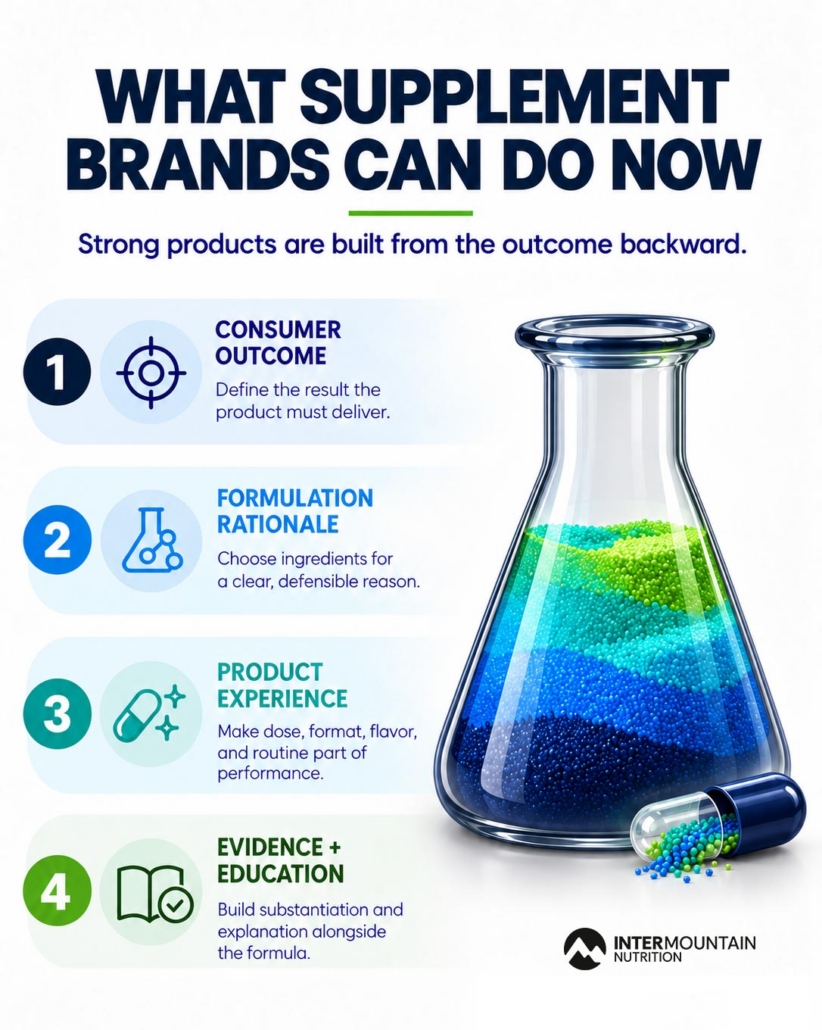
What Supplement Brands Can Do Now

The self-directed consumer doesn’t require every brand to chase every emerging trend. The stronger response is a more disciplined development process that connects consumer insight with evidence, formulation, communication, and execution.

Start With the Consumer Outcome

A product concept should begin with a clearly defined need state.

“Energy” may describe a category, but it doesn’t explain whether the product is intended to support morning alertness, exercise performance, sustained focus, or recovery from fatigue. Each outcome may require a different audience, formulation, format, and communication strategy.

A clear outcome helps teams make better decisions throughout development. It also gives consumers a simpler reason to understand the product.

INFOGRAPHIC: What Supplement Brands Can Do Now

Establish the Formulation Rationale Early

Ingredient selection should follow the intended outcome. The development team should be able to explain the role of each key ingredient, the reason for its form, and the logic behind the dose.

This process can reveal problems before they become expensive. A formula may require an impractical serving size. A promising ingredient may create unacceptable bitterness. A combination may create stability or sourcing concerns. An early review can guide the concept toward a more workable solution.

Treat Product Experience as a Performance Requirement

Taste, texture, convenience, and serving size influence whether a consumer continues using a product.

That makes sensory development part of product performance. A powder that mixes poorly, a gummy with an unpleasant aftertaste, or a capsule routine that feels inconvenient can weaken adherence even when the formula is scientifically sound.

Format decisions should consider the intended dose, consumer routine, stability requirements, packaging, and production scale from the beginning.

Build the Evidence & Education Plan Alongside the Formula

Evidence shouldn’t enter the process after the formula and claims have already been decided.

Brand, regulatory, R&D, and quality teams should align early around:

  • the evidence relevant to the intended outcome
  • the claims the product can responsibly support
  • the information consumers are likely to question
  • the testing and documentation needed for confidence
  • the educational content required before launch

This approach also creates stronger product pages, retailer listings, FAQs, sales materials, and launch content.

Why the Manufacturing Partner Has Become a Strategic Asset

The self-directed consumer judges the finished product, but many of the decisions that shape that experience happen long before launch.

Dose, ingredient form, flavor, serving size, stability, packaging, testing, and production consistency all influence whether a product earns trust and repeat purchase. Those decisions require close coordination between product development, quality, regulatory, procurement, marketing, and manufacturing teams.

That makes the manufacturing partner part of the strategic process.

Execution Starts Before the Purchase Order

A manufacturing partner should contribute while the concept is still taking shape.

Early collaboration can help identify:

  • whether the proposed dose fits the selected format
  • whether the ingredients can be sourced consistently
  • whether the formula can meet its cost target
  • whether flavor or texture may limit adherence
  • whether the product can remain stable through its intended shelf life
  • whether the packaging and serving instructions support routine use
  • whether the product can scale beyond an initial pilot run

These questions can prevent expensive rework later.

They can also help teams distinguish between a compelling idea and a commercially workable product. A formula may look attractive on paper but require too many capsules, carry an impractical flavor burden, or depend on an ingredient with unstable supply. Identifying those issues early creates room for better decisions.

From Concept to Scalable Product

Intermountain Nutrition supports that connected process through formulation and R&D, flavoring and masking, pilot and scale-up work, quality and regulatory support, packaging and labeling, logistics, and commercial manufacturing.

Our capabilities span capsules, powders, stick packs, pouches, and gummies. On-site third-party testing supports quality review as products move through development and production.

That combination gives brands a way to connect consumer insight with practical execution. The goal is a product that makes sense from several perspectives at once:

  • It addresses a clear consumer need.
  • It uses meaningful ingredients and appropriate doses.
  • It offers a format people can use consistently.
  • It can meet quality and regulatory requirements.
  • It can be produced reliably at commercial scale.

A responsive manufacturing partner helps reduce the distance between those decisions. That can shorten avoidable delays while preserving the work required to protect product quality.

Winning With the Self-Directed Health Consumer

The self-directed health consumer has raised the standard for supplement brands.

Consumers are researching before purchase. They’re comparing products across categories. They’re asking more specific questions about ingredients, evidence, testing, sourcing, and format. They’re also judging whether a product fits their routines and delivers an experience worth repeating.

A More Responsive Brand System

Winning in this environment requires alignment across the full product lifecycle.

Consumer research should inform the initial concept. Evidence should shape the formulation and claims. Sensory development should support adherence. Quality and testing should reinforce confidence. Manufacturing should be considered early enough to protect scale, cost, and consistency.

That alignment helps brands respond with greater precision.

It also gives marketing teams stronger material to work with. A clear formulation rationale supports better education. A well-documented quality process supports more credible transparency. A product designed for routine use creates a stronger foundation for retention.

The five frameworks introduced in this series provide a roadmap for that work:

  • The Consumer Innovation Gap examines the growing distance between consumer learning and responsible product development.
  • The Evidence Economy explores how substantiation and transparency shape trust.
  • Formulation Intelligence examines the decisions that turn science into effective, appealing, scalable products.
  • The AI Discovery Journey follows how consumers use AI and digital platforms to research health solutions.
  • The Trust Stack shows how discovery, education, evidence, transparency, experience, and consistency build confidence over time.

Together, these ideas point toward a broader shift in supplement strategy. Product development, education, quality, manufacturing, and marketing can no longer operate as disconnected stages.

They need to work as one system.

The brands best positioned for the next phase of growth will be those that understand consumer intent, evaluate opportunities carefully, formulate with purpose, communicate with clarity, and execute consistently.

The next article in this series begins with the challenge at the center of that shift: The Consumer Innovation Gap.

Frequently Asked Questions

A self-directed health consumer actively researches health goals, ingredients, products, and routines before making a purchase. These consumers may use podcasts, social platforms, wearables, online communities, scientific content, healthcare professionals, and AI tools to guide decisions. This consumer as increasingly intentional, informed, and focused on functional outcomes.

They’re evaluating supplements by outcomes, ingredient transparency, evidence, format, quality, and personal fit. Brand recognition still matters, but it increasingly works alongside clear product information and credible substantiation

No. Self-directed health consumers represent a behavioral shift rather than a single demographic group. Their level of research may vary, but more consumers now have access to digital health information, product comparisons, wearable data, and personalized recommendations.

Brands should define the intended outcome, build a clear formulation rationale, support claims with appropriate evidence, explain quality and testing, and design products for consistent use. Educational content should begin during product development so product pages, packaging, retailer listings, and FAQs communicate the same information.

AI is becoming an early research and comparison layer for health and wellness products. McKinsey reports that 22% of consumers use large language models for health and wellness topics, rising to 26% among Gen Z consumers. Shoppers may use AI to compare ingredient forms, evaluate doses, summarize research, identify potential product combinations, and decide which products deserve further consideration.

AI systems often draw from a broad information ecosystem that includes brand websites, retailer listings, reviews, online communities, blogs, videos, and third-party publications. McKinsey found that brand-owned websites accounted for only about 1% of the sources cited in its analysis of large language model results. That makes consistent, accurate information across public channels increasingly important.

For supplement brands, AI discovery raises the importance of generative engine optimization, or GEO. Product information should clearly explain:

  • the intended consumer outcome
  • ingredient names, forms, and amounts
  • serving size and directions
  • relevant evidence and research limitations
  • testing, certifications, and manufacturing information
  • common questions about use, tolerability, and product fit

AI-generated answers can be incomplete or inaccurate, so brands also need to review how products are represented across retailer pages, reviews, educational content, and other third-party sources. Clear and consistent information helps consumers make better-informed decisions while giving AI systems a more reliable basis for describing the product.

The Consumer Innovation Gap is the distance between how quickly consumers discover and adopt new health information and how long responsible supplement development takes. Closing that gap requires better coordination across consumer research, formulation, sourcing, sensory development, regulatory review, quality, manufacturing, and launch education.

Flavor, texture, serving size, and convenience influence whether consumers continue using a product. A formula may contain well-supported ingredients, but poor taste, difficult mixing, an unpleasant aftertaste, or an inconvenient serving routine can reduce adherence.

Taste and texture are basic expectations in functional nutrition. ECRM also notes that novelty may encourage initial trial, while lasting loyalty depends on efficacy and product performance.

Format also affects what a product can realistically deliver. A high-dose powder may work well in a pouch or stick pack, while a concentrated capsule formula may offer greater convenience. Gummies can improve approachability, but taste, texture, moisture, serving size, and active loading require careful evaluation.

Product development should therefore consider:

  • whether the format can deliver the intended dose
  • how the ingredients affect flavor, aroma, color, and texture
  • whether the product fits a realistic daily routine
  • how packaging will protect stability and quality
  • whether the sensory experience supports repeat purchase
  • whether the format can scale consistently in commercial production

The strongest format is the one that balances consumer appeal, meaningful dosing, sensory performance, stability, cost, and manufacturability. That makes flavor and format formulation decisions rather than final-stage marketing details.

Manufacturing decisions influence dose, format, flavor, stability, cost, testing, packaging, and scale. Early collaboration with a capable manufacturing partner can identify development risks sooner and help translate a promising concept into a consistent commercial product.

The Trust Stack is the series of signals that build confidence over time: discovery, education, evidence, transparency, experience, and consistency. A brand earns durable trust when those signals support one another across content, formulation, quality systems, manufacturing, packaging, and ongoing product use.

Related Postings

older couple walking in the park during autumn
three friends discussing and researching supplements for health and wellness
Blue Spirulina for Antioxidant Supplements