Formulation Intelligence: The Decisions Behind a Successful Supplement

October 21, 2026 |

Every formulation choice shapes the finished product. Explore how supplement brands can connect science, bioavailability, sensory experience, cost, and manufacturing requirements to build products with a clear commercial purpose.

At a Glance

  • Formulation Intelligence connects competing requirements. Scientific support, ingredient performance, serving size, sensory experience, cost, and manufacturability must work together.
  • Clear priorities guide better decisions. Defining essential requirements and flexible preferences helps teams evaluate alternatives without losing the product’s purpose.
  • Ingredient selection goes beyond the label. The chosen form must suit the intended benefit, biological delivery, and practical demands of the finished product.
  • Every addition needs a clear role. An ingredient’s contribution should justify the space, cost, and complexity it introduces.
  • Commercial value depends on the complete product. A strong formula brings its scientific rationale, consumer experience, and production requirements into alignment.

Why Formulation Intelligence Matters in Supplement Product Development

A supplement concept can look compelling on paper. The ingredients have a clear rationale. The benefit fits the brand. The preferred format offers a recognizable selling point.

Then the decisions become more specific.

Can the intended amounts fit into a manageable serving? How will the selected materials taste, mix, or process? Would a different ingredient form improve delivery—and what would that change elsewhere? If the estimated cost exceeds the target, which adjustments preserve the product’s value?

These questions are connected.

Changing one part of a formula can change what the rest of the product requires.

Formulation Intelligence is the judgment that connects scientific, consumer, sensory, commercial, and manufacturing requirements into a coherent supplement product. It involves understanding how choices interact, evaluating their consequences, and protecting the requirements that matter most.

The Competitive Value Is in the Decisions

Consider a hypothetical brand developing a healthy-aging supplement. Its initial brief calls for several ingredients, a small serving, an appealing flavor, and an accessible price.

Each requirement may make sense individually. Together, however, they create decisions the team must resolve. Should the formula focus on a narrower benefit? Would another format better accommodate the intended amounts? Does a particular ingredient contribute enough value to justify its demands on the product?

There may be several workable answers.

The strongest choice depends on the brand’s priorities and what development work establishes.

For supplement executives, this makes formulation a strategic investment. Ingredient selection, serving size, delivery, sensory design, and cost determine what the brand can ultimately offer.

A useful starting question is therefore: What must this product deliver, and how should each formulation choice support that purpose?

Decide What the Supplement Must Deliver and Where It Can Adapt

A clear product purpose gives formulation decisions direction. However, teams also need to establish which requirements are essential and which can change as development progresses.

Without that hierarchy, every requested feature can become equally important. A small serving, extensive ingredient list, specific format, appealing flavor, and aggressive cost target may all enter the brief as fixed expectations. When those requirements conflict, the team needs a basis for choosing what to protect.

Separate Essential Requirements From Flexible Preferences

Safety, quality, and appropriate scientific support establish the foundation. Within that foundation, the brand should identify the features that define the product’s value.

These priorities will differ by concept. A powder designed for a daily beverage ritual may depend heavily on its preparation and sensory experience. A capsule product may prioritize a focused formula within a manageable daily serving.

A practical brief can organize requirements into three groups:

Requirement What to establish
Essential requirements The primary purpose, intended consumer, scientific basis, and product characteristics the concept must preserve
Commercial targets Target product cost, retail positioning, serving count, and packaging requirements
Preferences to evaluate Desired format, flavor, ingredient count, ingredient sources, and label attributes that may allow alternatives

The categories should reflect the actual business. For example, a gummy format may be a flexible preference for one brand and essential to another brand’s identity.

The important step is to make those priorities explicit. If format is fixed, the team must evaluate what the formula can responsibly deliver within it. If the intended ingredient amounts are fixed, the team may need flexibility in format or serving size.

Make Tradeoffs Against the Product’s Purpose

Consider the hypothetical healthy-aging concept introduced earlier. The brand wants a broad formula, a small serving, and an accessible price.

Before selecting ingredients, the team should clarify the primary benefit. “Healthy aging” provides a positioning umbrella, but the development brief needs a more specific purpose to guide choices.

From there, the team can evaluate alternatives: narrow the formula’s scope, reconsider the format, or adjust the commercial target. Each option should preserve a clear reason for consumers to choose the product.

Formulation Intelligence begins with knowing what to protect and where a thoughtful adjustment can strengthen the finished concept.

Treat Serving Size as a Formulation Budget

Serving size creates a practical boundary for supplement design. Every component must fit within that boundary while supporting the product’s intended use.

The amounts listed in a concept brief are only part of the calculation. Development must account for the actual raw materials, supporting ingredients, and physical requirements of the chosen format.

Distinguish the Declared Amount From the Material Required

The desired amount of a nutrient or constituent may differ from the weight of the material supplying it.

For a simplified hypothetical example, suppose a raw material contains 20% of the constituent the formula needs. Delivering 100 mg of that constituent would require 500 mg of the material:

100 mg ÷ 0.20 = 500 mg of raw material

This calculation illustrates material loading only. Actual formulation calculations must use the material’s specifications, analytical basis, and applicable labeling requirements.

The distinction matters when teams estimate whether a concept can fit into its proposed serving. Adding together the desired nutrient or constituent amounts may understate the material the product requires.

Account for The Complete Formula

Supporting ingredients also need space. Their roles differ by format, so the full formulation must be evaluated together.

Format What the serving must accommodate
Capsules Active raw materials and any needed processing aids within the available capsule volume
Gummies Active raw materials within a gummy base that also meets texture, flavor, and processing requirements
Powders Active raw materials plus any flavoring, sweetening, acidification, or other supporting ingredients

For capsules, a weight estimate alone cannot establish fit; the blend’s density also matters. For gummies and powders, the complete serving must account for the ingredients needed to create the intended experience. These are considerations to confirm through formulation and development work.

Use the Budget to Compare Better Options

If the proposed formula exceeds the serving target, the next step is to revisit the priorities established in the brief.

The team might evaluate a more focused ingredient combination, another suitable raw material, a larger serving, or a different format. Each change requires review of its scientific, sensory, commercial, and manufacturing implications.

For the hypothetical healthy-aging product, this creates a useful decision point: does the brand place greater value on breadth of ingredients, a smaller serving, or the preferred format?

A serving-size budget makes those choices visible before the concept becomes a finished formula.

Choose Ingredient Forms for Biological & Formulation Performance

An ingredient name identifies a starting point. Selecting the right raw material requires a closer look at how it will function in the body and behave in the finished product.

Those considerations belong together. A material may offer an appealing delivery advantage while introducing new requirements for serving size, flavor, processing, or cost. Formulation Intelligence means evaluating the complete choice.

Consider Bioavailability in the Context of the Intended Benefit

Bioavailability concerns how much of a substance becomes available for absorption and use. Ingredient form can influence that availability. For example, NIH notes that magnesium citrate, chloride, lactate, and aspartate generally show greater bioavailability than magnesium oxide and sulfate in small studies.

However, an absorption advantage answers only part of the formulation question. Teams must also determine whether it supports the product’s intended benefit and use.

When evaluating an ingredient form or delivery technology, ask:

  • What specific material or formulation was evaluated?
  • Did researchers measure absorption, a health outcome, or both?
  • What dose and conditions of use produced the findings?
  • Does the proposed commercial product preserve the relevant characteristics?
  • What additional cost, material loading, or processing requirements accompany the choice?

Greater absorption alone doesn’t establish a greater consumer benefit. Likewise, an absorption comparison doesn’t automatically justify reducing an ingredient’s dose. Those decisions need support relevant to the intended outcome.

As explored in The Evidence Economy, research must apply to the product being developed. Here, that principle becomes a practical selection decision: what does the proposed delivery advantage contribute to this particular formula?

Evaluate How the Material Behaves in the Product

Biological delivery is one part of raw-material selection. The development team must also assess the characteristics that affect production and consumer experience.

Characteristic to evaluate Formulation question
Composition and concentration How much material is required to supply the intended amount?
Density and flow How does the material affect blending, handling, and capsule filling?
Solubility and dispersibility How does it behave under the product’s intended preparation conditions?
Flavor, aroma, and color What sensory requirements does it introduce?
Stability and processing suitability Can it maintain the required characteristics through production and storage?

These questions create a more useful comparison than ingredient price alone. Supplier specifications help establish the starting requirements, while development work determines how a material performs within the complete formula.

For the hypothetical healthy-aging concept, a different ingredient form might offer a worthwhile advantage. The team should compare that advantage with its effect on the serving, experience, and commercial target.

The strongest choice is the material whose relevant benefits and practical requirements fit the product’s purpose.

Make Every Added Ingredient Earn Its Place

A broader ingredient list can create room for meaningful differentiation. It also creates more decisions.

Each proposed addition should have a defined role within the product. That role might support the primary benefit, address a complementary need, or perform a necessary technical function. The team should be able to explain its contribution before committing space and budget.

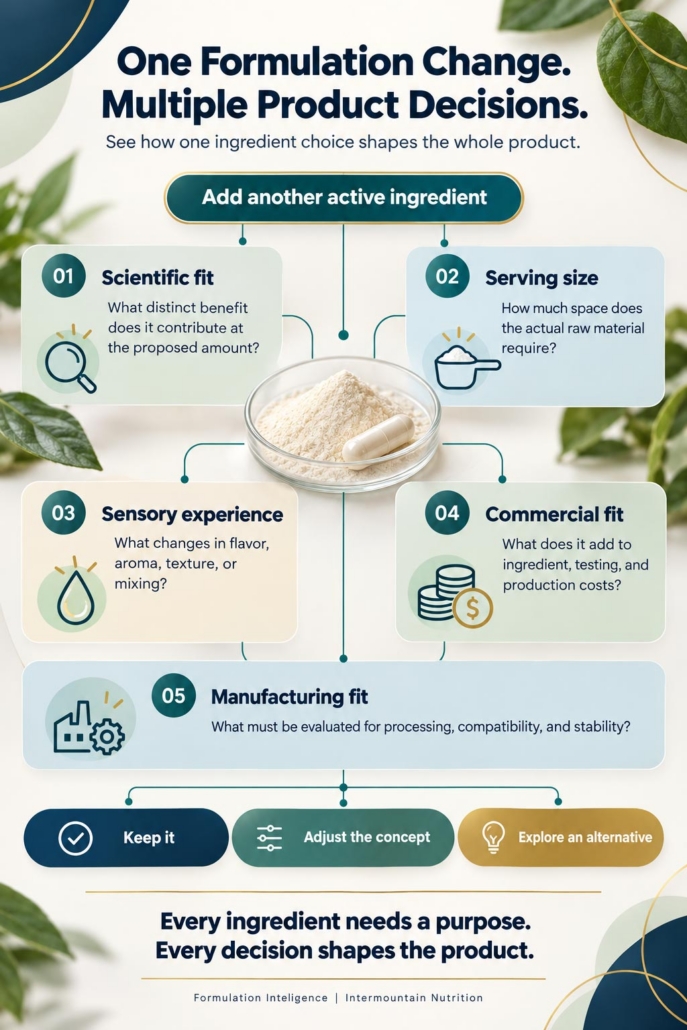
INFOGRAPHIC: One Ingredient, Many Product Decisions

Define the Contribution Before Expanding the Formula

For each additional active ingredient, establish:

  • Purpose: What specific contribution should it make?
  • Amount: Can the formula accommodate an appropriate quantity?
  • Distinct value: Does it add something useful beyond the existing ingredients?
  • Product fit: How does it affect the serving and sensory experience?
  • Commercial fit: Does its contribution justify the associated cost and development requirements?

A complementary mechanism can provide a reason to investigate a combination. It doesn’t, by itself, establish that the finished combination produces better outcomes. FTC guidance emphasizes evaluating whether evidence supports the particular product and claim, including relevant differences in ingredient combinations.

The formulation decision is therefore broader than whether an ingredient has interesting science. The question is whether it makes a useful, supportable contribution at the amount and under the conditions proposed.

Examine What the Addition Requires Elsewhere

A new ingredient also prompts questions about the rest of the product. Does it require more flavor support? Does it change the proposed serving? Can the existing analytical approach evaluate the relevant specifications? What sourcing and production considerations need review?

The answers are specific to the material and formula. Adding an ingredient doesn’t necessarily create a separate assay or a major production challenge. However, its implications should be understood before the team treats it as a minor addition.

For the hypothetical healthy-aging product, a secondary ingredient might strengthen a complementary benefit but exceed the preferred serving size. The brand then has a clear choice: accept a larger serving, reconsider another component, or preserve a more focused formula.

Use Complexity Where It Creates Value

A focused formula can offer a clear purpose and practical serving. A broader formula can also make sense when its components contribute distinct value within a workable product.

Ingredient count alone cannot determine which approach is stronger.

The better evaluation is whether the complete formula fulfills its purpose within the brand’s scientific, sensory, commercial, and manufacturing requirements.

Every ingredient should have a reason to be there — and the complete product should make those reasons work together.

Design the Sensory Experience Around the Whole Formula

A flavor name establishes a direction. The complete formula determines what it takes to deliver that experience.

For powders and gummies, sensory development involves more than selecting a flavoring. Teams must consider how the ingredients, sweetness, acidity, aroma, texture, and preparation conditions work together. An appealing first impression also needs to hold through the full serving.

Choose a Flavor Direction the Formula Can Support

Start with the intended experience. Should the product feel refreshing, comforting, indulgent, or neutral? Then evaluate that direction against the characteristics of the proposed ingredients.

This creates practical questions for development:

  • Which ingredient notes need balancing or masking?
  • Does the flavor direction complement those characteristics?
  • Can the desired sweetness and acidity fit the brand’s positioning?
  • Does the product remain pleasant through the final sip or gummy?
  • What aftertaste remains?

These questions help distinguish a desirable flavor concept from an achievable sensory profile. A brand may prefer a delicate fruit flavor, for example, but development must establish whether that profile can accommodate the formula’s more pronounced notes.

When the first approach falls short, the team can compare adjustments to the flavor system, ingredient materials, serving concentration, or format. Each option should remain consistent with the product’s essential requirements.

Evaluate the Product as It Will Be Used

Sensory evaluation should reflect the intended preparation and consumption experience.

For a powder, that means defining the liquid, volume, temperature, mixing method, and expected time before consumption. Evaluate appearance, aroma, mouthfeel, and mixing behavior alongside taste.

For a gummy, consider texture, chew, stickiness, flavor release, and aftertaste across the full serving. For capsules, evaluate practical use characteristics such as size, count, and noticeable odor.

These observations should become documented development criteria. “Good flavor” is difficult to act on. A defined target gives the team something specific to assess and refine.

For the hypothetical healthy-aging product, sensory work might reveal that the preferred beverage volume needs adjustment. That finding creates a decision about preparation instructions, serving concentration, or formulation.

Sensory development helps establish how the product can deliver its intended experience under realistic conditions.

Reach the Cost Target While Protecting Product Value

A cost target is most useful when it guides decisions alongside the product’s priorities.

Before changing the formula, establish what the estimate includes. Ingredient costs, analytical testing, processing, packaging, serving count, and order quantity all belong in the commercial discussion. Their contribution will depend on the project.

A useful estimate makes those assumptions visible so teams can identify which changes deserve investigation.

Compare the Consequences of Each Cost-Saving Option

Several approaches may bring a concept closer to its target. Each requires a different review.

Potential adjustment What the team should reassess
Remove a secondary active ingredient Whether the product retains its primary purpose and meaningful differentiation
Evaluate another raw material Scientific relevance, composition, material loading, sensory behavior, and specifications
Reconsider the delivery format Serving practicality, consumer experience, processing, and packaging requirements
Adjust packaging Product protection, compatibility, convenience, and brand positioning
Change the serving count Cost per container, cost per day, and the duration of use offered
Review order quantity Quoted unit economics, inventory needs, cash commitment, and shelf-life planning

These options are candidates for evaluation. Their value depends on the complete product and business model.

For example, reducing the serving count may lower the container price while changing the value consumers receive. Similarly, a less expensive raw material requires review before the team can determine whether it is a suitable substitution.

Compare Complete Product Scenarios

Ask the development team to present alternatives with consistent assumptions: the same defined scope, comparable quantities, and clearly stated inclusions.

For the hypothetical healthy-aging concept, compare a broader formula with a larger serving against a focused formula that preserves the primary benefit. An alternative format could provide a third scenario.

For each option, identify:

  • The product value it preserves.
  • The requirements it changes.
  • The estimated cost under stated assumptions.
  • The development work still needed.

This makes the commercial decision easier to assess. Executives can see what a lower estimate means for the actual product.

The goal is a cost structure that supports the brand’s business while preserving a compelling reason for consumers to choose the supplement.

Formulation Intelligence in Practice: Compare Complete Product Options

The value of Formulation Intelligence becomes clearer when a brand compares different ways to fulfill the same brief.

Consider the hypothetical healthy-aging concept introduced earlier. The brand wants a product for adults building a daily wellness routine. Its initial preferences include several active ingredients, a small serving, an enjoyable experience, and an accessible price.

The team first needs to define a specific primary benefit within healthy aging. Then it can develop options around that purpose.

The comparison below illustrates a decision-making approach. It doesn’t represent a validated formula, production assessment, or cost estimate.

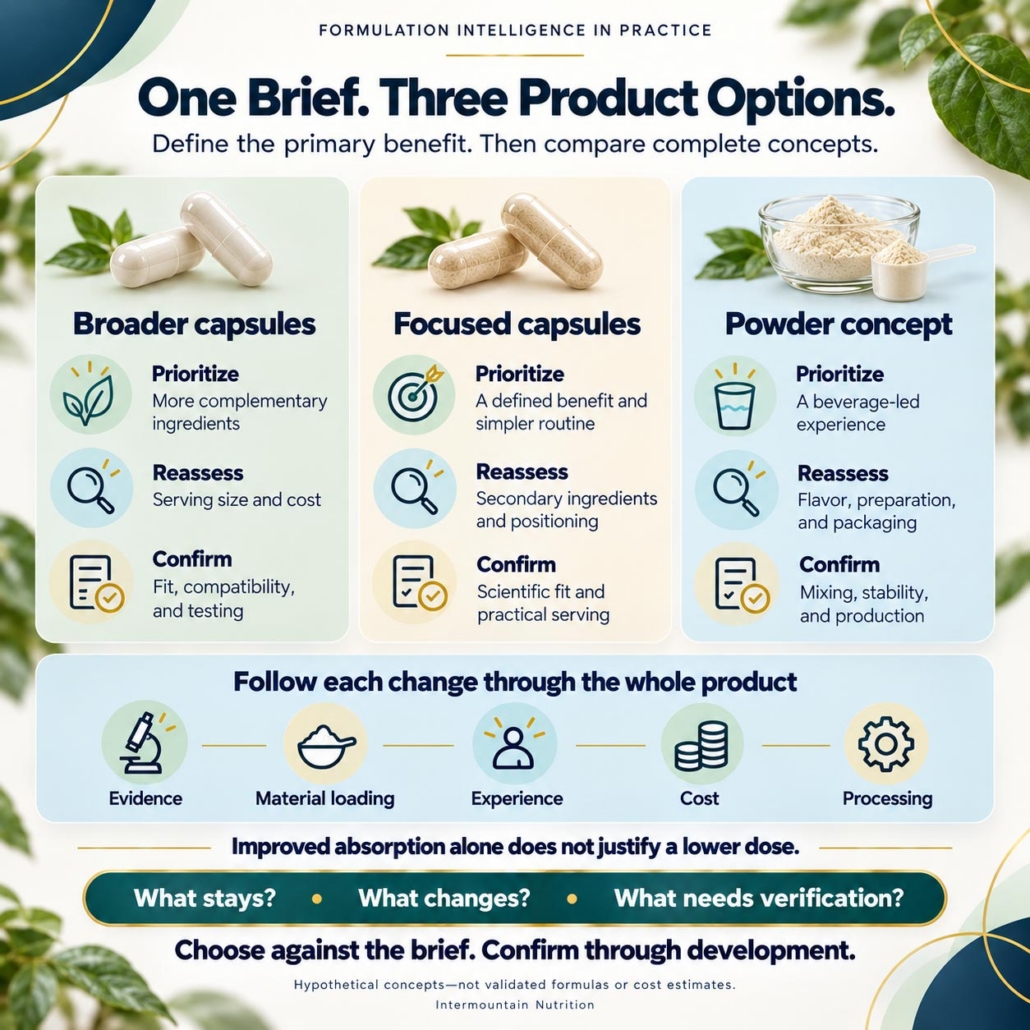
Three Paths From the Same Product Brief

Development option What it prioritizes What changes What needs verification
Broader capsule formula Retains more of the proposed ingredients and complementary roles Allows a larger capsule serving and flexibility in the cost target Ingredient amounts, blend density, capsule fit, compatibility, analytical requirements, and quoted cost
Focused capsule formula Protects the primary benefit within a smaller serving target Removes secondary ingredients and narrows the product’s positioning Whether the remaining formula supports its purpose, fits the serving, and meets commercial requirements
Powder concept Builds the product around a beverage occasion Reconsiders ingredient selection, preparation instructions, flavor, packaging, and serving volume Dispersion, sensory performance, stability, ingredient delivery, manufacturing feasibility, and quoted cost

Each option gives the brand a different proposition to evaluate.

The broader capsule concept may suit a brand whose customers value a comprehensive formula and accept the proposed serving.

The focused concept may fit a brand that prioritizes a clearly defined benefit and simpler routine.

The powder may suit a beverage-led experience, provided development establishes that the ingredients and preparation work together.

INFOGRAPHIC: One Brief, Three Product Concepts

Follow One Change Through the Entire Product

Suppose the team considers an alternative ingredient form with evidence of improved absorption under particular conditions.

The decision should account for that evidence alongside the material’s concentration, required weight, cost, and processing characteristics. If the alternative needs more room in the serving, the team must assess whether its advantages justify that requirement.

It should also determine whether the evidence supports the intended use without assuming that improved absorption permits a lower dose.

The same reasoning applies to a cost adjustment. Removing a secondary ingredient could preserve the primary purpose while changing the breadth of the positioning. Moving to powder could create a different consumer experience while introducing flavor and preparation requirements.

A useful comparison follows each proposed change through the complete product.

Choose Against the Brief, Then Confirm Through Development

Before selecting an option, document what it preserves, what it changes, and what remains unresolved.

From there, the appropriate development work can test the assumptions behind the choice. A promising concept advances because it meets defined requirements and resolves important uncertainties.

This gives executives a clearer investment decision. They can assess a proposed product with an identifiable purpose, practical requirements, and a realistic path toward production.

Build a Product With a Clear Reason Behind Every Choice

A well-defined concept gives a brand direction. Formulation expertise helps reveal the options available within it.

That is where productive collaboration begins. A preferred format, ingredient list, or cost target can start the conversation. Exploring the reasoning behind those preferences helps the team identify what matters most—and where another approach could create greater value.

The opportunity for supplement brands is to make those decisions deliberately.

A focused benefit, a thoughtful ingredient choice, or a better-designed serving can give a product a stronger reason to exist.

Bring the goal, the commercial requirements, and the questions that still need answers.

Intermountain Nutrition can help evaluate those questions through formulation, flavor development, quality planning, and manufacturing expertise. Together, we can explore the choices that turn a promising concept into a product with a clear purpose and a practical path to scale.

Planning a new supplement or refining an existing formula? Connect with Intermountain Nutrition to discuss the next step in development.

NEXT UP: The AI Discovery Journey

The decisions behind a supplement give it a distinct purpose. Ingredient forms, serving amounts, sensory choices, and delivery systems all contribute to what the finished product offers. But consumers need access to that reasoning to understand its value.

What happens when their first explanation comes from an AI assistant?

A consumer might ask an AI tool to compare formulas, explain an unfamiliar ingredient, or assess how a product fits a wellness routine. The resulting answer introduces another layer of interpretation between the brand’s development decisions and the consumer’s understanding.

The AI Discovery Journey explores how supplement brands can prepare for that interaction. We’ll examine how product pages, ingredient education, FAQs, and third-party sources contribute to the information consumers encounter through AI-assisted research.

The opportunity is to make the product’s purpose and supporting information clear, consistent, and verifiable — so the care invested in formulation is easier to recognize wherever discovery begins.

Frequently Asked Questions

A format change requires a new feasibility review. The ingredient amounts provide a starting point, but the new product also needs suitable processing, supporting ingredients, sensory performance, packaging, and stability.

Teams should establish which elements of the original formula can carry forward and which require development. The goal is to preserve the intended purpose within the requirements of the new format.

Materials with similar ingredient names may differ in concentration, composition, density, particle size, taste, or other characteristics. Those differences create questions about serving size, processing, sensory experience, and biological delivery.

Compare supplier specifications and relevant research, then evaluate the selected material within the complete formula. A shared ingredient name alone doesn’t establish interchangeability.

A bioavailability finding alone doesn’t establish the appropriate dose for a health benefit. Teams need to evaluate what researchers measured, which material they studied, and whether the findings support the proposed amount and intended outcome.

For formulation decisions, distinguish evidence of increased absorption from evidence that a lower dose delivers the intended benefit.

Ingredient count is a poor measure of product value. A broader formula can be appropriate when its components have distinct, supportable roles at suitable amounts.

A focused formula can also offer meaningful differentiation. Assess what each ingredient contributes and whether the complete product meets its scientific, sensory, serving-size, and commercial requirements.

Review ingredient identity, composition, specifications, scientific relevance, and the amount required. Then assess the implications for sensory performance, processing, testing, stability, labeling, and cost.

The scope of additional development depends on the proposed substitution. Establish what must be verified before approving the change.

A useful brief identifies the intended consumer, primary benefit, preferred format, serving-size target, commercial requirements, and essential product attributes.

It should also explain which preferences are flexible. Sharing that hierarchy gives the development team a stronger basis for comparing options and recommending a practical direction.

References

AOAC INTERNATIONAL. (n.d.). Botanical Ingredients and Dietary Supplement Integrity program (BIDSI).

Blake, R., & Krishnamurthy, K. (2026). Setting shelf life: Factors and insights. Institute of Food Science and Technology.

Federal Trade Commission. (2022, December). Health products compliance guidance.

Gilbert, K., & Prusa, K. (2021). Food product development lab manual. Iowa State University Digital Press.

Institute of Food Science and Technology. (n.d.). Sensory science resources.

Institute of Food Technologists. (n.d.). Sensory & Consumer Sciences Division.

McClements, D. J., Decker, E. A., Park, Y., & Weiss, J. (2009). Structural design principles for delivery of bioactive components in nutraceuticals and functional foods. Critical Reviews in Food Science and Nutrition, 49(6), 577–606.

National Institutes of Health, Office of Dietary Supplements. (n.d.-a). Analytical Methods and Reference Materials (AMRM) Program: Overview.

National Institutes of Health, Office of Dietary Supplements. (n.d.-b). ODS product integrity guidance.

National Institutes of Health, Office of Dietary Supplements. (2026, January 6). Magnesium: Fact sheet for health professionals.

Related Postings

Holding Urolithin A capsules in the palm of a hand while holding a glass of water
older man lifting weights for resistance training in addition to taking a creatine supplement drink
STOCK FORMULA: Mushroom Memory Cocoa Powder