Botanicals for Women’s Health Formulations
Targeted plant-based ingredients for hormone, cycle, and life-stage support


Targeted plant-based ingredients for hormone, cycle, and life-stage support
Vitex agnus-castus
Vitex | Monk’s Pepper | Chaste Tree Berry | Abraham’s Balm | Monk’s Tree
Native to the Mediterranean and Central Asia; cultivated in Southern Europe and parts of the United States. The medicinal part is the small peppercorn-like fruit, which is harvested after ripening, then dried and processed for extracts, powders, or capsules.
Chasteberry is one of the most widely studied botanicals for women’s hormone health, particularly for menstrual cycle regulation and premenstrual support. It primarily acts on the hypothalamic-pituitary-ovarian (HPO) axis, helping modulate prolactin levels and supporting the balance between estrogen and progesterone.
Research suggests that vitex may influence dopamine receptors, which in turn helps regulate prolactin secretion. Elevated prolactin levels are often associated with symptoms such as irregular cycles, breast tenderness, and mood fluctuations. By supporting normal prolactin levels, chasteberry may help promote more predictable cycles and improved hormonal rhythm.
In addition, vitex is commonly used in formulations targeting PMS symptom support, including mood changes, irritability, and discomfort. Its effects are not estrogenic in the traditional sense; instead, it works upstream in endocrine signaling, making it a versatile ingredient across different life stages.
Because of its mechanism, chasteberry is often positioned in daily-use formulas designed for cycle support, hormone balance, and reproductive wellness. Consistency of use is typically emphasized, as benefits are associated with sustained intake over multiple cycles.
Actaea racemosa
Cimicifuga | Black Snakeroot | Bugbane | Rattleroot | Macrotys
Native to eastern North America, especially rich woodland regions of the Appalachian area. The root and rhizome are the primary plant parts used in supplements, typically harvested from mature plants, cleaned, dried, and extracted.
Black cohosh is best known for its role in menopause and perimenopause support, particularly for managing vasomotor symptoms such as hot flashes and night sweats. It has been widely used in both traditional and modern formulations targeting hormonal transitions.
Unlike phytoestrogenic botanicals, black cohosh does not appear to bind directly to estrogen receptors in a significant way. Instead, research suggests it may act on serotonergic pathways and central nervous system signaling, which can influence thermoregulation and mood stability. This mechanism helps explain its use in addressing both physical and emotional symptoms associated with menopause.
Black cohosh is also associated with neuroendocrine modulation, supporting communication between the brain and endocrine system during periods of hormonal fluctuation. As a result, it is often included in formulations designed for women experiencing irregular cycles, sleep disturbances, and mood changes during life-stage transitions.
In formulation, standardized extracts are preferred to ensure consistency in active compounds such as triterpene glycosides. Because the ingredient is often used for symptom-specific support, it is frequently combined with complementary botanicals like red clover or adaptogens.
Angelica sinensis
Dang Gui | Female Ginseng | Chinese Angelica | Tang Kuei
Native to cool, high-altitude mountain regions of China and East Asia. The yellow-brown root is harvested in the fall, then dried and sliced or extracted for use in traditional women’s health formulations.
Dong quai has a long history of use in Traditional Chinese Medicine, where it is often referred to as “female ginseng” due to its role in supporting circulation and women’s reproductive health. It is commonly used in formulations targeting menstrual health and hormonal balance.
The botanical contains a range of bioactive compounds, including ferulic acid and ligustilides, which are associated with circulatory support and smooth muscle relaxation. These properties contribute to its traditional use in promoting healthy blood flow and supporting menstrual comfort.
Dong quai is also thought to influence estrogenic activity, although its effects are complex and not fully equivalent to direct hormone replacement. Instead, it may support overall endocrine balance through indirect pathways, making it suitable for inclusion in multi-ingredient blends.
In modern formulations, dong quai is often positioned for cycle support, menstrual comfort, and overall women’s vitality. It is frequently combined with botanicals like peony root or chasteberry to create synergistic effects across hormonal and circulatory pathways.
Because of its traditional use and broad functional profile, dong quai remains a foundational ingredient in women’s health supplements, particularly in products targeting holistic reproductive wellness.
Asparagus racemosus
Shatamuli | Wild Asparagus | Indian Asparagus | Satavar
Native to India and Southeast Asia, where it grows in tropical and subtropical regions. The tuberous roots are harvested once the plant matures, then washed, dried, and milled or extracted for use in Ayurvedic women’s health products.
Shatavari is a cornerstone botanical in Ayurvedic women’s health, traditionally used to support hormonal balance, reproductive health, and stress resilience. It is classified as an adaptogen, meaning it helps the body regulate physiological responses to stress—an important factor in maintaining hormonal equilibrium.
The root contains steroidal saponins, including shatavarins, which are believed to contribute to its phytoestrogenic and endocrine-supportive properties. These compounds may help modulate estrogen activity and support reproductive tissues, making shatavari particularly relevant for women across multiple life stages, from fertility to menopause.
In addition, shatavari supports the hypothalamic-pituitary-adrenal (HPA) axis, which plays a critical role in the stress-hormone connection. Chronic stress can disrupt hormonal signaling, and adaptogenic botanicals like shatavari help restore balance by promoting resilience and recovery.
Shatavari is also commonly used in formulations targeting female vitality, hydration, and tissue nourishment, particularly in Ayurvedic frameworks. Its broad functional profile makes it well-suited for daily-use products focused on long-term hormonal and reproductive wellness.
Trifolium pratense
Meadow Clover | Purple Clover | Cow Clover
Native to Europe, Western Asia, and Northwest Africa, and now cultivated widely in temperate regions. The flowering tops are harvested during bloom, then dried and processed for isoflavone-rich extracts.
Red clover is a well-established botanical used for menopause support and hormonal balance, primarily due to its content of naturally occurring isoflavones. These compounds, such as genistein and daidzein, are classified as phytoestrogens, meaning they can weakly bind to estrogen receptors and influence estrogen signaling pathways.
This activity makes red clover particularly relevant for women experiencing declining estrogen levels during menopause. It is commonly used in formulations targeting hot flashes, night sweats, and overall hormonal transition support.
Beyond hormone-related effects, red clover also provides antioxidant and cardiovascular support, which is important as women’s heart health risk profile changes post-menopause. Its dual role in endocrine and circulatory support makes it a valuable multifunctional ingredient.
In formulation, standardized extracts are preferred to ensure consistent isoflavone content, which is critical for both efficacy and label claims. Red clover is frequently paired with other menopause-support botanicals such as black cohosh or adaptogens to create comprehensive, symptom-focused blends.
Dioscorea villosa
Mexican Wild Yam | Colic Root | Rheumatism Root | China Root
Native to North America, especially woodland and thicket regions of the eastern and southeastern United States. The rhizome and root are harvested after the growing season, then dried and processed for powdered or extracted supplement forms.
Wild yam has a long history of use in traditional herbal medicine for menstrual comfort and hormone support, particularly in formulations aimed at easing discomfort associated with the menstrual cycle.
The root contains diosgenin, a plant-derived compound that has been used historically as a precursor in the synthesis of steroid hormones in pharmaceutical settings. However, it is important to note that the body does not directly convert diosgenin into hormones. Instead, wild yam is believed to support hormonal health through indirect mechanisms, including anti-inflammatory and smooth muscle-supporting effects.
These properties make wild yam relevant for formulations targeting menstrual discomfort, cramping, and general cycle support. It is often included in blends designed to promote comfort and balance rather than direct endocrine modulation.
Wild yam is also valued for its traditional positioning in women’s wellness and reproductive support, particularly in combination with other botanicals that address broader hormonal pathways. Its gentle profile and historical use contribute to its continued inclusion in modern formulations.
Trigonella foenum-graecum
Methi | Greek Hay | Bird’s Foot | Hulba
Native to the Mediterranean, Southern Europe, and Western Asia, and widely cultivated in India. The seeds are harvested from mature pods, dried, cleaned, and ground or extracted for use in lactation, metabolic, and women’s vitality formulas.
Fenugreek is a multifunctional botanical widely used in women’s health formulations, particularly for lactation support, metabolic health, and hormone balance. The seeds contain bioactive compounds such as saponins, fiber, and phytoestrogen-like constituents that contribute to its diverse physiological effects.
One of its most recognized uses is in postpartum and lactation support, where fenugreek is traditionally used to help promote milk production. While the exact mechanism is not fully understood, it is believed to involve hormonal signaling pathways related to prolactin activity.
In addition, fenugreek plays a role in glucose metabolism and insulin sensitivity, which is increasingly relevant in women’s health, particularly in conditions associated with metabolic imbalance. Supporting metabolic function can have downstream effects on hormonal health, as insulin and reproductive hormones are closely linked.
Fenugreek is also included in formulations targeting libido and overall vitality, due to its potential influence on endocrine and metabolic pathways. Its versatility makes it a valuable ingredient across multiple product categories.
Rubus idaeus
Red Raspberry Leaf | European Raspberry Leaf
Native to Europe and Northern Asia and widely cultivated in North America. The leaves are harvested before or during flowering, then dried and cut for teas, powders, capsules, or botanical extracts.
Raspberry leaf is a traditional botanical used to support uterine health and menstrual cycle regulation, particularly in women’s reproductive wellness. It has been widely used in herbal practices for pregnancy preparation and general cycle support.
The leaf contains tannins, flavonoids, and minerals that contribute to its toning effect on uterine smooth muscle. This action is often associated with promoting uterine strength and function, which is why raspberry leaf is commonly included in prenatal and reproductive health formulations.
In addition, raspberry leaf is used to support menstrual comfort, particularly by helping regulate contractions and reduce discomfort during the menstrual cycle. Its mild astringent properties also contribute to its traditional use in supporting overall reproductive tissue health.
Modern formulations position raspberry leaf as a foundational ingredient in cycle support and pregnancy-focused products, often combined with minerals and other botanicals for comprehensive support.
Turnera diffusa
Mexican Damiana | Old Woman’s Broom | Turnera
Native to Mexico, Central America, South America, and parts of the Caribbean. The leaves and aerial parts are harvested, dried, and processed into powders, teas, tinctures, or extracts for mood and vitality formulations.
Damiana is traditionally used as a botanical for mood, libido, and hormonal wellness, particularly in formulations targeting women’s vitality and emotional balance.
The plant contains flavonoids, terpenoids, and other phytochemicals that are believed to influence the central nervous system and circulatory pathways. These effects may contribute to improved mood, relaxation, and enhanced sense of well-being.
Damiana is often positioned in formulations designed to support libido and sexual wellness, where both psychological and physiological factors play a role. Its potential to support mood and reduce stress also aligns with the broader connection between emotional health and hormonal balance.
Additionally, damiana may provide mild adaptogenic-like benefits, helping the body manage stress and maintain equilibrium. This makes it a useful complementary ingredient in hormone-focused blends.

Paeonia lactiflora
White Peony | Bai Shao | Chinese Peony Root | Peony Extract
Native to China and East Asia, with a long history in Traditional Chinese Medicine. The root is harvested from mature plants, commonly peeled or processed depending on the preparation style, then dried and extracted.
Peony root is a key botanical in Traditional Chinese Medicine, commonly used to support hormonal balance and menstrual cycle regulation. It is often included in formulas designed to harmonize the relationship between liver function and endocrine signaling.
The root contains compounds such as paeoniflorin, which are associated with anti-inflammatory and immunomodulatory effects. These properties contribute to its role in supporting overall systemic balance, including reproductive health.
Peony root is frequently used in combination with other botanicals, such as dong quai, to create synergistic effects that support cycle regularity, menstrual comfort, and hormonal equilibrium. This pairing is well established in traditional formulations.
In modern supplement design, peony root is positioned as a supportive botanical for hormone regulation, particularly in women experiencing irregular cycles or hormonal fluctuations.
Oenothera biennis
EPO (Evening Primrose Oil) | Night Willow Herb | Sundrops
Native to North America and cultivated in Europe and Asia. The seeds are harvested from mature seed capsules, then cold-pressed or extracted to produce evening primrose oil, a source of gamma-linolenic acid.
Evening primrose is widely used in women’s health due to its rich content of gamma-linolenic acid (GLA), an omega-6 fatty acid that plays a role in inflammatory regulation and skin health.
GLA is involved in the production of prostaglandins, which are signaling molecules that influence inflammation, hormonal activity, and skin function. This makes evening primrose particularly relevant for addressing symptoms associated with hormonal fluctuations.
It is commonly included in formulations targeting PMS support, particularly for symptoms such as breast tenderness, skin changes, and general discomfort. In addition, its role in skin hydration and barrier function supports its use in beauty-from-within products.
Evening primrose is also positioned for menopause and hormonal transition support, where inflammatory balance and skin health become increasingly important.
Ribes nigrum
Cassis | European Black Currant | Blackcurrant
Native to Europe and Northern Asia and cultivated in temperate regions worldwide. The berries are harvested when fully ripe for anthocyanin-rich extracts, while the seeds may be pressed for black currant seed oil, another source of gamma-linolenic acid.
Black currant is a nutrient-dense botanical rich in anthocyanins and gamma-linolenic acid (GLA), making it a valuable ingredient for women’s health formulations that target both hormonal and skin-related concerns.
Its anthocyanin content provides strong antioxidant support, helping protect cells from oxidative stress. This is particularly relevant in the context of aging and hormonal transitions, where oxidative balance becomes increasingly important.
The presence of GLA contributes to its role in hormonal and inflammatory support, similar to evening primrose. These combined effects make black currant suitable for formulations targeting PMS, menopause, and skin health.
Additionally, black currant supports circulatory health, which plays a role in nutrient delivery and overall vitality. Its broad functional profile allows it to bridge multiple categories, including women’s health, beauty, and cardiovascular support.
| Botanical | Scientific Name | Primary Positioning | Best-Fit Benefits | Formulation Notes |
|---|---|---|---|---|
| Black Cohosh | Actaea racemosa | Menopause support | Hot flashes, mood, sleep | Standardize for triterpene glycosides; stability-sensitive; often paired with red clover |
| Black Currant | Ribes nigrum | Antioxidant + hormone support | Skin, inflammation, menopause support | Source of GLA + anthocyanins; works well in powders and oils |
| Chasteberry (Vitex) | Vitex agnus-castus | Hormone regulation | PMS support, cycle balance, prolactin modulation | Use standardized extract (agnusides); best in capsules; bitter taste requires masking |
| Damiana | Turnera diffusa | Mood + libido | Stress, mood, vitality | Often used in blends; mild bitterness; flexible format use |
| Dong Quai | Angelica sinensis | Circulation + hormone support | Menstrual health, blood flow, vitality | Strong herbal taste; best in capsules or blended powders |
| Evening Primrose | Oenothera biennis | Hormonal + skin support | PMS, skin health, inflammation | Typically used as oil (softgel format); sensitive to oxidation |
| Fenugreek | Trigonella foenum-graecum | Lactation + metabolic support | Milk production, blood sugar, vitality | Strong maple-like odor; can impact flavor systems |
| Peony Root | Paeonia lactiflora | Hormone modulation | Cycle regulation, inflammation | Commonly paired with dong quai; traditional blend synergy |
| Raspberry Leaf | Rubus idaeus | Uterine support | Cycle health, pregnancy prep, tone | Mild flavor; suitable for teas, powders, capsules |
| Red Clover | Trifolium pratense | Phytoestrogen support | Menopause, bone health, hormonal transition | Standardize isoflavones; works well in capsules and powders |
| Shatavari | Asparagus racemosus | Adaptogenic hormone support | Fertility, stress, hormone balance | Hygroscopic; requires moisture control; earthy taste |
| Wild Yam | Dioscorea villosa | Cycle comfort | Menstrual support, anti-inflammatory | Low direct hormonal activity; supportive role in blends |
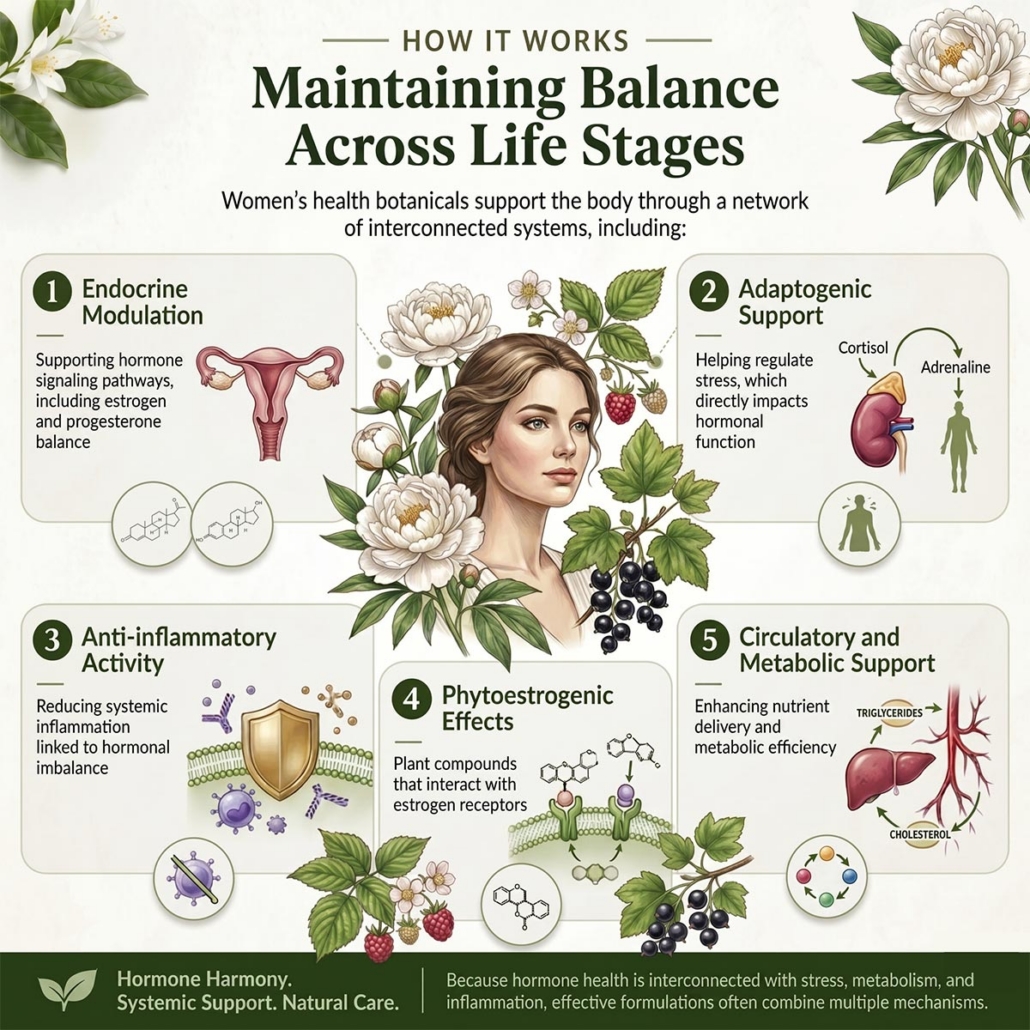
Women’s health botanicals are used to support a wide range of physiological functions related to hormone balance, reproductive health, and life-stage transitions such as menstruation, fertility, and menopause.
These ingredients often work by interacting with endocrine signaling pathways, helping regulate hormones like estrogen, progesterone, and prolactin. In addition, many botanicals provide secondary benefits, including stress modulation, anti-inflammatory activity, and circulatory support, all of which influence hormonal health.
Because hormone regulation is interconnected with systems like the nervous system and metabolism, botanicals are often used in combination to deliver multi-pathway support. For example, adaptogenic herbs may help manage stress-related hormonal disruption, while phytoestrogen-containing botanicals may support estrogen receptor activity during menopause.
As a result, these ingredients are commonly included in formulations targeting PMS, cycle regulation, reproductive wellness, and menopausal symptom management.
Many botanical ingredients have a long history of traditional use for hormone support and are increasingly being evaluated through modern clinical research. While not all botanicals act directly on hormone receptors, many influence upstream regulatory systems such as the hypothalamic-pituitary axis, which governs hormone production and balance.
For example, chasteberry is often used to support prolactin regulation, while red clover contains isoflavones that interact with estrogen receptors.
Effectiveness depends heavily on formulation quality. Key factors include extract standardization, clinically relevant dosing, and ingredient synergy within a formula. Standardized extracts ensure consistent levels of active compounds, which is critical for delivering predictable outcomes.
In addition, combining complementary botanicals can enhance efficacy by targeting multiple pathways simultaneously. When formulated correctly, botanical ingredients can play a meaningful role in supporting hormonal balance and symptom management.
Capsules remain the most widely used format for women’s health botanicals because they allow for precise dosing, ingredient stability, and minimal impact on taste. This is particularly important for botanicals that have naturally bitter, earthy, or astringent flavor profiles. Capsules also support higher dose loads, which are often required for clinically relevant botanical extracts.
However, alternative formats are gaining traction. Powders and stick packs are increasingly popular for daily wellness routines, especially when paired with flavor systems that improve palatability.
Gummies are also growing in popularity due to their convenience and consumer appeal, although formulation constraints such as sugar content and dose limitations must be carefully managed.
Ultimately, the optimal format depends on the target consumer, desired positioning, and formulation complexity. Brands should balance efficacy, compliance, and sensory experience to drive long-term adherence and product success.
Brands should prioritize ingredient quality, clinical relevance, and consumer experience when formulating women’s health products. Standardization is critical, as it ensures consistent levels of active compounds and supports label credibility. Without standardized extracts, it becomes difficult to deliver reliable outcomes or substantiate product positioning.
Dose optimization is equally important. Many botanicals require specific intake levels to achieve meaningful effects, so formulations must align with clinical research while remaining practical for daily use.
In addition, taste and sensory experience should not be overlooked. Bitter or astringent botanicals may require masking strategies or alternative delivery formats to maintain consumer compliance.
Regulatory positioning also plays a key role. Structure/function claims must be carefully crafted to avoid disease claims, particularly when addressing hormone-related concerns. Finally, brands should consider ingredient synergy, combining botanicals that support multiple pathways such as stress, inflammation, and endocrine signaling for a more comprehensive solution.
The women’s health supplement market is evolving toward more personalized, targeted, and life-stage-specific solutions. Consumers are increasingly seeking products designed for distinct needs such as PMS support, fertility, perimenopause, and menopause, rather than general wellness formulas. This shift is driving demand for more precise formulations and clearer product positioning.
At the same time, there is growing preference for clean-label, plant-based ingredients with transparent sourcing and clinical backing. Botanical ingredients are well positioned to meet this demand, especially when supported by research and standardized extracts. Additionally, education around hormonal health is expanding, leading to more informed consumers who expect both efficacy and transparency.
Digital health tools, including cycle tracking and personalized supplement platforms, are also influencing the market by enabling more tailored recommendations. As a result, brands that combine science-backed formulations with strong storytelling and consumer education are best positioned to succeed in this rapidly growing category.

