The Consumer Innovation Gap: How Supplement Brands Can Turn Consumer Needs Into Scalable Products

October 7, 2026 |

Consumer needs can surface quickly, but developing a responsible supplement takes coordination across research, formulation, quality, and manufacturing. The brands that close this gap build agility into how they listen, decide, develop, and scale.

At a Glance

  • The Consumer Innovation Gap is the distance between evolving consumer needs and the work required to develop useful, manufacturable supplement products.
  • Search and social behavior can help brands hear emerging questions, but those signals need to be checked against consumer research and scientific evidence.
  • Consumers want more agency and products that fit their goals, routines, and budgets.
  • A coordinated product line can offer choice while helping customers understand how products fit together.
  • Agility — not speed alone — helps brands respond to meaningful demand while protecting quality and regulatory discipline.

What Is the Consumer Innovation Gap?

The Consumer Innovation Gap is the distance between changing consumer needs and the careful work required to develop useful, evidence-informed, manufacturable supplement products.

Consumers may notice a concern, encounter a new ingredient, or begin comparing products in a matter of days. Developing a product to serve a need requires more: teams must evaluate the evidence, define the product’s purpose, choose a suitable formula and format, address quality and sourcing, and plan for consistent production.

This is an Intermountain Nutrition framework for connecting those two realities. The gap is not simply a difference in speed. It reflects a broader disconnect between how consumers navigate health choices and how supplement products are often conceived and developed.

Closing it takes agility. For supplement brands, agility means recognizing meaningful signals, making informed decisions earlier, and coordinating development so teams can adapt as they learn. It does not mean rushing every trend to market or skipping the work that makes a product credible and manufacturable.

The Self-Directed Consumer Is Widening the Consumer Innovation Gap

Self-directed health consumers are shifting the product landscape for supplement product development. Before ever making a purchase, they increasingly search health questions, compare functional ingredients, and look for products that fit their goals and routine. They also read reviews and research benefits and solutions using AI.

Listen to The Consumer’s Path From Concern to Choice

The development challenge is to hear the consumer’s question without assuming the answer. Search interest in a disease or symptom does not establish a supplement opportunity. Teams must determine whether a safe, evidence-supported, lawful, and manufacturable product can responsibly serve the underlying need.

Search can reveal questions people may not voice elsewhere

Search behavior can offer an honest signal of what people are trying to understand or what is bothering them about their health and well-being. People may search privately for questions they would hesitate to raise in conversation. Social platforms can also surface emerging interests and language consumers use to describe their experiences.

These signals are useful, but partial. Search and social data do not represent every consumer, explain every motivation, or prove that a supplement can address a particular health concern. Brands should compare them with consumer research, customer questions, practitioner and retailer feedback, and scientific evidence.

Recommendations don’t end the research process

Consumers may continue to investigate products even after receiving a recommendation. In AlixPartners’ Professional VMS survey, 92% of respondents who received a healthcare provider’s recommendation for a vitamin, mineral, or supplement said they conducted additional research. That finding points to a practical need: brands should make their product rationale and information easy to evaluate.

Connect the concern to a clear product purpose

Many product pages open with what’s in the bottle. Yet consumers may arrive with a different question: What is this for, and how could it fit my needs?

Brands can make that path easier to follow by explaining the product’s intended role first, then describing the ingredient rationale, evidence, format, and directions for use. This keeps consumer concerns in view while giving scientific support and formulation decisions their proper weight.

Search data helps brands listen. Evidence and product development determine what to do with what they hear.

The Gap Is About More Than Speed

The conversation often turns to speed to market. Yet speed alone does not explain the Consumer Innovation Gap — or close it.

Consumers move from concern to comparison

Consumers can form expectations quickly as they encounter research, expert discussion, and peer conversation. Brands must translate those signals into products that are evidence-informed, useful, coherent within the product line, and feasible to manufacture.

Consumers want control and clarity

Self-directed consumers want to make choices that fit their needs. They also need clear explanations of what a product is for, how it fits into a routine, and how it relates to other products in a line. When brands leave those connections unclear, consumers must do more of the work themselves.

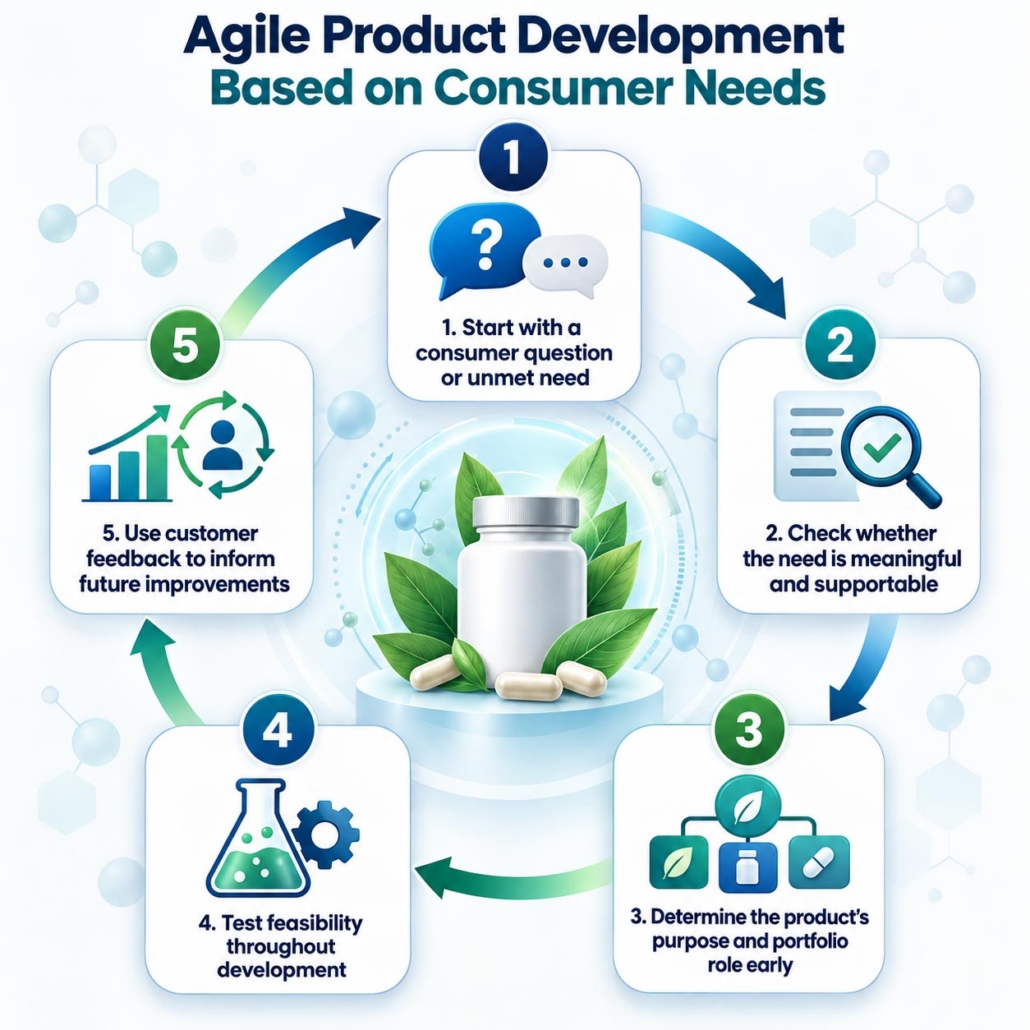
INFOGRAPHIC: Need-Based Product Development

Product development should start in the right place

A product-first process may begin with a trending ingredient, format, or formulation concept, then search for a consumer need it can serve. This can produce a product that attracts attention but lacks a clear purpose or distinct role in the brand’s line.

A need-led process starts by asking what consumers are trying to understand or accomplish. Teams then investigate whether that need is meaningful, whether evidence supports a responsible supplement concept, and whether the product can work in a practical format at a viable dose and cost.

They also consider how it fits the portfolio and how customers might use it alongside other products.

Clear evidence, directions, and limitations help consumers evaluate the product without relying on an ingredient list alone.

This approach gives teams a stronger basis for deciding what to develop, refine, or set aside.

Agility isn’t launching every idea faster. It’s recognizing worthwhile opportunities, making sound decisions earlier, and adapting as teams learn.

Where Supplement Product Development Can Get Stuck

A promising idea can lose momentum when important questions surface late. A formula may look compelling on paper, yet still need work to meet its target dose, taste, cost, format, or manufacturing requirements.

Common sources of friction include:

  • An unclear product brief: The team hasn’t defined the intended user, need, benefit, or place in the portfolio.
  • A dose-format mismatch: The target amount may not fit the chosen serving size or delivery format.
  • Late feasibility decisions: Sourcing, taste, stability, packaging, cost, or production constraints emerge after development is underway.
  • Portfolio overlap: The new product duplicates existing ingredients or leaves customers uncertain about how products fit together.
  • Late claims and quality review: Evidence, labeling, specifications, and quality requirements are addressed only near launch.

These issues don’t mean every project should follow the same timeline. They show why teams benefit from reviewing consumer need, evidence, formulation, quality, and manufacturing feasibility as connected decisions.

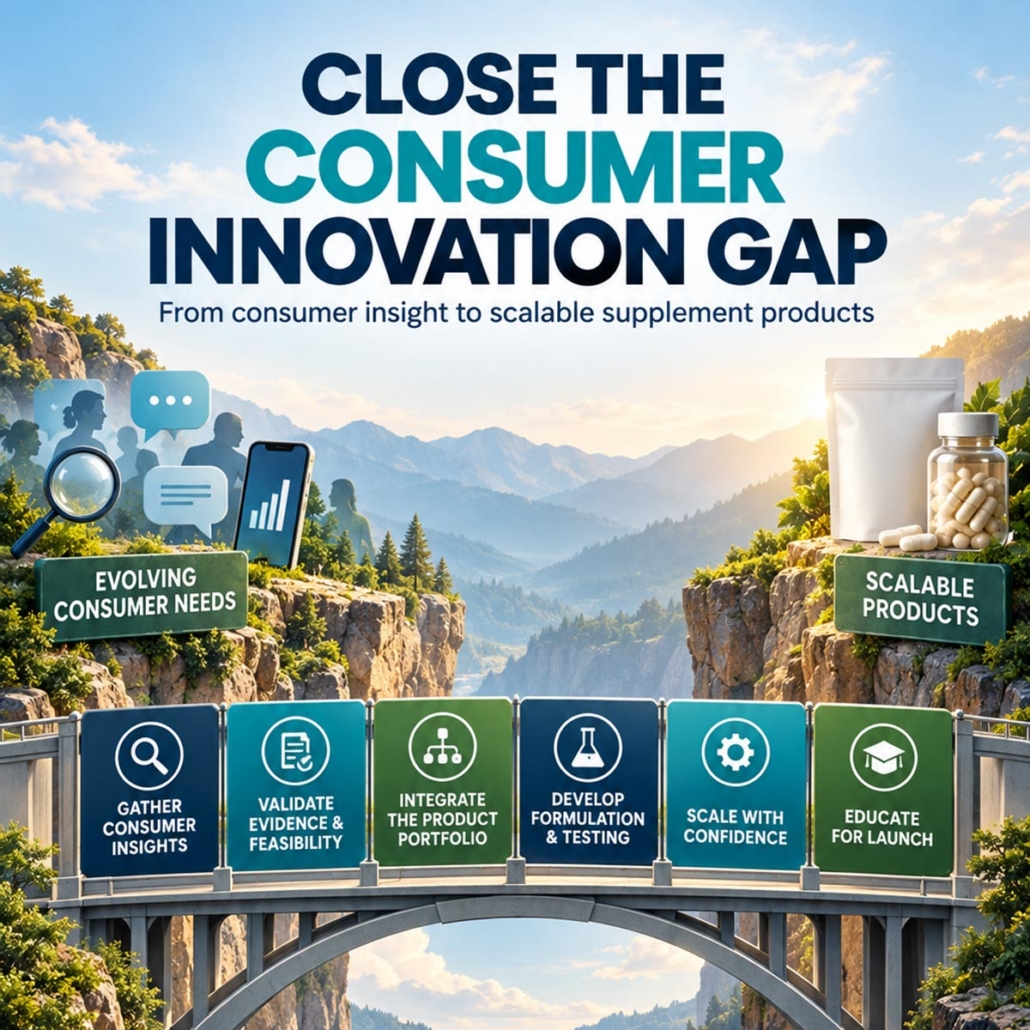
INFOGRAPHIC: Building The Bridge To Close the Consumer Innovation Gap

Build a Bridge From Consumer Insight to Scalable Product

A clear development process can connect consumer signals with products that are useful, coherent within a portfolio, and ready for consistent production. The six steps below offer a practical framework. Teams may revisit steps as they learn more, but considering them together can help surface important questions earlier.

Step Action Key question
1 Gather Consumer Insights What are consumers asking, experiencing, and trying to accomplish?
2 Validate Evidence & Feasibility Is the opportunity supportable, and can the product work?
3 Integrate the Product Portfolio What role will this product play alongside the rest of the line?
4 Develop Formula & Testing Can the formula serve its purpose in a suitable format?
5 Scale with Confidence Can the product be made consistently at commercial scale?
6 Educate for Launch Can customers understand the product’s purpose, evidence, and use?

1. Gather Consumer Insights

A product opportunity can begin with a search trend, a customer question, a retailer conversation, or a recurring theme in reviews. Each source offers a partial view. Comparing signals helps teams distinguish a meaningful need from a short-lived spike in attention.

Study the consumer’s path from concern to choice

Search and social signals can help supplement brands hear what consumers are asking and how they describe their concerns. But a signal is a starting point, not a product brief. Teams need to determine whether the need is meaningful, whether a supplement can responsibly address it, and whether a viable product fits the brand’s portfolio.

Spate’s analysis suggests that consumers may begin with a specific concern, then compare products using broader benefit language. Its findings come from Google, TikTok, and Instagram interaction data, so they can reveal patterns in those platforms, but they don’t represent every consumer or prove why someone purchases.

How consumer signals can become better product decisions

Use consumer signals to sharpen the questions in the product brief:

  • What need or goal is the consumer trying to address?
  • What do consumers currently find confusing or difficult?
  • What evidence and expert input can help evaluate the opportunity?
  • What role could a product play in the brand’s line?
  • What format and use pattern might make sense for the intended audience?

Messaging can follow the same path. Lead with the consumer’s relevant question, then explain the product’s intended role and the rationale behind its ingredients and format. Keep claims within appropriate, substantiated boundaries.

Translate the concern into a product opportunity

A useful product brief connects the consumer’s question to a clear product purpose, then tests whether the concept can deliver. That means considering the evidence, intended use, ingredient amounts, delivery format, sensory experience, and how the product fits with the rest of the line.

A message that begins with the consumer’s concern can make the product easier to understand. From there, brands can explain the ingredient rationale, evidence, directions, and quality practices. This puts the product’s purpose up front while giving consumers the information they need to evaluate it.

Trend-led development Agile, need-led development
Starts with a popular ingredient or format Starts with a consumer question or unmet need
Assumes attention means a viable product opportunity Checks whether the need is meaningful and supportable
Defines the formula before clarifying the product’s role Sets the product’s purpose and portfolio role early
Finds dose, taste, cost, or scale constraints late Tests feasibility throughout development
Treats launch as the finish line Uses customer feedback to inform future improvements

This is a strategic comparison, not a claim that all brands follow one model or that every need-led process guarantees commercial success.

Make daily use part of the design

The formula also needs to fit a realistic routine. Taste, serving size, convenience, format, and clear directions can affect how easy a product is to adopt. Spate points to format as a meaningful part of product adoption in its category analysis.

Manufacturing feasibility belongs in this discussion early. Product specifications and manufacturing capabilities influence whether a supplement can be produced consistently and scaled from pilot to market production.

2. Validate Evidence & Feasibility

Before investing in development, determine whether the consumer need represents a sound product opportunity. Start by defining the product’s intended purpose, then evaluate whether the available evidence supports that purpose for the ingredient form, amount, and use being considered. Evidence about an ingredient in general may not support every dose, format, or product claim.

Review safety considerations, applicable claim requirements, ingredient sourcing, supplier documentation, cost targets, and format constraints. Consider whether the proposed formula can deliver its intended purpose in a practical serving size and whether the brand can explain its rationale clearly and responsibly.

Set decision points before development advances: proceed, revise the concept, gather more information, or stop. A trend can be worth investigating without becoming a product.

Potential friction at this step

Evidence may not match the proposed use or dose; a claim may lack adequate support; or safety, sourcing, supplier documentation, cost, or format constraints may undermine the concept. Identifying these issues early helps teams refine the opportunity — or decide not to pursue it — before committing to later development work.

3. Integrate the Product Portfolio

A new product should make sense on its own and within the brand’s wider line. Product architecture — the way a brand organizes products by need, benefit, or role — helps consumers understand where each option fits and how to choose. When the structure is clear, the value proposition is easier to communicate across the portfolio.

A coordinated product line gives consumers choice with guidance

Self-directed consumers want to make choices for themselves. Brands can support that agency with a coordinated product line: each product has a clear role on its own, and the full portfolio is designed with combinations and ingredient overlap in mind.

The goal is not to make every customer follow the same stack. Instead, a brand can provide a clear starting point, relevant options, and practical guidance for customers who want to personalize their routine.

Design products to work together

Each product should provide value independently. Brands can present combinations as optional when there is a sound rationale, while avoiding claims that everyone needs the full line or that products work better together without evidence for that specific combination.

A portfolio review can help teams identify where products complement one another, where formulas overlap, and where customers may need clearer directions. This is especially useful when several products contain shared nutrients or ingredients.

Review ingredients, serving directions, and intended roles across the portfolio. Clear information can help customers understand how products relate and notice ingredient overlap. Individual needs vary, and customers may use products from multiple brands or follow advice from a health professional.

Make the value clear without requiring the whole stack

Each product should have a distinct purpose and be worthwhile on its own. Combinations can be presented as options when there is a sound rationale, but brands should avoid suggesting that everyone needs every product or that products work better together without evidence for that specific combination.

This approach makes personalization more navigable. It also gives brands a framework for developing new products: Does this product answer a real need, fit the portfolio, and help customers build a routine they can understand and maintain? That kind of product architecture takes planning.

Potential friction at this step

A new SKU may duplicate an existing product’s role, shift demand without strengthening the overall line, or blur the brand’s value proposition. Ingredient overlap across products can also create risks when customers combine them, especially if total daily amounts are unclear.

At the same time, gaps in the portfolio or unclear product roles may leave consumer needs or usage occasions underserved. Review product roles, formulas, serving directions, and likely combinations together so the line is easier to navigate and any overlap or gaps are visible before launch.

4. Develop Formula & Testing

Formulate for the product’s intended purpose, serving size, format, taste, stability, and quality requirements. These decisions affect one another. For example, a target dose may not fit the chosen format, while a flavoring change can affect the sensory experience or other formulation considerations.

Develop the sensory profile alongside the formula

Sweetener selection, flavoring, and masking can shape how a product tastes and feels, especially when active ingredients bring bitterness, acidity, earthy notes, or lingering aftertastes. The right approach depends on the ingredients, format, target audience, and desired flavor profile.

Evaluate these choices during formulation so the finished product feels coherent and practical to use — not as a final correction after the formula is set.

Involve formulation, quality, regulatory, sourcing, marketing, and manufacturing expertise early enough to surface constraints while the team can still act on them. Testing and specifications should support the product’s quality plan and intended production process.

Potential friction at this step

The target dose may not fit the selected serving size; an ingredient may create taste or stability challenges; or specifications and testing needs may be identified too late. Sweetener or flavor choices may also conflict with the product’s positioning or fail to balance the active ingredients.

Early, cross-functional review can help teams assess these trade-offs before they become extensive reformulation work.

5. Scale with Confidence

A formula that works in a prototype still needs to perform consistently in commercial production. Plan how the product will be made at the intended scale, with clear specifications, suitable processes, reliable materials, and appropriate quality controls.

Assess raw-material availability and consistency, equipment and production capacity, packaging supply, scheduling, and the process requirements for repeatable production.

Consider what may change between pilot and commercial runs, and establish how the finished product will be checked against its specifications. Scale-up planning connects the formula and its quality requirements with the practical conditions of manufacturing.

Potential friction at this step

A process that works at pilot scale may need adjustment for commercial production. Raw-material variability, limited supply, equipment or capacity constraints, packaging delays, or specifications that are difficult to meet consistently can affect production readiness.

Identifying these factors early helps teams plan a realistic path to scale and address issues before they disrupt launch or ongoing supply.

6. Educate for Launch

Self-directed consumers research across product pages, search results, social platforms, retailer listings, reviews, and AI tools. They may encounter a brand in one place and verify its claims somewhere else. Make it easy for them to find a clear, consistent explanation of what the product is for, how it fits their routine, and what supports its claims.

Structure product education around the consumer’s path

Start with the relevant question or goal, then explain the product’s intended purpose and place in the brand’s product line. Show why the formula includes its selected ingredients and amounts. Summarize the evidence in plain language, including important limits, and provide clear directions for use.

Keep core facts aligned

Keep core facts aligned across every platform: product name, intended use, ingredients and amounts, serving directions, warnings, evidence summary, and quality information. Check product pages, labels, retailer listings, FAQs, social content, and other brand materials when details change.

Conflicting names, amounts, or claims can confuse consumers and make it harder for search engines and AI systems to represent the product accurately. Clear, specific, consistent information gives people — and the systems that summarize it — a stronger basis for understanding what the product does and does not claim.

Transparency supports trust

Explain ingredients, serving amounts, and relevant quality practices clearly. When applicable, describe what third-party testing covers and what it does not establish. Avoid broad statements that imply testing guarantees effectiveness or safety for every person.

Potential friction at this step

If education starts late, product information may be incomplete or inconsistent across channels. The label, product page, retailer listing, and social content may describe different purposes, amounts, or directions.

Vague quality statements can also leave consumers uncertain about what was tested. Prepare and review core product information alongside development, then keep it aligned as content is adapted for each platform.

Together, the six steps make agility practical: gather, validate, integrate, develop, scale, and educate. Each step informs the next, while new information may send a team back to refine an earlier decision.

Learn From the Product After Launch

A launch gives brands the chance to learn whether a product and its education meet the need they were designed to serve. It also reveals where customers may encounter friction.

Review several signals together:

  • Customer questions and recurring confusion
  • Feedback about taste, format, serving size, and ease of use
  • Repeat purchase and discontinuation patterns
  • Complaints, returns, and quality signals
  • Changes in search and social language
  • Customer understanding of the product’s role in the portfolio

No single measure explains the full customer experience. Repeat purchase, for example, can reflect many factors — not just satisfaction or product performance. Consider feedback alongside customer service trends, quality data, and other relevant information.

Use what the team learns to improve directions, strengthen education, refine a future formulation, or clarify how products fit together. This creates a continuing loop between consumer insight, development, launch, and future decisions.

The Manufacturing Partner’s Role in Closing the Gap

A supplement manufacturer can contribute before a product reaches the production line. Early manufacturing input can help brands assess whether an idea can work as a formula, fit a practical format, and move toward consistent commercial production.

  • A manufacturing partner may help teams evaluate:
  • Whether the target dose fits the format and serving size
  • Flavor and masking considerations
  • Ingredient sourcing and supply
  • Testing, specifications, and quality planning
  • Pilot work, production processes, and scale-up
  • Packaging and production readiness

These questions benefit from coordination among formulation, quality, regulatory, sourcing, and manufacturing teams. The aim is to surface constraints early and inform decisions — not to promise that every project will follow the same timeline.

At Intermountain Nutrition, support can include R&D and formulation, flavoring and masking, pilot and scale-up work, QA/QC, regulatory support, packaging, and on-site third-party testing. The right mix depends on the product, format, and brand’s goals.

Close the Gap With Agility

Self-directed consumers bring new questions and expectations to the supplement category.

Brands can meet them with products that have a clear purpose, fit a coherent portfolio, and are developed with evidence, formulation, quality, and manufacturing in view.

The Consumer Innovation Gap will not close through speed alone. Agility is the ability to recognize meaningful needs, make informed decisions, coordinate development, and adapt as teams learn.

Listen closely. Validate carefully. Build products that make sense individually and within a larger line. Then explain their purpose clearly and scale them with confidence.

Planning a supplement concept or expanding an existing product line? Intermountain Nutrition can help assess formulation and manufacturing considerations as you develop your next product.

INFOGRAPHIC: Close The Consumer Innovation Gap

NEXT UP: The Evidence Economy – Why Supplement Brands Must Make Science Easier to Evaluate

Consumers can discover a supplement quickly, but deciding whether to trust it takes more work. They compare ingredients, look for credible research, and weigh brand claims across search, social media, retail pages, and AI-generated summaries.

That creates a new challenge for supplement brands. Scientific evidence may be complex, uneven, or limited, while product messaging often needs to fit a label, product page, or short post. When brands simplify too much, they risk overstating what the research shows. When they provide too little context, consumers may struggle to understand why an ingredient or formula belongs in the product.

In the self-directed health economy, evidence is part of the value proposition. Brands need to explain what supports a product’s purpose, how strong that support is, and where uncertainty remains—in language people can evaluate.

The next article explores how supplement companies can build an evidence-informed approach to product development and communication, strengthen trust, and help consumers make more informed choices.

Frequently Asked Questions

The Consumer Innovation Gap is the distance between evolving consumer needs and the work required to develop useful, evidence-informed, manufacturable supplement products. It’s a framework for thinking about how brands can move from consumer insight to product delivery with agility.

Development involves connected decisions about the product’s purpose, ingredients, dose, format, taste, sourcing, testing, quality, packaging, and production scale. The time required varies by project. A new formula, a change to an existing product, and a stock formula can have different development needs.

Search and social data can help brands notice the questions, concerns, and language consumers use. These signals should be considered alongside consumer research, expert input, and scientific evidence. They do not, by themselves, establish product demand or prove that a supplement can address a health concern.

Either approach may make sense, depending on the intended consumer and product strategy. A coordinated line can offer individual products with distinct roles and optional combinations, supported by clear directions and information about ingredient overlap. Each product should provide value on its own; brands should not imply that customers need an entire stack without an appropriate rationale.

Map the ingredients, serving directions, and intended roles across the portfolio. Consider how customers might combine products and make relevant information easy to find. This can help customers understand the line and notice overlapping ingredients, while recognizing that individual needs vary.

Agility means adapting as teams learn — making informed decisions earlier, coordinating expertise across development, and addressing feasibility questions before they become late-stage problems. It does not mean skipping evidence review, testing, quality controls, or regulatory considerations.

Self-directed consumers are bringing new questions and expectations to the supplement category. Brands can respond by listening carefully, validating product opportunities, and designing products that make sense both individually and within a broader line.

The Consumer Innovation Gap won’t close through speed alone. It takes agility: the ability to make good decisions, coordinate development, and keep learning from the people a product is meant to serve.

When brands connect consumer insight with evidence, formulation, portfolio fit, and manufacturing expertise, they can move from emerging need to scalable product with greater clarity.

Related Postings

older couple walking in the park during autumn
Blue Spirulina for Antioxidant Supplements
STOCK FORMULA: Antioxidant Gummies for Healthy Aging Support