The Evidence Economy: Why Supplement Brands Must Make Science Easier to Evaluate

October 14, 2026 |

Today’s supplement consumers aren’t just looking for scientific claims. They’re investigating the evidence behind them. Discover how brands can turn credible research, formulation transparency, and clear communication into lasting consumer trust.

At a Glance

  • The self-directed health consumer is changing how supplement brands earn trust. Consumers can independently research ingredients, compare formulations, and evaluate scientific claims before purchasing.
  • Access to evidence doesn’t always mean understanding it. Consumers increasingly encounter clinical studies, expert commentary, and AI-generated summaries that may lack important scientific context.
  • Scientific substantiation must connect to the finished product. Ingredient forms, dosages, formulations, and claims should accurately reflect the evidence supporting them.
  • Transparency helps consumers make informed decisions. Clear explanations of research, testing, ingredient selection, and limitations make evidence more useful and credible.
  • AI adds another dimension to evidence communication. Brands need accurate, accessible scientific information that supports reliable interpretation by both consumers and AI systems.
  • The opportunity extends beyond regulatory compliance. Brands that make evidence understandable and meaningful can strengthen consumer confidence and long-term differentiation.

Why Scientific Credibility Matters to the Self-Directed Supplement Consumer

Scientific evidence has always been fundamental to responsible supplement development. Manufacturers and brands rely on research to evaluate ingredients, determine appropriate dosages, substantiate claims, and support product quality. However, the relationship between scientific evidence and consumer trust is changing.

Today’s self-directed health consumers aren’t simply accepting the information brands provide. They’re investigating ingredients, comparing supplement formulations, questioning marketing claims, and seeking independent perspectives. Scientific studies, health podcasts, online communities, and AI-powered research tools are increasingly part of that process.

NielsenIQ’s 2026 analysis, Health & Wellness Consumer Trends: The Rise of the Self-Directed Health Consumer, describes a marketplace in which consumers take a more active role in managing their health. Rather than relying exclusively on traditional brand authority, they increasingly seek information that helps them make decisions aligned with their individual goals and priorities.

For supplement brands, this shift introduces a new competitive dynamic: Scientific evidence must do more than support a product’s claims. It must also help consumers understand why the product deserves their trust.

From Scientific Substantiation to Consumer Evaluation

We call this emerging dynamic the Evidence Economy: a marketplace in which the accessibility, credibility, and interpretation of scientific evidence increasingly influence how consumers discover, evaluate, and trust health products.

The distinction matters.

Consumers Are Taking a More Active Role in Evaluating Scientific Evidence

Traditionally, brands have managed much of the scientific narrative surrounding their products. Research informed formulation decisions, regulatory substantiation supported marketing claims, and educational materials communicated selected findings to consumers.

Those responsibilities remain essential. However, consumers now have more ways to independently examine the science behind a product.

A consumer evaluating a magnesium supplement might investigate the differences between glycinate, citrate, and oxide. Someone considering creatine for healthy aging might search for clinical trials involving older adults. Another consumer might ask an AI assistant whether a particular ingredient dose matches the amount used in published research.

These consumers aren’t necessarily scientific experts. Yet they have access to information and interpretation tools that can influence their expectations before they encounter a brand’s marketing.

Greater Access to Research Creates New Challenges for Supplement Brands

That creates both an opportunity and a challenge.

Access to scientific information doesn’t guarantee scientific understanding.

A compelling study may involve a different ingredient form, dose, population, or outcome than the product being evaluated. An AI-generated summary may explain a research finding accurately while overlooking limitations that affect its relevance.

Consequently, the challenge for supplement brands isn’t simply to publish more studies or make stronger scientific claims. It’s to help consumers distinguish meaningful evidence from incomplete interpretations and understand how the available research relates to the finished product.

Why the Evidence Economy Changes Brand Strategy

In this environment, evidence becomes more than a scientific or regulatory responsibility. It becomes part of the consumer experience.

Ingredient selection, formulation design, clinical substantiation, quality testing, and educational content all contribute to the information consumers use to evaluate a product.

For brands, the strategic opportunity lies in connecting those elements into a credible, consistent scientific story. That means explaining not only what ingredients a product contains, but why they were selected, what the research supports, and where meaningful uncertainties remain.

It also means recognizing that consumers may encounter that information through an AI-generated answer rather than directly from the brand.

The brands best positioned for this environment won’t necessarily be those making the most ambitious claims. They’ll be those whose products and scientific explanations withstand informed scrutiny.

In the Evidence Economy, trust isn’t earned by presenting more evidence. It’s earned by making the right evidence understandable, relevant, and verifiable.

From Brand Authority to Consumer Evaluation

Brand recognition, reputation, and customer loyalty still matter in the supplement industry.

However, they no longer determine how every consumer evaluates product credibility. Self-directed consumers have more tools to investigate products independently, often before visiting a brand’s website or making a purchase.

This shift changes the role of scientific evidence in the buying process.

Consumers can compare ingredient forms, investigate recommended dosages, review clinical studies, and consult independent sources. Rather than relying exclusively on a brand’s explanation, they can seek additional perspectives and question whether the product delivers what its marketing suggests.

For supplement brands, credibility increasingly depends on how well product information withstands independent evaluation — not simply how convincingly it’s presented.

Third-Party Tools Are Changing How Consumers Judge Credibility

NielsenIQ’s 2026 health and wellness analysis offers a compelling illustration of this shift.

According to NIQ BASES survey findings from January 2026, approximately one in four surveyed consumers used third-party label-scanning apps, representing nearly 50% growth in less than a year. Furthermore:

27% reported trusting these apps more than product labels.

62% reported trusting the apps and product labels equally.

87% said they would return a product to the shelf if an app flagged undesirable ingredients.

Although these findings reflect broader packaged-product evaluation rather than supplements specifically, they reveal an important change in consumer behavior.

Shoppers are increasingly willing to consult external tools that independently interpret product information.

For supplement brands, the implications extend beyond label-scanning apps. Consumers may use scientific databases, ingredient comparison websites, online communities, or AI assistants to investigate a formulation. Each resource introduces another interpretation of the product’s quality, relevance, or scientific credibility.

However, independent evaluation doesn’t automatically mean accurate evaluation. A label-scanning app may apply simplified scoring criteria. An influencer may overlook study limitations. An AI assistant may summarize ingredient research without distinguishing between preliminary findings and established human evidence.

The opportunity for brands is to provide scientifically accurate information that helps consumers navigate these interpretations rather than simply competing with them.

Consumers Are Evaluating Ingredients, Not Just Product Claims

As consumers become more informed, their questions often become more specific.

A traditional supplement shopper might compare two products based on their advertised benefits, price, or brand familiarity. A more research-oriented consumer may also examine the ingredient forms, amounts, supporting studies, and intended outcomes.

Consider a magnesium supplement marketed for relaxation. A self-directed consumer might investigate why the manufacturer selected magnesium glycinate instead of citrate or oxide. They may also question the elemental magnesium content and whether the research supports the advertised benefit.

Similarly, a consumer evaluating a creatine supplement for healthy aging may look beyond the ingredient name. They might investigate whether the evidence involves creatine monohydrate, what daily amounts researchers studied, and whether the findings apply to their age group.

These examples illustrate an important distinction: Ingredient recognition can attract consumer interest, but formulation credibility requires a more complete explanation.

Brands should be prepared to explain why an ingredient belongs in the formula, how its amount relates to the available evidence, and what consumers can reasonably expect. This approach helps turn scientific substantiation into information consumers can actually use.

Independent Research Creates New Opportunities for Brand Differentiation

The shift toward consumer evaluation presents challenges, but it also creates opportunities for brands willing to communicate with greater scientific precision.

A smaller supplement brand may lack the recognition of an established competitor. However, it can still demonstrate credibility through transparent formulations, carefully substantiated claims, meaningful quality information, and accessible scientific education.

Importantly, this doesn’t require overwhelming consumers with technical documentation. It requires providing clear explanations supported by reliable sources.

Brands can strengthen their credibility by making it easier to understand:

  • Why specific ingredient forms and amounts were selected.
  • What published research supports the intended benefit.
  • Whether the evidence applies to individual ingredients or the finished formulation.
  • What quality testing verifies about the product.
  • Where the scientific evidence remains preliminary or uncertain.

These details help consumers evaluate a product on its merits rather than relying entirely on marketing language or external interpretations.

For supplement executives, the strategic question is changing. It’s no longer enough to ask whether the brand has scientific evidence to support its claims.

The more relevant question is whether an informed consumer can independently examine that evidence and reach a conclusion consistent with the brand’s positioning.

That requires more than effective communication. It requires scientific integrity throughout product development, from ingredient selection and formulation to substantiation, quality assurance, and labeling.

Access to Research Doesn’t Equal Scientific Understanding

Self-directed consumers have more opportunities than ever to investigate the science behind dietary supplements. Published studies, clinical trial summaries, ingredient databases, podcasts, and AI assistants can help them explore unfamiliar ingredients and evaluate health claims.

However, greater access to research doesn’t necessarily translate into a more accurate understanding of the evidence.

A consumer may encounter a promising study without recognizing that it involved animals rather than humans. Another might interpret an improvement in a laboratory biomarker as proof of a meaningful health benefit.

An AI-generated summary could accurately describe a study’s findings while overlooking limitations that affect their relevance to a particular supplement.

For brands, this creates a critical responsibility: Make scientific evidence accessible without removing the context that gives it meaning.

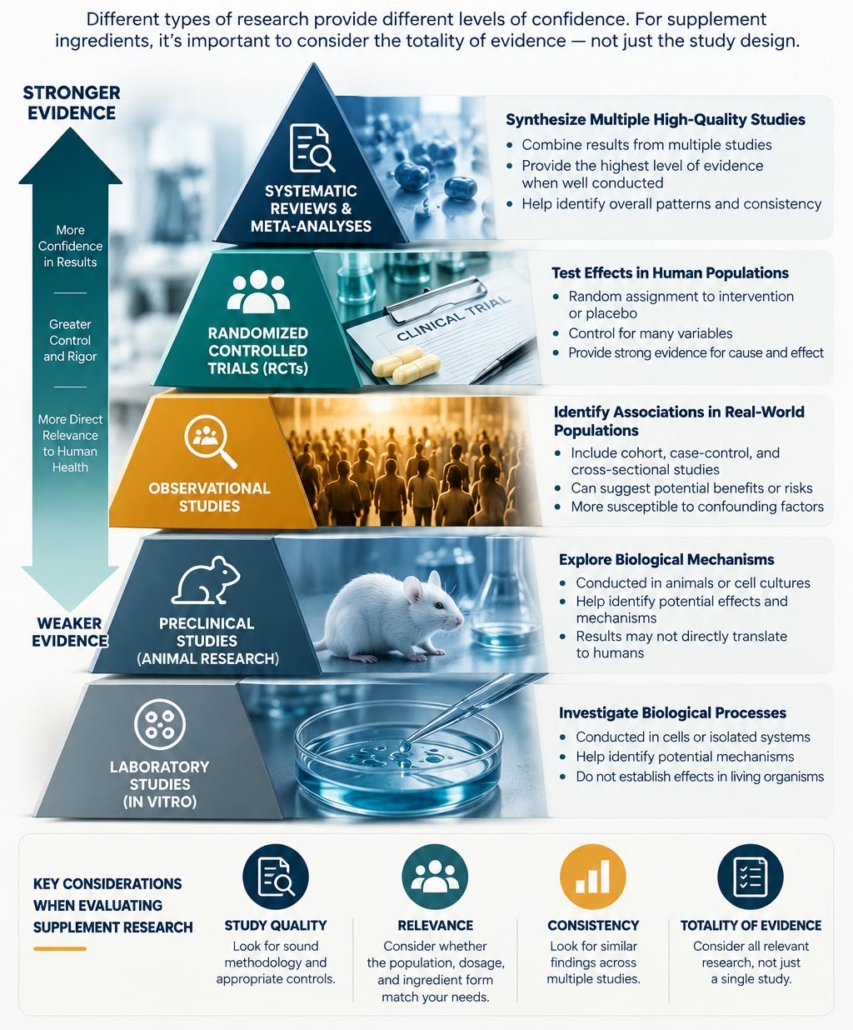
Not All Scientific Evidence Carries the Same Weight

Scientific studies answer different questions, and their findings don’t all provide the same level of confidence.

Laboratory and animal research can reveal biological mechanisms and identify promising ingredients. However, these findings don’t establish that an ingredient produces the same effects in humans.

Human clinical trials provide more directly applicable evidence, but their strength depends on study design, sample size, duration, outcomes, and risk of bias.

Systematic reviews and meta-analyses can offer broader perspectives by evaluating multiple studies, although their conclusions remain dependent on the quality and consistency of the underlying research.

For supplement brands, understanding these distinctions is essential when translating research into product claims and educational content.

These categories provide a useful starting point, not an automatic ranking of individual studies. A well-designed randomized trial may offer stronger evidence for a specific outcome than a poorly conducted meta-analysis.

The goal isn’t to teach consumers to become clinical researchers. It’s to help them recognize what the evidence establishes — and what it doesn’t.

INFOGRAPHIC: Scientific Evidence Hierarchy
Evidence type What it can tell us Important limitation
Laboratory studies How an ingredient may affect cells or biological pathways Findings may not translate into human benefits
Animal studies Potential physiological effects and mechanisms Animal responses may differ from human responses
Observational human studies Associations between exposures and health outcomes Associations don’t establish causation
Randomized controlled trials Whether an intervention produces measurable effects under studied conditions Results may not generalize beyond the studied population, dose, or formulation
Systematic reviews and meta-analyses What the collective research suggests Conclusions depend on study quality, consistency, and analytical methods

Clinical Relevance Matters as Much as Scientific Interest

One of the most common challenges in supplement communication is translating promising research into meaningful consumer benefits.

Consider an ingredient studied for its effects on oxidative stress. Laboratory findings may demonstrate antioxidant activity, while a small human trial might identify changes in selected biomarkers.

Those results may justify additional investigation. However, they don’t automatically establish that supplementation slows biological aging, improves longevity, or prevents disease.

Similarly, an ingredient studied in healthy young adults may not produce the same outcomes in older adults or individuals with different health characteristics.

For self-directed consumers, these distinctions can be difficult to recognize when research appears as a headline, social media post, or abbreviated AI response.

Brands can provide greater clarity by explaining three essential elements of the research:

  1. What was studied: The ingredient, formulation, dose, population, and duration.
  2. What researchers observed: The actual measured outcomes, including whether findings were statistically and clinically meaningful.
  3. What remains uncertain: Study limitations, unanswered questions, and whether additional research is needed.

This approach doesn’t diminish promising science. Instead, it helps establish realistic expectations and strengthens the credibility of the brand’s scientific communication.

When AI Summarizes the Science, Context Becomes Even More Important

AI assistants add another layer to how consumers encounter supplement research.

A consumer can now ask an LLM to explain a clinical study, compare ingredient forms, summarize potential benefits, or identify published research supporting a particular supplement.

These tools can make complex scientific information easier to explore. However, they can also produce incomplete interpretations, misrepresent findings, or generate references that don’t support the stated conclusions.

For example, an AI assistant might summarize research on a standardized botanical extract without explaining that the findings cannot automatically be applied to every extract of the same plant.

It might also describe evidence for an individual ingredient in a way that suggests a finished multi-ingredient supplement has been clinically validated.

These distinctions matter because consumers may treat a clear, confident AI-generated explanation as an authoritative interpretation of the research.

For supplement brands, scientific communication must be accurate enough to withstand independent examination and clear enough to reduce the risk of misinterpretation. That includes publishing accessible research summaries, identifying relevant ingredient forms and dosages, linking to original studies, and acknowledging important limitations.

Brands cannot control how AI systems interpret their information. However, they can make accurate, well-organized evidence easier to find and evaluate.

Evidence Literacy Is an Opportunity to Build Trust

In the Evidence Economy, consumers don’t necessarily need more scientific information. They need help understanding which information is relevant to their decisions.

Brands can contribute by translating complex research into practical explanations without exaggerating findings or oversimplifying important distinctions.

That might mean explaining why a particular ingredient form was selected, why researchers used a specific dose, or why preliminary findings aren’t sufficient to support a broader health claim.

It also means acknowledging uncertainty when the science is still developing.

For supplement companies, this approach represents a shift from using research primarily to validate marketing messages toward using research to educate consumers and support informed choices.

The brands that communicate evidence responsibly can demonstrate something more valuable than scientific sophistication: a commitment to helping consumers make well-informed decisions.

And that commitment becomes especially important when consumers begin comparing published research with the ingredients, dosages, and claims on the actual product label.

The Evidence-to-Product Gap: When Research Doesn’t Match the Label

A supplement can contain a scientifically studied ingredient without delivering the same formulation evaluated in clinical research.

This distinction is becoming increasingly important as self-directed consumers investigate the evidence behind the products they purchase. They may recognize an ingredient from a clinical study, compare recommended amounts, or ask an AI assistant whether a supplement contains a clinically relevant dose.

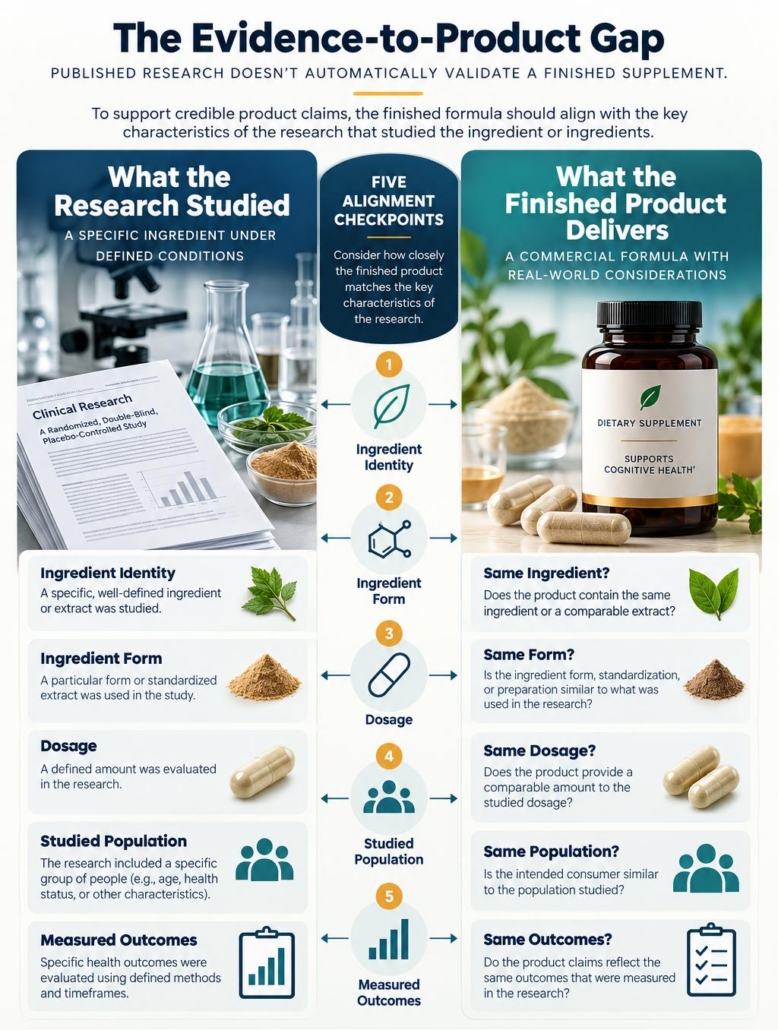
For brands, these questions expose what we call the Evidence-to-Product Gap: the disconnect that can occur between published research and the ingredient forms, dosages, combinations, or claims used in a commercial supplement.

The gap doesn’t necessarily indicate a poor-quality product. Formulation decisions must account for many factors, including safety, stability, delivery format, sensory experience, and cost. However, when a product differs materially from the research supporting its positioning, brands need to understand whether the evidence remains applicable.

A clinically studied ingredient doesn’t automatically make a finished supplement clinically validated.

INFOGRAPHIC: Evidence To Product Gap

Why Ingredient Form & Dosage Matter

Clinical evidence is specific to the conditions under which researchers generated it. An ingredient’s identity, chemical form, standardization, amount, and administration schedule can influence how relevant those findings are to a finished product.

Botanical extracts offer a useful example.

Two supplements may list the same botanical ingredient, yet contain extracts with different concentrations of active or marker compounds. One may use a standardized extract evaluated in human trials, while another uses a general botanical powder.

Although both products share a familiar ingredient name, their compositions may differ substantially. Therefore, research involving one preparation cannot automatically substantiate the same effects for the other.

Dosage introduces another consideration.

A study may demonstrate a benefit using a specific daily amount of an ingredient. If a commercial formulation contains substantially less, the manufacturer must evaluate whether the available evidence supports the lower amount and the intended claim.

The same principle applies to nutrient forms, delivery systems, and ingredient combinations.

For supplement brands, these distinctions should inform formulation development before they become questions raised by consumers.

Multi-Ingredient Formulas Require Additional Consideration

Many supplements combine ingredients to support a broader functional benefit. This approach can create meaningful product differentiation, but it also complicates how scientific evidence applies to the finished formula.

Consider a cognitive wellness supplement containing several ingredients independently studied for aspects of brain health.

Research supporting each ingredient may help explain its inclusion. However, combining those ingredients doesn’t automatically establish that the finished product delivers the same outcomes observed in separate studies.

Interactions, relative amounts, bioavailability, and the characteristics of the target population can influence how a formulation performs.

This doesn’t mean every multi-ingredient supplement requires its own clinical trial. Rather, brands must evaluate whether the available evidence adequately supports the specific claims being made about the finished product.

The scientific rationale for a formulation and clinical validation of that formulation are related, but they aren’t interchangeable.

For self-directed consumers comparing research with product labels, communicating this distinction clearly can strengthen credibility.

Formulation Decisions Should Be Defensible, Not Just Marketable

The Evidence-to-Product Gap also highlights an important opportunity for product developers.

Instead of beginning with a list of trending ingredients, brands can establish the intended consumer outcome, evaluate the available evidence, and determine which formulation choices are scientifically and commercially appropriate.

That process includes several questions:

  • Does the research support the intended benefit and target consumer?
  • Is the selected ingredient form comparable to the one studied?
  • Does the proposed daily amount align with the supporting evidence?
  • Could the delivery format, processing, or stability affect the ingredient’s performance?
  • Do the finished product’s claims accurately reflect the available substantiation?

These considerations become particularly important when developing gummies, powders, and multi-ingredient capsules, where ingredient loading, taste, stability, and serving size can influence formulation decisions.

A lower-dose formula, alternative ingredient form, or different delivery format may be appropriate for a particular product. However, those decisions should be supported by a defensible scientific rationale rather than assumptions that all versions of an ingredient perform identically.

Closing the Gap Creates a Stronger Foundation for Trust

The Evidence-to-Product Gap isn’t simply a formulation challenge. It’s also a communication challenge.

Consumers may encounter research through an ingredient supplier, a scientific publication, an influencer, or an AI-generated summary. If that information doesn’t accurately represent the finished supplement, the consumer may develop expectations the product’s evidence cannot support.

Brands can reduce this disconnect by connecting their scientific substantiation directly to their formulation decisions and product education.

That means clearly identifying ingredient forms, communicating meaningful amounts, distinguishing ingredient-level evidence from finished-product research, and explaining the rationale behind formulation choices.

It also means ensuring that marketing claims remain consistent with the evidence, even when a more ambitious message might appear commercially attractive.

For supplement brands, scientific credibility begins with a formulation that can be defended and continues with communication that accurately represents what the product can reasonably deliver.

As consumers become more capable of examining these details independently, that alignment becomes an increasingly valuable foundation for trust.

Transparency Makes Evidence Easier to Evaluate

For self-directed consumers, transparency is becoming an important part of how they assess supplement credibility. Ingredient lists and marketing claims may introduce a product, but they don’t always answer the questions consumers have about its scientific rationale, quality, or manufacturing standards.

Today’s research-oriented shoppers may want to know why a particular ingredient was selected, whether its dosage aligns with published studies, or what testing supports the product’s quality. They may also investigate certifications, ingredient sourcing, and manufacturing practices before making a purchase.

For supplement brands, transparency offers an opportunity to make these details easier to understand.

However, more information doesn’t necessarily create greater trust. The information must be relevant, accurate, and useful.

From Ingredient Disclosure to Meaningful Transparency

A Supplement Facts panel provides essential information about a product’s composition. Yet consumers investigating scientific evidence may need additional context to understand what those details mean.

For example, identifying a botanical extract on a label doesn’t necessarily explain its standardization, the research supporting its use, or why the manufacturer selected a particular amount.

Brands can make this information more accessible through ingredient education, formulation explanations, research summaries, and clearly organized product pages.

Meaningful transparency may include:

  • Ingredient identity: The specific form, source, or standardization relevant to the formulation.
  • Scientific rationale: Why the ingredient was selected and how available research relates to its intended function.
  • Dosage context: How the amount per serving compares with relevant published research.
  • Quality verification: What testing is performed and which characteristics it evaluates.
  • Evidence limitations: What research supports, what remains uncertain, and whether the finished product itself has been clinically studied.

These details help consumers move beyond recognizing an ingredient name toward understanding its role in the finished product.

Importantly, transparency doesn’t require disclosing proprietary formulation methods or confidential supplier information. It requires communicating the information consumers need to evaluate product credibility without creating misleading impressions.

Clinical Evidence, Testing & Certifications Serve Different Purposes

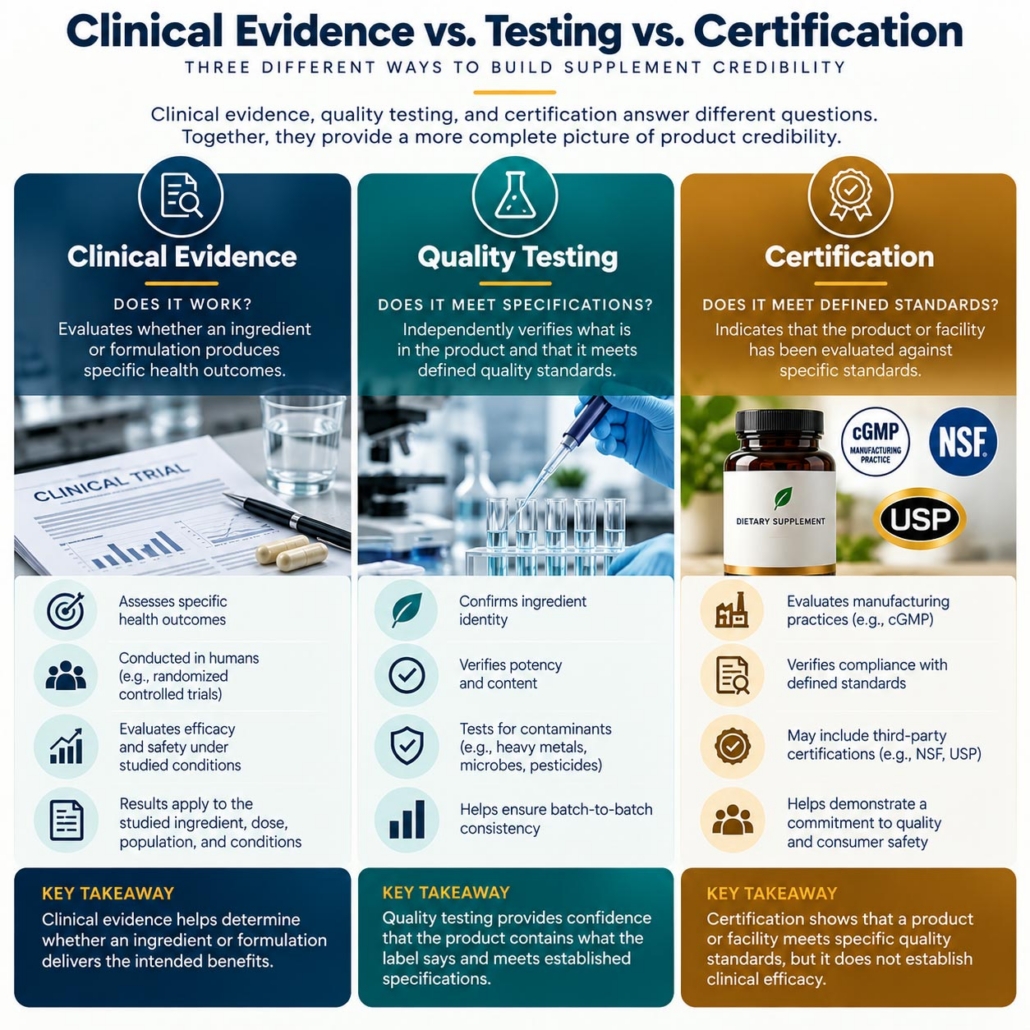
One of the most important distinctions brands can communicate is the difference between scientific substantiation and product quality verification. These activities support credibility, but they answer different questions.

Clinical research evaluates whether an ingredient or intervention produces particular outcomes under studied conditions. Its relevance to a commercial supplement depends on factors such as ingredient identity, dose, population, and study design.

Quality testing evaluates specified characteristics of ingredients or finished products. Depending on the methods and specifications, testing may verify identity, potency, purity, microbiological quality, or contaminant limits. It doesn’t establish that a supplement produces a particular health benefit.

Manufacturing quality systems help ensure products are consistently produced and controlled according to applicable requirements. Current Good Manufacturing Practices (cGMPs), for example, establish requirements for dietary supplement manufacturing, packaging, labeling, and holding operations.

Third-party certifications provide independent verification against defined standards. However, certifications vary in scope. A certification addressing manufacturing practices, organic production, or product quality doesn’t automatically establish clinical efficacy.

These distinctions matter because consumers may interpret phrases such as “clinically backed,” “third-party tested,” or “certified” as interchangeable indicators of product effectiveness. They’re not.

INFOGRAPHIC: Clinical Evidence, Testing, And Certification

A supplement can meet rigorous quality specifications without having demonstrated a particular clinical benefit. Likewise, an ingredient may have promising clinical evidence while the finished product still requires appropriate quality verification.

Brands that explain these differences help consumers develop a more accurate understanding of what each type of evidence establishes.

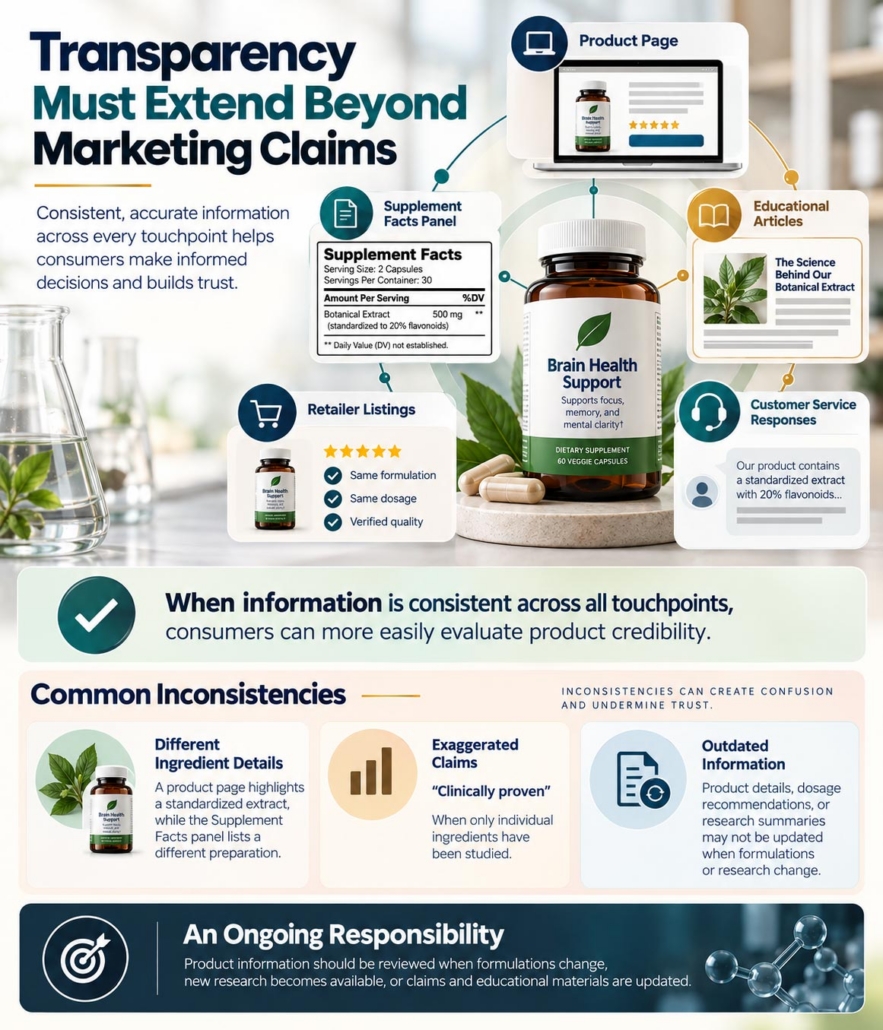
INFOGRAPHIC: Transparency Beyond Marketing Claims

Transparency Must Extend Beyond Marketing Claims

Transparency becomes more meaningful when information remains consistent across the consumer experience.

A brand’s product page, Supplement Facts panel, educational articles, retailer listings, and customer service responses should communicate compatible information about ingredients, dosages, benefits, and quality standards.

Inconsistencies can create confusion, particularly when consumers compare information across multiple sources.

For example, a product page might emphasize research involving a standardized botanical extract, while the Supplement Facts panel identifies a different preparation. Even if the difference has a legitimate explanation, failing to provide that context may undermine the credibility of the scientific narrative.

Similarly, describing a product as “clinically proven” when only its individual ingredients have been studied can create expectations that exceed the available evidence.

For brands, this makes transparency an ongoing responsibility rather than a one-time marketing initiative.

Product information should be reviewed when formulations change, new research becomes available, or claims and educational materials are updated.

The Value of Verifiable Information

Self-directed consumers don’t necessarily expect every supplement to have extensive finished-product clinical research. However, they benefit from knowing what has been evaluated and what hasn’t.

Brands can support informed decisions by providing direct references to relevant studies, explaining the scope of testing, and identifying certifications accurately.

For example, a statement that a supplement undergoes third-party testing becomes more meaningful when consumers understand what is tested, whether testing applies to ingredients or finished products, and what standards are used.

Similarly, an educational article becomes more credible when readers can access the underlying research and understand its limitations.

This approach also helps establish a reliable foundation for information that consumers may encounter through search engines, AI assistants, and independent research tools.

In the Evidence Economy, transparency isn’t simply about revealing more. It’s about making credible information easier to find, understand, and verify.

For supplement brands, that clarity can strengthen consumer confidence while reinforcing the scientific and quality standards behind the finished product.

When AI Interprets the Evidence: How Brands Can Shape Their Product Narrative

Self-directed consumers no longer need to navigate scientific databases or interpret clinical studies entirely on their own. AI assistants can summarize research, explain unfamiliar ingredients, compare formulations, and answer questions about supplement benefits in conversational language.

This accessibility creates new opportunities for consumer education. However, it also introduces another layer between a brand’s scientific substantiation and the information consumers receive.

An AI-generated answer may combine published research, manufacturer information, third-party commentary, and other online sources into a single explanation. While that synthesis can be useful, it may also omit important context, rely on outdated information, or incorrectly apply ingredient-level findings to a finished product.

For supplement brands, the challenge isn’t to control what AI says. It’s to make accurate, verifiable product information easier for AI systems — and consumers — to discover and interpret.

AI Can Explain Evidence Without Fully Understanding Its Limitations

A consumer might ask an AI assistant whether a supplement contains clinically meaningful amounts of its ingredients or whether published studies support its advertised benefits.

The resulting answer may appear comprehensive and authoritative. Yet its accuracy depends on the information available, how the system retrieves and interprets that information, and whether it correctly distinguishes among different types of evidence.

For example, an AI assistant might identify clinical research involving a standardized botanical extract and associate those findings with a supplement containing a different preparation. It might also describe the benefits of several independently studied ingredients without clarifying that the finished combination hasn’t been clinically evaluated.

These errors can create expectations that the underlying research doesn’t support.

Brands can reduce the risk of misinterpretation by publishing scientific explanations that clearly identify the studied ingredient, relevant dosage, population, measured outcomes, and important limitations.

This doesn’t guarantee accurate AI-generated answers. However, it creates a stronger information foundation for both automated interpretation and independent consumer evaluation.

Make Scientific Information Accessible to Consumers & AI Systems

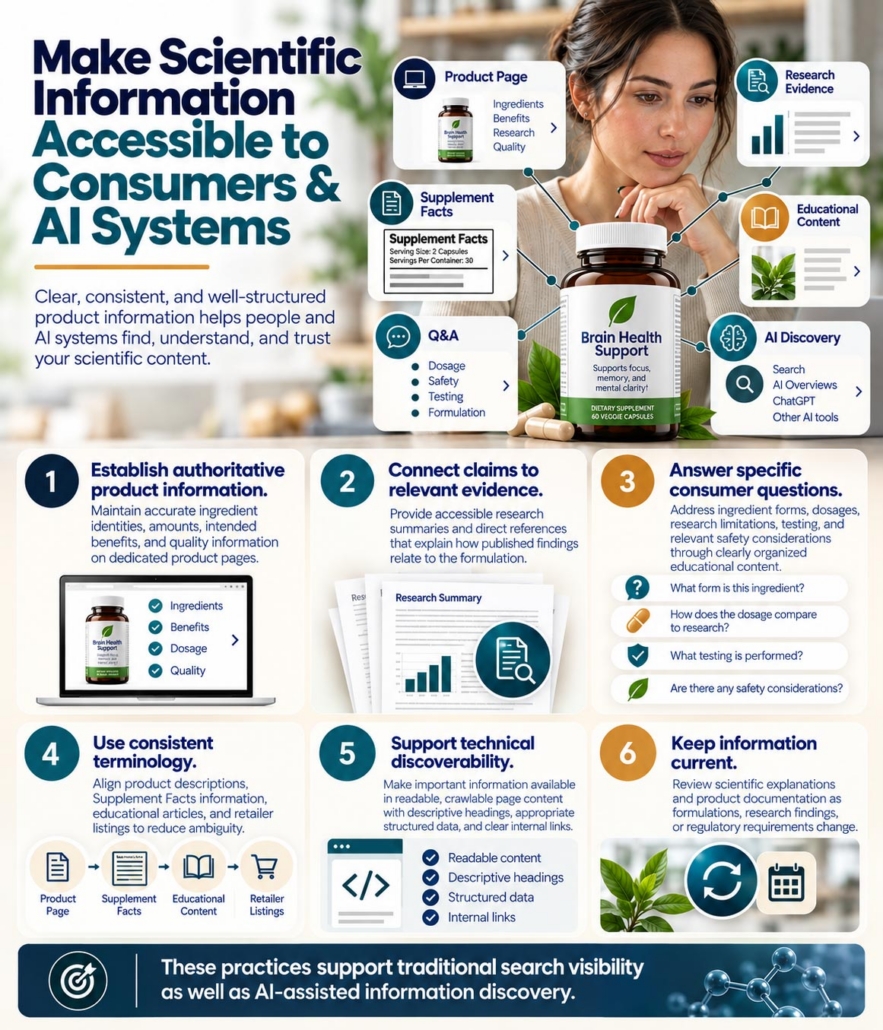
Scientific credibility becomes more useful when supporting information is easy to locate, understand, and verify. For supplement brands, that means treating product education as an extension of scientific substantiation rather than a separate marketing activity.

Several practices can strengthen this approach:

Establish authoritative product information. Maintain accurate ingredient identities, amounts, intended benefits, and quality information on dedicated product pages.

Connect claims to relevant evidence. Provide accessible research summaries and direct references that explain how published findings relate to the formulation.

Answer specific consumer questions. Address ingredient forms, dosages, research limitations, testing, and relevant safety considerations through clearly organized educational content.

Use consistent terminology. Align product descriptions, Supplement Facts information, educational articles, and retailer listings to reduce ambiguity.

Support technical discoverability. Make important information available in readable, crawlable page content with descriptive headings, appropriate structured data, and clear internal links.

Keep information current. Review scientific explanations and product documentation as formulations, research findings, or regulatory requirements change.

These practices support traditional search visibility as well as AI-assisted information discovery. However, structured data and technical optimization don’t guarantee that an AI system will retrieve, cite, or accurately represent a particular source.

INFOGRAPHIC: Making Scientific Information Accessible

Audit How AI Describes Your Products

Brands can also evaluate how AI systems interpret their publicly available information.

A practical AI product narrative audit begins with questions consumers might reasonably ask:

  • What scientific evidence supports this supplement’s advertised benefits?
  • Are the ingredient forms and amounts consistent with the published research?
  • Has the finished product been clinically studied, or does the evidence concern individual ingredients?
  • What testing and quality standards support the product?
  • What limitations or safety considerations should consumers understand?

Marketing and regulatory teams can compare the responses with verified product documentation to identify factual errors, outdated information, missing context, or unsupported conclusions.

Because AI responses can vary by platform, prompt, source availability, and time, these audits should be treated as diagnostic exercises rather than definitive measures of brand visibility or credibility.

When inaccuracies appear, the first step is to determine whether the brand’s own information is complete, consistent, and accessible. Brands can then correct outdated pages, clarify ambiguous explanations, and address discrepancies in sources they control.

Scientific Accuracy Is the Foundation of AI Visibility

The growing role of AI doesn’t change the scientific standards supplement brands should follow. It increases the importance of communicating those standards clearly.

Brands shouldn’t optimize content to encourage AI systems to repeat exaggerated claims or present preliminary findings as established benefits. Instead, they should make accurate information about their formulations, substantiation, and quality practices readily available.

In the Evidence Economy, a credible product narrative must remain defensible whether consumers encounter it on a label, through a scientific publication, or in an AI-generated answer.

For supplement brands, the opportunity is to become a more reliable source of the information consumers — and the technologies assisting them — use to evaluate product credibility.

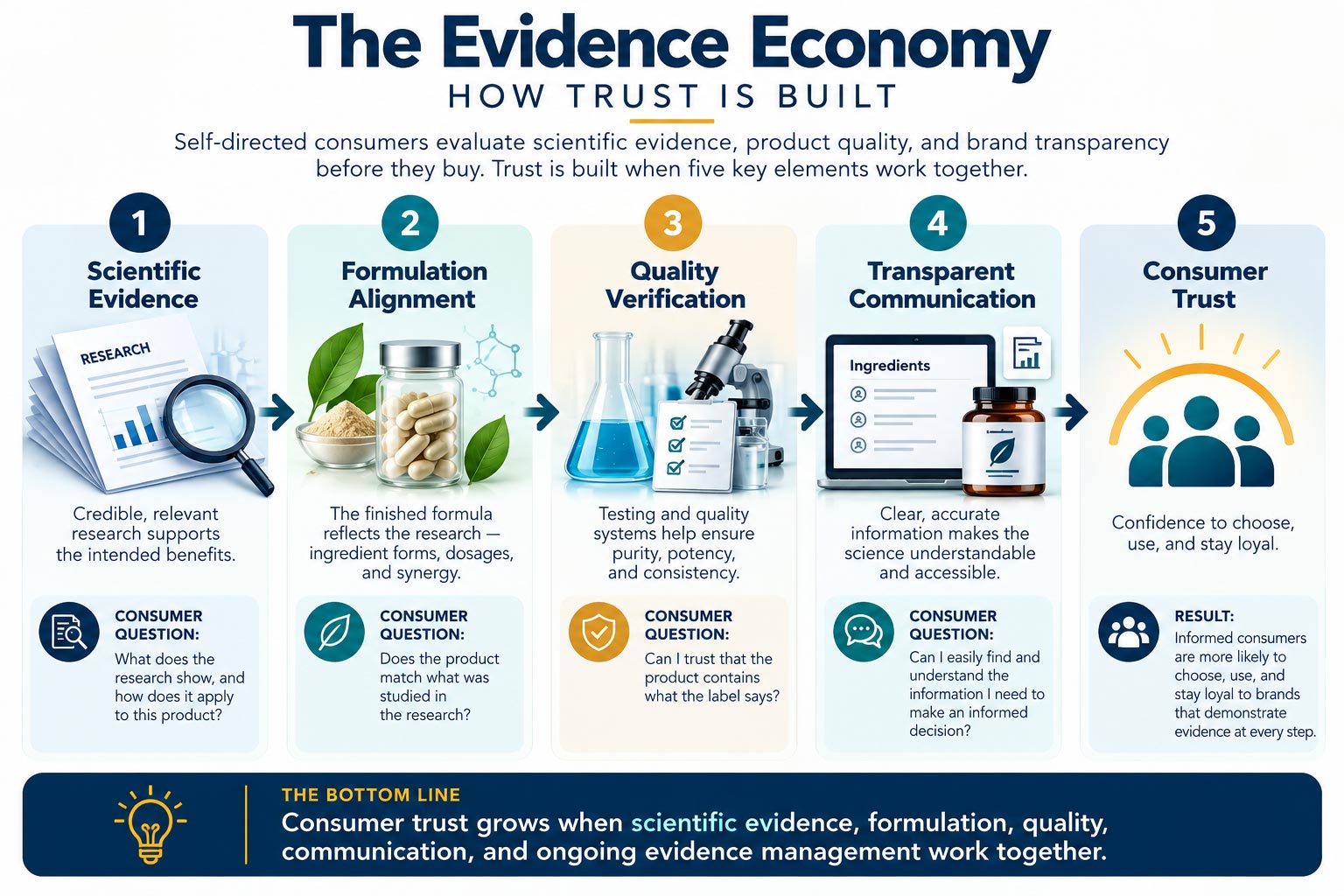
INFOGRAPHIC: The Evidence Economy

How Supplement Brands Can Compete in the Evidence Economy

As self-directed consumers become more involved in evaluating supplement science, brands need to rethink how evidence supports product development, marketing, and consumer education.

The opportunity isn’t simply to publish more research. It’s to build a coordinated approach that connects scientific substantiation with formulation decisions, product quality, and accessible information.

For supplement brands, competing in the Evidence Economy requires five strategic priorities.

1. Make Evidence Part of Product Strategy From the Beginning

Scientific substantiation should inform product development before ingredient selection and marketing positioning are finalized.

Start by identifying the intended consumer benefit and evaluating the strength of the supporting research. Then determine whether the evidence applies to the target population, proposed ingredient forms, and intended dosages.

This approach helps brands distinguish between ingredients with established human evidence and emerging innovations that may require additional investigation.

It also reduces the risk of developing products around appealing marketing concepts that the available research cannot adequately support.

The strategic advantage: Product concepts built around credible evidence provide a stronger foundation for formulation, claims development, and consumer education.

2. Align the Finished Formula With the Scientific Rationale

A strong research foundation only creates value when it translates into an appropriate commercial formulation.

Ingredient identity, standardization, dosage, bioavailability, and delivery format all influence how closely a finished product aligns with published research.

Brands should evaluate these factors alongside practical considerations such as stability, sensory performance, ingredient compatibility, manufacturing feasibility, and cost.

When formulation constraints require changes, teams should reassess whether the original scientific rationale and proposed claims remain appropriate.

The strategic advantage: Evidence-aligned formulations help brands defend their product positioning when informed consumers compare labels with published studies.

3. Turn Scientific Substantiation Into Consumer Education

Self-directed consumers increasingly encounter research through search engines, AI assistants, social media, and independent information sources.

Brands can help consumers navigate that information by translating scientific findings into clear, accurate explanations.

Effective educational content should address the questions consumers are likely to investigate: Why was an ingredient selected? What outcomes have researchers studied? Does the dosage align with the evidence? What remains uncertain?

Direct references, accessible research summaries, and clearly explained limitations can make technical information more useful without overstating the science.

The strategic advantage: Educational content helps brands demonstrate expertise while creating reliable information that consumers and AI-assisted research tools can reference.

4. Make Quality Verification Meaningful

Quality assurance and scientific substantiation serve different purposes, but both contribute to product credibility.

Brands should communicate what their testing programs and certifications actually verify. That may include ingredient identity, potency, purity, contaminant limits, manufacturing practices, or compliance with defined standards.

Clear explanations help consumers understand the difference between a product that meets quality specifications and one whose health benefits have been evaluated in clinical research.

This distinction is particularly important when communicating third-party testing, cGMP compliance, and other quality credentials.

The strategic advantage: Specific, verifiable quality information gives consumers a more meaningful basis for evaluating product reliability.

5. Manage Evidence Throughout the Product Lifecycle

Scientific substantiation shouldn’t end when a supplement launches.

New studies may strengthen, challenge, or refine existing conclusions. Ingredient suppliers may update specifications, formulations may change, and regulatory expectations may evolve.

Brands should establish a process for periodically reviewing scientific support, product claims, educational materials, and consumer-facing information.

This responsibility should extend across marketing, regulatory, quality, and product development teams to maintain consistency.

It should also include periodic reviews of how AI systems describe products, particularly when those descriptions rely on outdated or incomplete information.

The strategic advantage: Ongoing evidence management helps brands maintain credible product positioning as scientific knowledge and consumer expectations evolve.

Evidence Is a Cross-Functional Responsibility

These five priorities share a common principle: Scientific credibility cannot be managed by a single department.

Research informs formulation. Formulation determines what a product contains. Quality systems help verify that the product meets established specifications. Marketing translates substantiated benefits into consumer-facing information.

When these functions operate independently, inconsistencies can emerge between the research, the finished product, and the claims consumers encounter.

When they work together, brands can create a more coherent foundation for consumer trust.

In the Evidence Economy, competitive differentiation comes not from having the most scientific information, but from consistently connecting credible evidence to the products and experiences consumers receive.

Why Formulation & Manufacturing Matter to Consumer Trust

In the Evidence Economy, scientific credibility begins long before a supplement reaches the consumer. It starts with the decisions that determine what goes into the product, how it’s manufactured, and whether its quality and composition can be consistently verified.

For self-directed consumers, these decisions are becoming more visible. Ingredient forms, dosages, testing practices, and manufacturing standards can all become part of their independent product evaluation.

This makes formulation and manufacturing expertise essential to building a product that can withstand informed scrutiny.

Turning Scientific Evidence Into Scalable Products

Translating research into a commercial supplement requires more than selecting clinically studied ingredients.

Brands must balance scientific rationale with ingredient compatibility, stability, bioavailability, sensory performance, manufacturing feasibility, and cost. These considerations become particularly important when developing multi-ingredient capsules, functional powders, and gummies.

For example, a formulation may contain an ingredient at a research-supported dose but encounter challenges involving flavor, ingredient loading, or stability. Addressing those challenges requires technical expertise without losing sight of the evidence supporting the product’s intended benefits.

Manufacturing consistency is equally important. Ingredient qualification, documented specifications, quality controls, and appropriate testing help ensure that finished products meet established requirements from batch to batch.

Scientific substantiation establishes the rationale for a product. Formulation and manufacturing determine how faithfully that rationale is translated into a consistent commercial supplement.

Partnering for Evidence-Based Product Development

For supplement brands, choosing the right manufacturing partner can help connect scientific credibility with commercial execution.

At Intermountain Nutrition, we support brands through custom formulation, research and development, ingredient evaluation, flavor development, quality assurance, and scalable manufacturing. Our capabilities include capsules, powders, and gummies, supported by established quality systems and on-site third-party testing.

By considering scientific evidence alongside formulation feasibility and manufacturing requirements, we help brands make informed product development decisions from concept through commercialization.

In a marketplace where consumers increasingly investigate the science behind their supplements, that alignment matters.

The goal isn’t simply to manufacture a product with scientifically recognized ingredients. It’s to develop a supplement whose formulation, quality, and supporting evidence tell a credible, consistent story.

The Future of Supplement Trust Is Evidence Consumers Can Verify

The self-directed health consumer is changing how supplement brands establish credibility. Consumers increasingly investigate ingredients, compare research, and question whether product claims align with the available science. AI-powered tools are making that information easier to access, even as they introduce new challenges in interpreting evidence accurately.

For supplement brands, this shift creates an opportunity to move beyond simply presenting scientific credentials.

Trust grows when consumers can connect credible research to the ingredients, dosages, quality standards, and benefits of the products they’re considering.

Success in the Evidence Economy requires collaboration across research, formulation, manufacturing, quality assurance, and marketing. Brands that connect these disciplines can build products supported by a clear scientific rationale and communicate their value with greater confidence.

Build Products That Stand Up to Informed Scrutiny

At Intermountain Nutrition, we help supplement brands translate scientific insights into commercially viable formulations. From ingredient evaluation and custom formulation to quality assurance, on-site third-party testing, and scalable manufacturing, our team supports product development with scientific and technical expertise.

Ready to develop supplements that meet the expectations of today’s informed consumers? Connect with Intermountain Nutrition to explore how our formulation and manufacturing capabilities can support your next product.

NEXT UP: Formulation Intelligence — Turning Science Into Competitive Advantage

Scientific evidence provides the foundation for credible supplements. But evidence alone doesn’t create a successful product.

In our next article in the Self-Directed Health Consumer series, we’ll explore Formulation Intelligence — the intersection of scientific research, ingredient selection, clinically relevant dosing, delivery formats, sensory experience, and manufacturing feasibility.

Discover why the next competitive advantage isn’t simply choosing trending ingredients. It’s knowing how to combine science, consumer expectations, and formulation expertise to create products that stand apart in an increasingly informed marketplace.

Frequently Asked Questions

The Evidence Economy describes a marketplace in which the accessibility, credibility, and interpretation of scientific evidence increasingly influence consumer purchasing decisions. Self-directed consumers investigate ingredients, compare formulations, and evaluate claims rather than relying exclusively on brand recognition or marketing.

Self-directed consumers take a more active role in researching products. They may investigate ingredient forms, compare dosages with published studies, consult independent sources, and use AI assistants to interpret scientific information. This creates greater demand for accurate product information, transparent formulations, and accessible research.

An evidence-based supplement has a scientific rationale supported by research relevant to its ingredients, amounts, intended benefits, and target population. The strength of that support depends on study quality, consistency, and applicability. Brands must also ensure their product claims accurately reflect the available substantiation.

No. Research supporting an individual ingredient doesn’t automatically establish that a finished supplement delivers the same benefits. Differences in ingredient form, dosage, formulation, or delivery system may affect how the evidence applies. Claims that a finished product is clinically proven require appropriate substantiation for that claim.

Third-party testing independently evaluates specified product characteristics, such as identity, potency, purity, or contaminants. Clinical validation evaluates whether an ingredient or formulation produces particular health outcomes under studied conditions. Both can support product credibility, but quality testing doesn’t establish clinical efficacy.

Brands should use accurate research summaries, cite relevant studies, explain ingredient forms and dosages, and acknowledge meaningful scientific limitations. They should also distinguish preliminary findings from established human evidence and ensure marketing claims remain consistent with the available substantiation.

AI assistants can summarize research, explain ingredient differences, and compare product information. However, their responses may omit important context or misinterpret scientific findings. Brands can support more accurate interpretation by publishing clear, verifiable, regularly updated information about their products and supporting research.

Manufacturing helps translate a scientifically supported formulation into a consistent commercial product. Ingredient qualification, established specifications, quality controls, and appropriate testing help verify that products meet defined requirements. These practices support the credibility of the formulation and the information brands communicate to consumers.

References

Consumer Behavior and the Self-Directed Health Consumer

NielsenIQ. (2026, June 18). Health & wellness in 2026: Winning the self-directed, results-driven consumer.

Scientific Evidence, Research Quality, and Consumer Understanding

National Center for Complementary and Integrative Health. (n.d.). Know the science. National Institutes of Health.

National Center for Complementary and Integrative Health. (n.d.). Using dietary supplements wisely. National Institutes of Health.

National Institutes of Health, Office of Dietary Supplements. (n.d.). Dietary supplements: What you need to know.

Scientific Substantiation, Product Claims, and the Evidence-to-Product Gap

Federal Trade Commission. (2022, December). Health products compliance guidance.

U.S. Food and Drug Administration. (2009, January). Guidance for industry: Substantiation for dietary supplement claims made under section 403(r)(6) of the Federal Food, Drug, and Cosmetic Act.

Supplement Manufacturing, Quality Assurance, and Transparency

U.S. Food and Drug Administration. (n.d.). Small entity compliance guide: Current good manufacturing practice in manufacturing, packaging, labeling, or holding operations for dietary supplements.

AI Search, LLM Discoverability, and Product Information Accuracy

Google Search Central. (n.d.). AI features and your website. Google for Developers.

Microsoft Bing. (2026, February 10). Introducing AI Performance in Bing Webmaster Tools public preview. Bing Webmaster Blog.

Microsoft Bing. (n.d.). AI performance in Bing Webmaster Tools.

OpenAI. (n.d.). Overview of OpenAI crawlers. OpenAI Developers.

Related Postings

older man lifting weights for resistance training in addition to taking a creatine supplement drink
STOCK FORMULA: Mushroom Memory Cocoa Powder
NAD+ For Healthy Aging Supplements