Creatine for Healthy Aging: Maintaining Muscle Strength

October 16, 2026 |

Creatine is gaining attention as a healthy aging ingredient. For supplement brands, the opportunity lies in turning that interest into products built around a clear outcome, a meaningful daily dose, and evidence the formula can support.

At a Glance

  • Creatine monohydrate has its strongest healthy aging evidence as an addition to resistance training for muscle strength in older adults.
  • A recent trial found encouraging strength and lean-tissue results at a 10 g daily dose even without structured exercise.
  • Cognitive health and women’s midlife health are promising research areas.
  • For a daily strength product, brands should begin with a 3–5 g creatine monohydrate concept and choose a format people can use consistently.

Why Creatine Belongs in the Healthy Aging Conversation

Creatine has long been sold for athletic performance. Now, interest is expanding to people who want to maintain strength as they age. That shift gives brands an opportunity to speak about a practical aspect of healthspan: the ability to keep moving, training, and taking part in everyday life.

Market analyst SPINS identifies creatine as a growing category and notes interest in uses beyond traditional sports nutrition.

The underlying science is straightforward. Creatine helps replenish the energy available for short bursts of muscular work. With resistance training, that can help people perform the work that builds strength over time.

A cellular energy mechanism, however, does not prove every proposed “longevity” benefit. Brands need to choose the outcome first, then examine whether human studies support the formula and message.

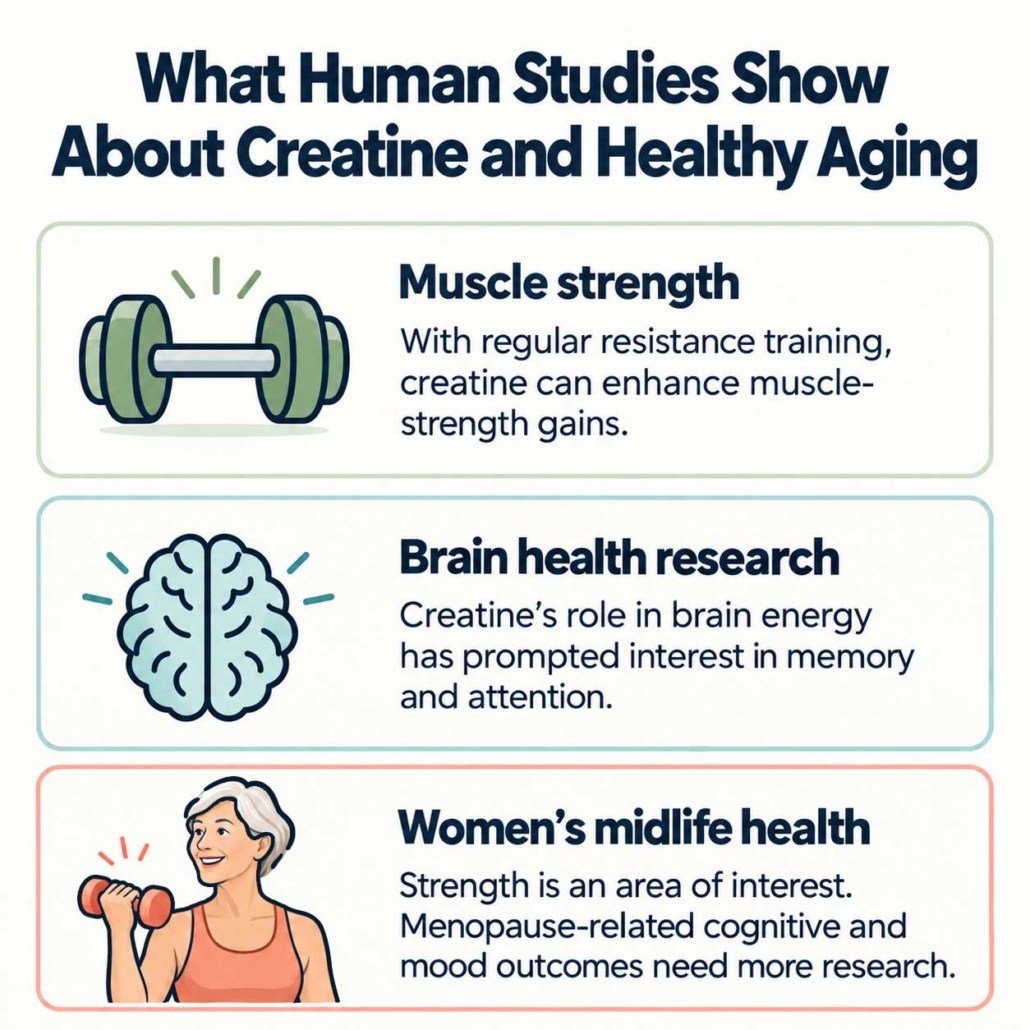
What Human Studies Show About Creatine & Healthy Aging

Muscle Strength Has The Clearest Support

The strongest case is daily creatine alongside resistance training. After reviewing intervention studies in adults over 55, the European Food Safety Authority concluded that daily doses of 3–6 g, combined with regular resistance training, can enhance muscle-strength gains.

A more recent review of adults 60 and older also found a modest additional strength benefit; effects on muscle mass and physical function were less certain.

That distinction matters for product positioning. Strength measured in a training study supports a more precise discussion than a broad promise to preserve independence, prevent falls, or slow aging.

Resistance training also remains central to the evidence: creatine adds to the intervention studied; it does not replace it.

Can Creatine Help Without Structured Exercise?

A 2026 trial offers a reason to investigate that question further. Over 12 weeks, 64 adults ages 45–65 completed a study comparing 10 g/day of creatine monohydrate with placebo. The researchers reported improvements in lean tissue and strength among creatine users in the group without structured exercise, with further benefits in the exercise program.

This finding broadens the research discussion, but it should not drive the primary product claim yet. The trial was relatively small and short, and its 10 g dose was not tested against a 3–5 g dose.

Changes in lean tissue also require careful interpretation because creatine can change water held in muscle. Brands should describe the study as an encouraging development, then anchor a strength-focused product in the wider body of training research.

Creatine & Sarcopenia: A Potential Adjunct to Resistance Training

Muscle relies on creatine and phosphocreatine to rapidly restore ATP, the energy used during repeated muscle contractions. As creatine stores rise, muscles may have more capacity to support demanding efforts such as resistance training.

Over time, this may help older adults train with greater volume or intensity, supporting the strength-building stimulus that helps maintain muscle. Creatine is best understood as a complement to training, not a substitute for it.

Creatine may also influence signals involved in muscle remodeling and protein turnover, although researchers have not confirmed these as the main reasons for its effects in older adults. The clearest practical rationale remains its role in supporting repeated high-effort exercise.

In trials and reviews, creatine combined with resistance training has improved some measures of strength and lean tissue in older adults compared with training alone. Results vary by outcome and study, so the evidence supports a muscle-maintenance strategy — not a promise that creatine alone prevents or reverses sarcopenia.

Creatine, Brain Energy & Menopause-Related Health

Creatine helps cells manage energy by supporting the rapid recycling of adenosine triphosphate (ATP), the form of energy cells use. The brain has a high, continuous energy demand, and its cells use the creatine–phosphocreatine system to help maintain ATP availability.

This role has prompted research into whether creatine supplementation could support cognitive processes such as memory and attention, particularly when energy demands are high.

Researchers are also exploring creatine in the context of menopause. Hormonal changes during the menopause transition may affect brain energy regulation, sleep, mood, and physical function.

Creatine’s role in cellular energy, alongside its potential to support strength when paired with resistance training, makes it a relevant ingredient for studying these connected changes.

For supplement brands, this creates room to develop women’s midlife concepts around clearly defined goals — such as strength or cognitive wellness — while research continues to clarify where creatine may offer meaningful support.

INFOGRAPHIC: Creatine And Healthy Aging Insights

What Brands Should Formulate: Creatine Form, Dose, Format, Flavor, and Testing

1. Start with the Studied Form and a Usable Daily Dose

Creatine monohydrate is the evidence benchmark. For a strength-focused healthy aging concept, a 3–5 g daily serving is a practical starting brief that aligns with the dose range studied alongside resistance training.

Daily use matters: in EFSA’s assessment, studies that provided creatine only on training days did not show the same strength effect. Brands should make the labeled daily serving and directions clear, including use on rest days.

A larger dose needs its own rationale. The new 10 g trial is valuable research, but it does not show that 10 g works better than 3–5 g for a healthy aging product. Likewise, an alternative creatine form should earn its place through relevant human evidence, delivered dose, stability, and cost—not a superior-sounding name.

2. Choose a Format that Can Carry the Full Serving

Creatine’s gram-level serving makes format an important part of product design. Powder tubs and single-serve stick packs can deliver a full daily serving without requiring consumers to take multiple capsules.

Tubs suit home use and provide flexibility in how consumers mix the powder. Stick packs offer premeasured portions that can travel easily and fit into a daily routine. A dry mix can also give brands room to develop a flavored drink or combine creatine with other compatible ingredients.

Before selecting a format, product teams should assess how the formula disperses in the intended liquid, whether it settles or feels gritty, and how flavor and texture hold up at the full serving size. Packaging should protect the finished product and make serving directions easy to follow.

Capsules offer a different kind of convenience for consumers who prefer to avoid flavored drinks or want a format they can take with water. However, delivering several grams of creatine may require multiple capsules per serving. Brands should calculate the capsule count, size, and daily use experience early in development so the format remains practical for the intended audience.

3. Develop Flavor for Everyday Use

Creatine powder is available both unflavored and flavored, giving brands two clear routes. Unflavored creatine suits consumers who want a simple, versatile product they can mix into water, smoothies, or other drinks.

Flavored powders make creatine a ready-to-mix beverage and are appearing in familiar, approachable profiles such as lemonade, lemon-lime, berry, watermelon, and tropical fruit. Some brands are also pairing fruit with citrus — for example, peach lemonade or mango orange.

Creatine monohydrate has a mild taste, so it can work well in both neutral and fruit-forward formulas. Citrus, lemonade, and tart berry profiles offer a refreshing direction, while watermelon and tropical blends bring a sweeter, more playful option.

For a healthy aging product, brands could explore a familiar fruit-citrus flavor alongside an unflavored version, then select based on the intended use occasion and target consumer. A powder’s gram-level serving also gives brands room to build a flavorful daily drink mix, including combinations with other compatible ingredients.

4. Verify the Finished Product

Testing should confirm that the finished product delivers its stated creatine amount through the end of shelf life.

Verify ingredient identity and purity, assess relevant contaminants, and check moisture and microbial quality against the product’s specifications.

For flavored powders, stability testing should also track creatine potency and creatinine formation in the packaged formula.

Intermountain Nutrition’s on-site third-party testing can help brands turn those results into clear specifications and informed shelf-life decisions.

Safety & Responsible Positioning

For generally healthy older adults, creatine monohydrate has a reassuring safety record when used at recommended doses. A review of eight trials involving older adults reported mainly temporary digestive discomfort and mild muscle cramps, with no serious adverse events recorded.

A broader analysis of 685 creatine trials found no significant difference in overall reported side-effect frequency between creatine and placebo participants. That broader finding includes many populations, so it is not a guarantee for every older adult.

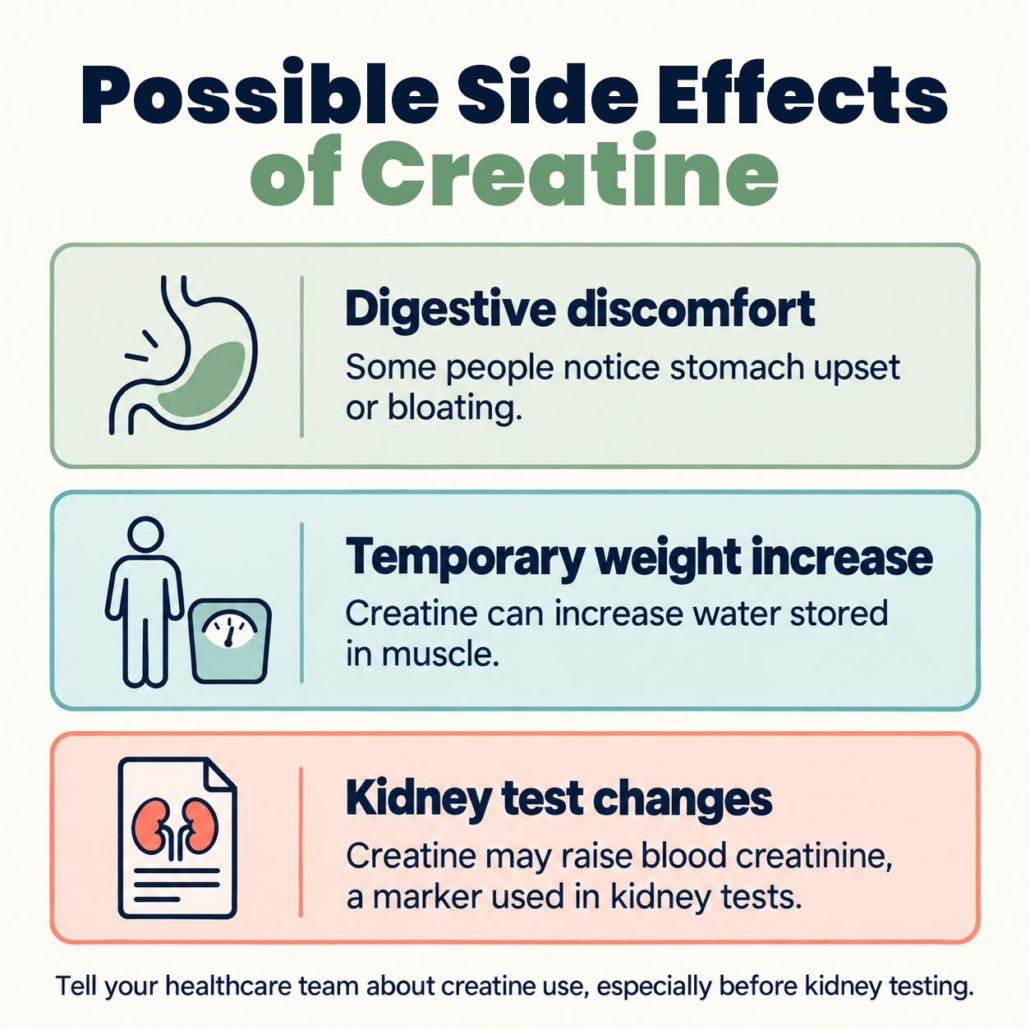
INFOGRAPHIC: Possible Side Effects Of Creatine

Possible Concerns Older Consumers May Have

Creatine monohydrate is generally well tolerated in studies of healthy adults, including older adults, though individual responses vary.

Some people experience digestive discomfort, such as nausea, loose stools, or bloating. These effects may be more likely with large amounts taken at once. Creatine can also increase body weight, often because muscles retain more water; the amount and timing vary between individuals.

Creatine use can affect how kidney blood tests are interpreted. Some creatine is converted to creatinine, a substance commonly measured to estimate kidney function.

Supplementation may raise blood creatinine and make creatinine-based estimates of filtration appear lower; that change alone does not establish kidney injury. Clinicians should know about creatine use when reviewing kidney tests and consider the full clinical picture.

People with kidney disease, or who are being monitored for kidney function, should consult a healthcare professional before using creatine. The clinician can weigh the person’s health history and medications, and advise whether supplementation and any additional monitoring are appropriate.

Match Every Claim to the Finished Product

A credible healthy aging message identifies who the product is for, what outcome it supports, and under what conditions the evidence applies. For a 3–5 g monohydrate product, the strongest editorial position is its role alongside resistance training for muscle strength in older adults.

The human evidence does not justify turning that finding into a promise to prevent falls, reverse muscle loss, improve memory, or slow biological aging. Health claims should reflect the quality and relevance of the substantiation behind the specific product.

For brands, this creates a clear development path: formulate a meaningful daily serving, confirm its quality and stability, and build education around realistic use. That approach gives consumers a useful product and gives marketing teams a defensible story.

Market Trends for Creatine Supplements

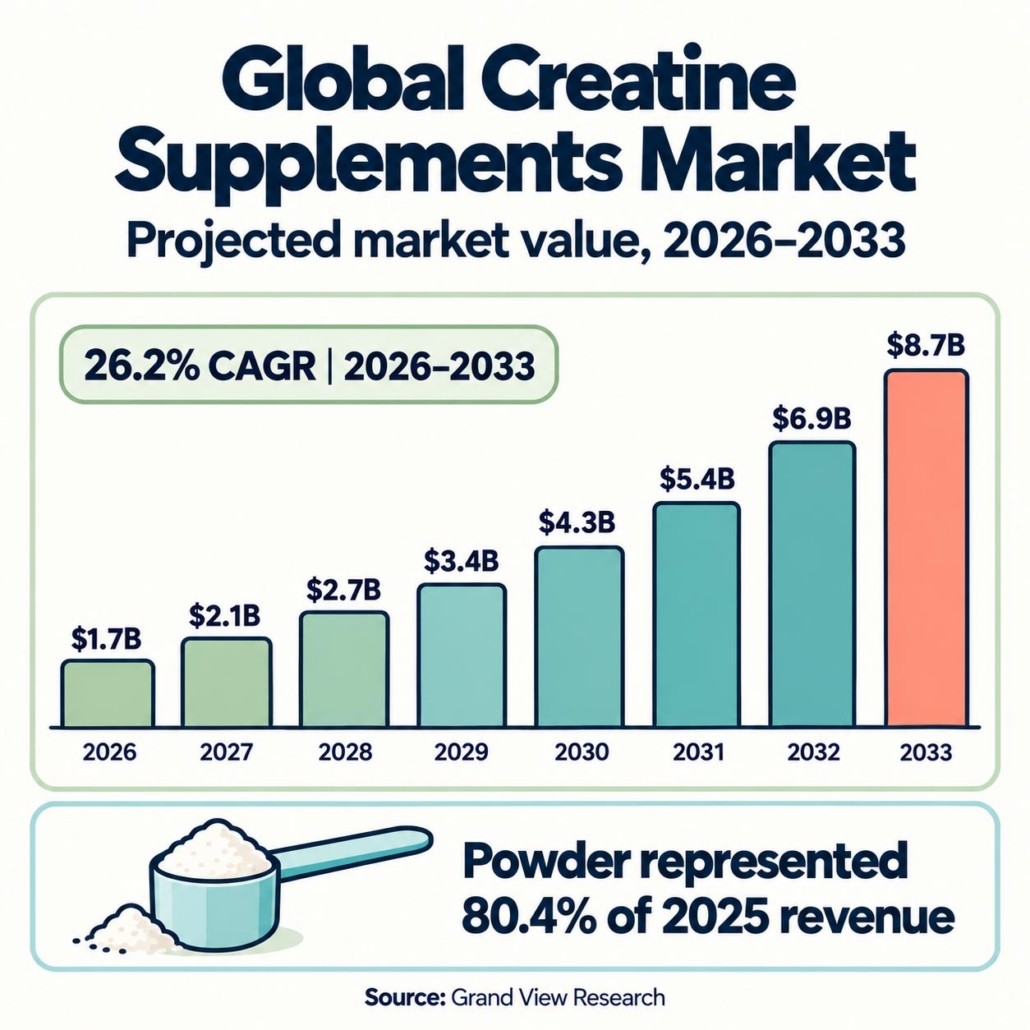
Grand View Research estimates the global creatine supplements market at $1.7 billion in 2026 and projects it will reach $8.7 billion by 2033 — a forecast compound annual growth rate of 26.2% from 2026 to 2033. In the same report, powder accounted for 80.4% of 2025 market revenue, underscoring its current position as the category’s leading format.

For brands, the figures point to a large and rapidly expanding category where powders remain central. A powder can accommodate creatine’s gram-level daily serving and gives formulators room to develop flavor and mixability.

At the same time, the market forecast alone does not show which audiences, claims, or product concepts will perform best. Brands targeting healthy aging can differentiate by connecting a clear strength-support purpose with an evidence-aligned serving and a format designed for consistent use.

INFOGRAPHIC: Global Creatine Market Trends

The Healthy Aging Opportunity for Creatine Brands

Creatine has a credible place in healthy aging, especially in products designed to support muscle strength alongside resistance training.

The opportunity for brands is to make that evidence useful: choose creatine monohydrate, deliver a meaningful daily serving, and develop a format people can use consistently.

New findings on benefits without structured exercise, cognition, and women’s midlife health are worth watching, but each calls for its own evidence review before shaping a product claim.

Ready to develop a creatine product for healthy aging? Connect with Intermountain Nutrition to discuss formulation, flavor development, packaging, and quality testing for a product built around your audience and goals.

Frequently Asked Questions

Creatine monohydrate is the best-studied form and the evidence benchmark for a strength-focused product. Alternative forms should be evaluated for human evidence, effective serving size, stability, and finished-product performance.

Cognition is an active research area, but current evidence in older adults is too limited to treat cognitive improvement as an established benefit of a standard creatine serving. A recent systematic review found that most of its included studies examined dietary intake rather than supplementation and called for better clinical trials.

Both approaches have a place. Unflavored powder offers flexibility for mixing into other drinks, while flavored powder turns the serving into a ready-to-mix beverage. Familiar profiles such as citrus, lemonade, berry, watermelon, peach, and tropical fruit are active in the market. The best choice depends on the product concept and intended use occasion.

The best-established older-adult strength evidence comes from creatine combined with resistance training. A newer, short-term study found encouraging results in adults who did not follow its structured exercise program, but it does not yet establish that creatine alone delivers the same benefits across older populations.

A 3–5 g daily serving of creatine monohydrate is a practical starting point for product development. EFSA’s assessment found that at least 3 g per day, taken consistently alongside regular resistance training, can enhance muscle-strength gains in adults over 55.

That has not been established. The recent trial using 10 g/day provides a promising result, but it did not compare 10 g directly with a 3–5 g daily serving. Brands should choose the dose that matches the outcome they intend to discuss and the studies supporting it.

The clearest evidence in older adults is for creatine used alongside resistance training. A product can be positioned around supporting a training routine, but creatine should not be presented as a substitute for exercise or as a stand-alone treatment for age-related muscle loss.

Powders and stick packs can deliver a full, gram-level serving conveniently. Capsules offer a familiar alternative for consumers who prefer not to mix a drink, though they may require several capsules per serving. Format decisions should account for serving size, ease of use, flavor preferences, and the performance of the finished formula.

Creatine participates in the system cells use to manage energy, including in the brain. Researchers are studying whether supplementation may support cognitive function and mood, including during menopause-related changes. These are promising areas for product and research exploration; brands should keep benefit statements specific and aligned with the evidence for the ingredient, dose, and target population.

Creatine supplementation may raise blood creatinine, which is used to estimate kidney filtration. As a result, a creatinine-based estimate can appear lower even when that change does not reflect kidney injury. Consumers should tell their healthcare professional they use creatine before kidney tests are interpreted.

Some users may experience digestive discomfort or an increase in body weight, often related to water retained in muscle. People with kidney disease or those being monitored for kidney function should seek medical guidance before using creatine. Clearly communicating the daily serving and asking consumers to disclose supplement use to their healthcare professional can support informed use.

References

Muscle strength, dosing, and exercise

EFSA Panel on Dietetic Products, Nutrition and Allergies (NDA). (2016). Creatine in combination with resistance training and improvement in muscle strength: Evaluation of a health claim pursuant to Article 13(5) of Regulation (EC) No 1924/2006. EFSA Journal, 14(2), Article 4400.

Yao, L., Yang, D., & Gao, J. (2026). Effects of resistance training combined with creatine supplementation on muscle strength, physical function, and muscle mass in older adults: A systematic review and three-level meta-analysis. Frontiers in Nutrition, 13, Article 1919884.

Newer and emerging healthy aging applications

Chun, J., Liu, Y., Kibler, G. L., Lee, H., Babakhani, K., Rhoades, N., Bivins, I., Ko, J., Dickerson, B., Gonzalez, D. E., Sowinski, R. J., Rasmussen, C. J., & Kreider, R. B. (2026). Effects of creatine supplementation with and without exercise and diet intervention on body composition, cognitive function, and markers of health in middle-aged and older adults. Journal of the International Society of Sports Nutrition, 23(Suppl. 1), Article 2716273.

Marshall, S., Kitzan, A., Wright, J., Bocicariu, L., & Nagamatsu, L. S. (2026). Creatine and cognition in aging: A systematic review of evidence in older adults. Nutrition Reviews, 84(2), 333–344.

Smith-Ryan AE, et al. (2021). Creatine Supplementation in Women’s Health: A Lifespan Perspective. Nutrients, 13(3), 877.

Safety and claims

Almeida, A. de S., Silva, L. O. D. da, Takahasi, B. N. A., Terada, B. D., Gonçalves, F. G. A., Porto, B. C., Sardenberg, R. A. da S., Passerotti, C. C., Maia, R. S., Samaan, F., Thoman, M., Molina, W. R., & Cruz, J. A. S. da. (2026). Impact of creatine supplementation on kidney health: A systematic review and meta-analysis. International Urology and Nephrology.

Kreider, R. B., Gonzalez, D. E., Hines, K., Gil, A., & Bonilla, D. A. (2025). Safety of creatine supplementation: Analysis of the prevalence of reported side effects in clinical trials and adverse event reports. Journal of the International Society of Sports Nutrition, 22(Suppl. 1), Article 2488937.

Liu, S., Huang, N., Wu, W., Ouyang, X., Luo, Y., Zhong, Y., Wang, M., & Xiao, L. (2025). The impact of creatine supplementation associated with resistance training on muscular strength and lean tissue mass in the aged: A systematic review and meta-analysis. European Review of Aging and Physical Activity, 22, Article 26.

Federal Trade Commission. (2022). Health products compliance guidance.

Market and flavor examples

SPINS. (2026, July 1). Creatine.

Related Postings

STOCK FORMULA: Mushroom Memory Cocoa Powder
an app scanning supplements for health and formulation information
NAD+ For Healthy Aging Supplements