NAD+ and Healthy Aging: How Cellular Energy, Repair, and Resilience Connect

October 12, 2026 |

NAD+ helps cells convert nutrients into energy and powers enzymes involved in repair and adaptation. Here’s what that biology could mean for healthy-aging research and supplement formulation.

At a Glance

  • NAD+ supports energy metabolism by carrying electrons between cellular reactions.
  • It also serves as a substrate for enzymes involved in DNA damage responses, protein regulation, and cell signaling.
  • NAD+ availability may change with age, although patterns vary among tissues and studies.
  • Human research shows that some NAD+ strategies can change NAD-related measures, while evidence for consistent improvements in meaningful health outcomes remains limited.
  • For supplement brands, a strong NAD+ concept starts with a clear intended outcome, distinct ingredient roles, workable doses, and claims that match the evidence.

What Is NAD+?

Nicotinamide adenine dinucleotide, or NAD+, is a coenzyme found in every living cell. It helps enzymes carry out reactions that keep cells functioning. Its name appears in longevity research because NAD+ supports both energy metabolism and several processes involved in cellular maintenance.

NAD+ works in two closely related forms. In its oxidized form, NAD+ accepts electrons during metabolic reactions and becomes NADH. NADH can then donate those electrons in other reactions, including those that help cells make energy. The body continually shifts NAD+ into NADH and back again, while also making and recycling NAD+ from vitamin B3 forms and other precursors.

This cycling gives NAD+ two broad roles. It acts as an electron carrier in metabolism, and it serves as a required substrate for enzymes involved in DNA damage responses, cell signaling, and regulation of gene activity. These roles connect NAD+ to many aspects of cell health.

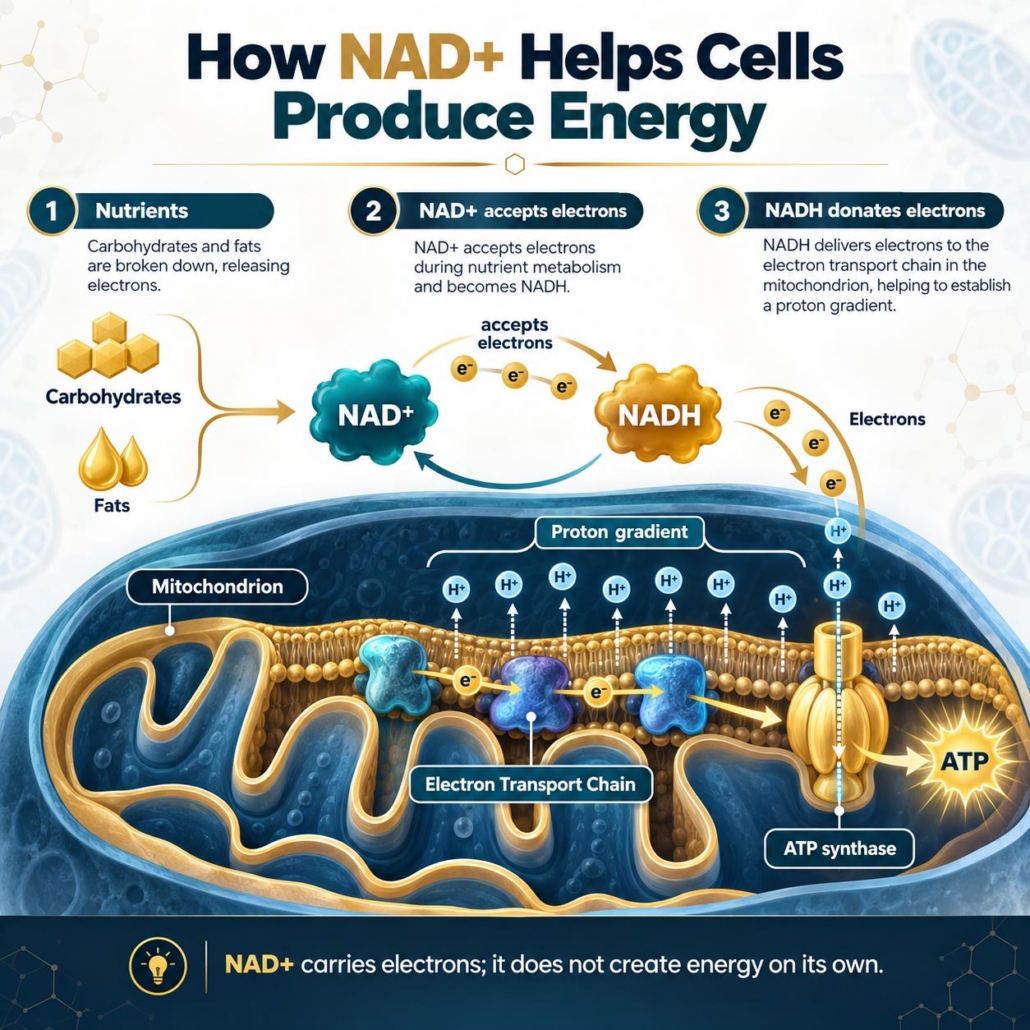
INFOGRAPHIC: How NAD+ Helps Cells Produce Energy

How NAD+ Helps Cells Produce Energy

Cells extract energy from carbohydrates, fats, and other nutrients through a series of linked reactions. NAD+ helps those reactions move forward by accepting electrons as nutrients are broken down. This converts NAD+ to NADH and captures some of the chemical energy released along the way.

In mitochondria, NADH transfers those electrons into the electron transport chain. Their movement through this system helps build a proton gradient across the inner mitochondrial membrane.

The cell uses that gradient to make ATP, its main immediately usable energy molecule. NAD+ therefore supports energy production by carrying electrons between metabolic steps; it does not create energy on its own.

The balance between NAD+ and NADH also helps cells regulate metabolism. Different tissues and cell compartments manage this balance in different ways, depending on their energy needs and the reactions underway. That makes NAD+ central to cellular energy flow.

NAD+ and the Cellular Response to Damage

NAD+ also supports cellular maintenance by serving as a substrate for enzymes that respond to stress or damage. One example is the poly(ADP-ribose) polymerase family, or PARPs.

When certain PARPs detect DNA damage, they use NAD+ to attach ADP-ribose units to proteins. This signaling helps organize the cell’s response and recruit components involved in DNA repair.

A second group, the sirtuins, also depends on NAD+. These enzymes modify proteins in ways that can influence gene activity, metabolism, and cellular stress responses. Researchers study sirtuins in aging biology because their activity connects nutrient and energy conditions with processes that help cells adapt.

These repair and adaptation processes use NAD+ differently from its electron-carrier role: enzymes consume NAD+ as they perform their work. That makes NAD+ availability relevant to both energy metabolism and cellular signaling. It also helps explain why researchers examine how production, recycling, and consumption of NAD+ change under conditions such as aging and cellular stress.

INFOGRAPHIC: NAD+ And The Cellular Response To Damage

Why NAD+ Availability May Matter More With Age

NAD+ availability depends on a continuing balance: cells must produce and recycle NAD+ while also using it in metabolic reactions and enzyme activity. Research suggests that this balance can shift with age. In some tissues and studies, NAD+ levels decline; the extent and pattern vary by tissue, species, and measurement method.

One possible contributor is increased NAD+ use during cellular stress and damage responses. For example, PARPs consume NAD+ as they participate in DNA damage signaling. Other enzymes, including CD38, also break down NAD+. Changes in NAD+ synthesis and recycling may contribute as well. Scientists are still investigating how much each process matters in different tissues and stages of aging.

This balance is one reason NAD+ metabolism has drawn interest as a healthy-aging research area. If a cell has less NAD+ available, that could affect processes that rely on it — from energy metabolism to repair and signaling. Supporting NAD+ metabolism is therefore a compelling strategy to investigate.

The NAD+ Longevity Network

NAD+ links several systems that are often discussed separately in healthy-aging research. As a coenzyme, it helps transfer electrons during nutrient metabolism.

As a substrate, it supports enzymes involved in DNA damage responses, protein regulation, and cell signaling. Together, these roles connect cellular energy with maintenance and adaptation.

Mitochondria sit at an important intersection. They use electrons carried by NADH to help produce ATP, while NAD+-dependent pathways can influence mitochondrial activity and cellular responses to stress.

Other processes, including DNA repair and immune signaling, also draw on NAD+ metabolism. This is why researchers view NAD+ as part of a broader cellular network rather than a single-purpose “energy molecule.”

The network creates a compelling rationale for studying ways to support NAD+ metabolism with age. The next question is whether interventions that change NAD+ measures also produce benefits people can feel or clinicians can measure.

INFOGRAPHIC: The NAD+ Longevity Network

What Ingredients Pair Well With NAD+ Strategies in Healthy Aging Formulas?

A complementary ingredient can give a formula a distinct purpose alongside NAD+ metabolism. The strongest rationale comes from matching each ingredient to a clear role and a realistic serving format — not from building the longest possible “longevity stack.”

Ingredient Potential role in a formula Formulation consideration
CoQ10 Connects the concept to mitochondrial electron transport and cellular energy metabolism. A biologically complementary ingredient, though combination-specific evidence should be checked before suggesting added benefit. A clinical trial in people with chronic kidney disease tested NR and CoQ10 as separate interventions, not as a combined formula.
Creatine Shifts the product story toward muscle energy and physical function. Its serving needs can make a powder more practical than a capsule. Treat the pairing as a product-development rationale unless a trial tests the actual combination.
Urolithin A Adds a distinct mitochondrial quality-control research angle. Evaluate the specific ingredient, dose, human evidence, and cost. Evidence for urolithin A alone does not establish an added benefit when paired with an NAD+ precursor.
Resveratrol or other polyphenols Offers a way to discuss cellular stress-response pathways alongside NAD+-dependent enzymes. Avoid implying that a mechanism or study of a specific combination establishes a general longevity benefit. Population and outcome matter.
B vitamins Provide nutritional context because vitamin B3 forms are used in NAD+ synthesis pathways. Include them to meet a defined formulation purpose; do not imply they are required to “activate” an NAD+ formula without supporting evidence.

For formulators, the practical sequence is straightforward: choose the intended outcome, select ingredients with distinct roles, and confirm that each can be delivered at a workable dose in the chosen format. The finished combination still needs its own rationale, quality controls, and claims review.

Market Trends for NAD+

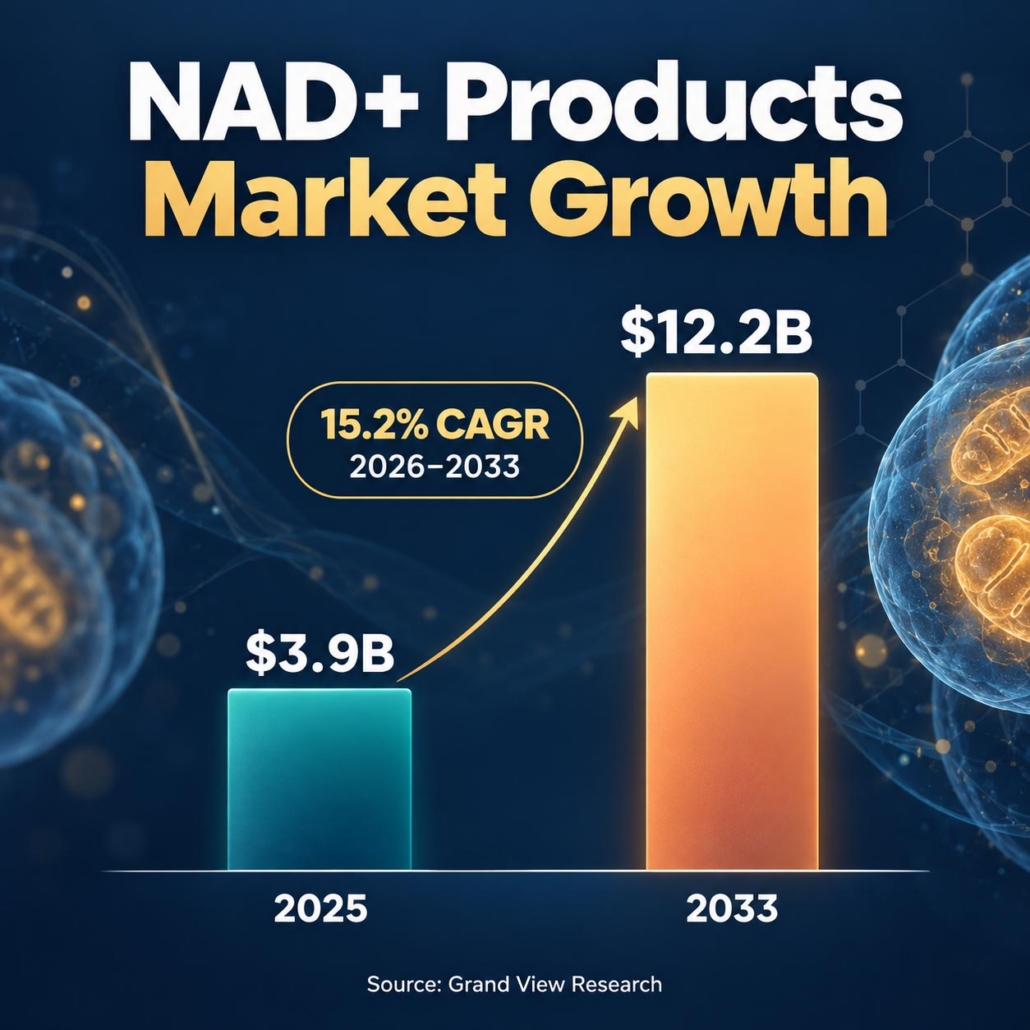
Grand View Research projects the global nicotinamide adenine dinucleotide products market will reach $12.2 billion by 2033, representing a forecast 15.2% compound annual growth rate from 2026 to 2033.

The forecast points to commercial interest in NAD+-related products. For supplement brands, the opportunity is to meet that interest with products that connect a clear consumer need to a credible ingredient strategy, workable dose, and evidence-aligned explanation.

A large projected market may attract new launches; durable differentiation will depend on how well a brand supports its product story from formulation through consumer education.

INFOGRAPHIC: NAD+ Products Market Growth

Selecting the Ingredient Format for NAD+

NAD+ products often use precursors such as nicotinamide riboside (NR) or nicotinamide mononucleotide (NMN). The selected form can affect the product’s dose, sensory profile, and format options, so brands should assess these factors early.

Match The Ingredient to The Format

Capsules can simplify development when a precursor has a challenging taste or when the intended serving fits comfortably into a solid dose form.

Powders allow more flexibility for larger or flavored servings, but they need sensory testing to determine whether bitterness, sharpness, or other notes come through. NR chloride, for example, has been described as bitter, which may make flavor masking important in powders or chewables.

Gummies and liquid products may require closer attention to stability. NR chloride can degrade in aqueous conditions, while NMN degradation in solution is influenced by temperature and pH. These findings don’t rule out moisture-containing formats; they make finished-product testing essential. Evaluate the chosen ingredient in the actual formula, manufacturing process, and package.

Flavor Can Affect Format Choice

NR chloride can have a sharp or bitter taste, creating a masking challenge in powders and chewable formats. That’s a practical reason capsules may be easier to develop, while a flavored powder or gummy may need sensory testing early in development. Supplier claims and consumer reviews suggest bitterness, but I’d treat those as formulation clues — not a substitute for controlled sensory evaluation.

Build Sensory & Stability Testing into Development

Capsules can simplify development when a precursor has a challenging taste or when the intended serving fits comfortably into a solid dose form. Powders allow more flexibility for larger or flavored servings, but they need sensory testing to determine whether bitterness, sharpness, or other notes come through. NR chloride, for example, has been described as bitter, which may make flavor masking important in powders or chewables.

Gummies and liquid products may require closer attention to stability. NR chloride can degrade in aqueous conditions, while NMN degradation in solution is influenced by temperature and pH. These findings don’t rule out moisture-containing formats; they make finished-product testing essential. Evaluate the chosen ingredient in the actual formula, manufacturing process, and package.

The Next Chapter in NAD+ Research

NAD+ matters because it helps cells turn nutrients into energy and supports enzymes involved in repair, signaling, and adaptation. These roles make NAD+ metabolism a compelling focus for healthy-aging research — and a promising foundation for new product concepts.

For brands, the opportunity is to translate that science into a clear, credible product strategy. Define the outcome first, then choose ingredients with distinct roles, workable doses, and a format that supports consistent use. A complementary mechanism can strengthen a formulation rationale, but it does not prove that a combination delivers greater benefits.

The next chapter will depend on human studies that connect changes in NAD+ measures to outcomes that matter in daily life. Until then, brands can build trust by explaining what their ingredients are designed to do, what the research has measured, and where questions remain. That approach gives NAD+ innovation room to advance while keeping product promises grounded in evidence.

Bring Your NAD+ Concept Into Focus

NAD+ science is creating new opportunities in healthy-aging product development. Turning that potential into a market-ready supplement takes thoughtful ingredient selection, a format that fits the dose and sensory profile, and testing that supports quality through shelf life.

Intermountain Nutrition partners with supplement brands on formulation, flavor development, scale-up, quality, and packaging across capsules, powders, stick packs, pouches, and gummies. Talk with our team about developing a healthy-aging product built for your brand and production goals.

Frequently Asked Questions

Nicotinamide adenine dinucleotide (NAD+) helps enzymes carry out essential reactions throughout the body. It accepts and transfers electrons as cells break down carbohydrates, fats, and other nutrients. NAD+ also serves as a substrate for enzymes involved in DNA damage responses, cell signaling, and regulation of protein activity. Together, these roles connect NAD+ with energy metabolism and cellular maintenance.

NAD+ is the oxidized form of nicotinamide adenine dinucleotide, while NADH is its reduced form. NAD+ accepts electrons during metabolic reactions and becomes NADH. NADH can then donate those electrons in other reactions, including steps that help mitochondria produce ATP, the cell’s main immediately usable energy molecule. Cells continually convert NAD+ into NADH and back again.

Researchers study NAD+ in healthy aging because it supports processes linked to cellular energy, repair, and adaptation. Studies have reported age-related changes in NAD+ availability in some tissues, raising questions about how those shifts affect cell function. This biology makes NAD+ metabolism a promising area of research, although it does not by itself show that increasing NAD+ improves health or slows aging.

Some studies have found lower NAD+ levels with age, but the pattern is not uniform. Findings can differ by tissue, population, and measurement method, and researchers continue to investigate why levels change. Both NAD+ production and recycling, as well as its use by cellular enzymes, may contribute. A change in one tissue or blood measurement does not necessarily describe NAD+ status throughout the body.

Human studies have not established that NAD+ supplements slow aging or extend lifespan. Some NAD+ precursors can change NAD-related measures, but evidence for consistent improvements in outcomes such as physical function, cognition, or metabolic health remains limited. Longer, well-designed trials are needed to determine which interventions may provide meaningful benefits for particular groups of people.

Nicotinamide riboside (NR) and nicotinamide mononucleotide (NMN) are compounds studied as precursors in NAD+ metabolism. The body uses vitamin B3 forms and related compounds in pathways that produce and recycle NAD+. Human trials have examined whether NR and NMN affect NAD-related measures, safety, and health outcomes. Results can vary with the dose, study duration, participant group, and outcome measured.

Ingredients such as CoQ10, creatine, urolithin A, and polyphenols may complement different healthy-aging formulation concepts. CoQ10 can support a cellular-energy story, while creatine may fit a product focused on muscle function. Urolithin A and some polyphenols connect to separate areas of mitochondrial and cellular-stress research. These rationales do not establish that an ingredient combination produces added benefits; evidence for the finished formula and its intended outcome matters.

Brands should begin by defining the outcome and audience for the product, then evaluate whether each ingredient has a distinct role and relevant evidence at the planned dose. The chosen format must deliver a practical serving while meeting requirements for taste, stability, and production. Teams should also verify ingredient identity and quality, and ensure product information and marketing claims match what the research actually tested.

References

NAD+ Biology and Aging

Chini, C. C. S., Cordeiro, H. S., Tran, N. L., et al. (2024). NAD metabolism: Role in senescence regulation and aging. Aging Cell, 23(1), e13920.

Cambronne, X. A., & Kraus, W. L. (2020). Location, location, location: Compartmentalization of NAD+ synthesis and functions in mammalian cells. Trends in Biochemical Sciences, 45(10), 858–873.

Kulkarni, C. A., & Brookes, P. S. (2019). Cellular compartmentation and the redox/nonredox functions of NAD+. Antioxidants & Redox Signaling, 31(9), 623–642.

Xie, N., Zhang, L., Gao, W., et al. (2020). NAD+ metabolism: Pathophysiologic mechanisms and therapeutic potential. Signal Transduction and Targeted Therapy, 5, 227.

Covarrubias, A. J., Perrone, R., Grozio, A., & Verdin, E. (2021). NAD+ metabolism and its roles in cellular processes during ageing. Nature Reviews Molecular Cell Biology, 22, 119–141.

Imai, S., & Guarente, L. (2016). NAD+ and sirtuins in aging and disease. Trends in Cell Biology, 26(12), 1003–1014.

Human Evidence and Clinical Research

Gallagher, C., & Emmanuel, O. O. (2026). NAD+ supplementation for anti-aging and wellness: A PRISMA-guided systematic review of preclinical and clinical evidence. Ageing Research Reviews, 116, 103057.

Dollerup, O. L., Christensen, B., Svart, M., et al. (2023). Randomized crossover clinical trial of coenzyme Q10 and nicotinamide riboside in chronic kidney disease. JCI Insight, 8(11), e167274.

Ingredient Stability and Format Considerations

Campbell, M. T. D., Jones, D. S., Andrews, G. P., & Li, S. (2019). Understanding the physicochemical properties and degradation kinetics of nicotinamide riboside, a promising vitamin B3 nutritional supplement. Food & Nutrition Research, 63, 3419.

Zhang, Y., et al. (2024). Degradation kinetics of β-nicotinamide mononucleotide based on reliable HPLC quantitative method. China Journal of Chinese Materia Medica.

Market Data

Grand View Research. (2026). Nicotinamide adenine dinucleotide products market size, share & trends analysis report, 2026–2033.

Related Postings

older couple walking in the park during autumn
three friends discussing and researching supplements for health and wellness
Blue Spirulina for Antioxidant Supplements