Black Seed Oil: Ancient Wellness Ingredient, Modern Market Opportunity

September 21, 2026 |

Why supplement brands are rediscovering one of the world’s oldest wellness ingredients — and what its long history, modern research, and growing popularity reveal about the future of everyday health and wellness.

At a Glance

  • Black seed oil is derived from Nigella sativa, a flowering plant native to Southwest Asia and the Mediterranean region.
  • The ingredient has been used for more than 2,000 years in traditional wellness systems, including Egyptian, Ayurvedic, and Unani medicine.
  • Thymoquinone is considered one of black seed oil’s most important bioactive compounds.
  • Consumer interest in botanical ingredients continues to rise, particularly among shoppers seeking natural wellness solutions.
  • Black seed oil is increasingly being positioned for immune health, metabolic wellness, healthy aging, beauty-from-within, and holistic wellness applications.
  • The ingredient offers compelling storytelling opportunities because of its rich cultural history and growing body of scientific research.
  • Formulators should pay close attention to standardization, oxidation stability, sourcing quality, and sensory considerations.
  • Black seed oil may offer supplement brands a versatile ingredient platform that supports multiple product categories and consumer audiences.

Why Black Seed Oil Matters Today

Few botanical ingredients can claim thousands of years of continuous use while simultaneously attracting growing interest from modern researchers, formulators, and consumers. Black seed oil, derived from Nigella sativa, is one of those rare exceptions.

For centuries, cultures throughout the Middle East, North Africa, Asia, and the Mediterranean have used black seed oil as part of traditional wellness practices. Today, however, supplement brands are looking at the ingredient through a different lens.

Increasingly, they view black seed oil as a versatile, science-supported ingredient capable of supporting multiple product categories, from immune health and healthy aging to beauty, metabolic wellness, and holistic lifestyle formulations.

As consumers continue to seek natural ingredients with authentic stories and modern scientific backing, black seed oil occupies a unique position in the nutraceutical market. It offers both historical credibility and emerging clinical interest, making it attractive for premium supplement brands seeking differentiation.

For supplement companies evaluating future product opportunities, black seed oil represents more than an ingredient trend. Instead, it may serve as a platform ingredient capable of supporting multiple wellness strategies and product lines.

The History of Black Seed Oil

The story of black seed oil begins thousands of years ago. Although many botanical ingredients have traditional roots, few possess the historical depth associated with Nigella sativa.

Archaeological discoveries suggest black seeds were used in ancient Egypt, including reports that seeds were found in the tomb of King Tutankhamun. Historians believe the ingredient held cultural and medicinal significance within Egyptian society, where botanical remedies were commonly used to support wellness and vitality.

INFOGRAPHIC: The History Of Black Seed Oil

Black Seed in Middle Eastern Traditions

Meanwhile, black seed spread throughout the Middle East, where it became deeply integrated into traditional health practices. Historical texts reference the seed as a valuable botanical ingredient, contributing to its enduring reputation across generations.

Black Seed in South Asian Medicine

In South Asia, practitioners of Ayurveda incorporated Nigella sativa into various traditional preparations. Likewise, practitioners of Unani medicine recognized black seed as an important component within their holistic approach to health and wellness.

The Expansion of Black Seed’s Popularity

As trade routes expanded across regions, so did the popularity of black seed. The ingredient gained recognition throughout North Africa, Europe, and Asia, becoming one of the most widely known traditional botanicals in several cultures.

Why Black Seed Has Endured

What makes black seed particularly remarkable is its longevity. Many historical ingredients disappear over time as consumer preferences evolve. Black seed oil, however, has maintained relevance for centuries. Today, modern science is helping researchers explore why this botanical has remained a trusted wellness ingredient across such diverse populations.

For supplement brands, this historical legacy provides more than an interesting story. It offers authenticity, cultural relevance, and a compelling narrative that resonates with consumers seeking ingredients rooted in tradition.

Key Takeaway: Black seed oil’s extraordinary history creates a powerful foundation for modern supplement brands seeking ingredients with both cultural credibility and contemporary relevance.

Why Black Seed Oil Is Gaining Attention Again

Several forces are converging to drive renewed interest in black seed oil.

Growing Demand for Natural Wellness Solutions

First, consumers increasingly favor natural wellness solutions. According to market research, shoppers continue to prioritize botanical ingredients, particularly those associated with traditional use and holistic wellness philosophies.

Increasing Consumer Education

Second, consumers are becoming more educated. Rather than simply looking for trending ingredients, many now seek products that combine historical use with scientific investigation. Black seed oil fits that preference exceptionally well.

Rising Interest in Multifunctional Ingredients

Third, multifunctional ingredients have become increasingly attractive to formulators. Instead of developing products around a single health concern, many brands are creating broader wellness solutions capable of supporting multiple consumer goals.

Emphasis on Preventive Wellness

Additionally, consumers continue to embrace preventive wellness strategies. Rather than waiting to address health concerns, many seek products that support long-term health, resilience, and healthy aging.

Influence of Social Media & Wellness Education

Finally, the growth of social media, wellness influencers, and educational content has increased awareness of heritage ingredients. Black seed oil’s rich history and unique story make it particularly well positioned within this environment.

Black Seed Oil’s Expanding Role in Botanical Wellness

As a result, black seed oil has moved from a traditional ingredient into a broader discussion about the future of botanical wellness products.

Key Takeaway: Black seed oil aligns with several major consumer trends, including natural wellness, preventive health, heritage ingredients, and multifunctional product development.

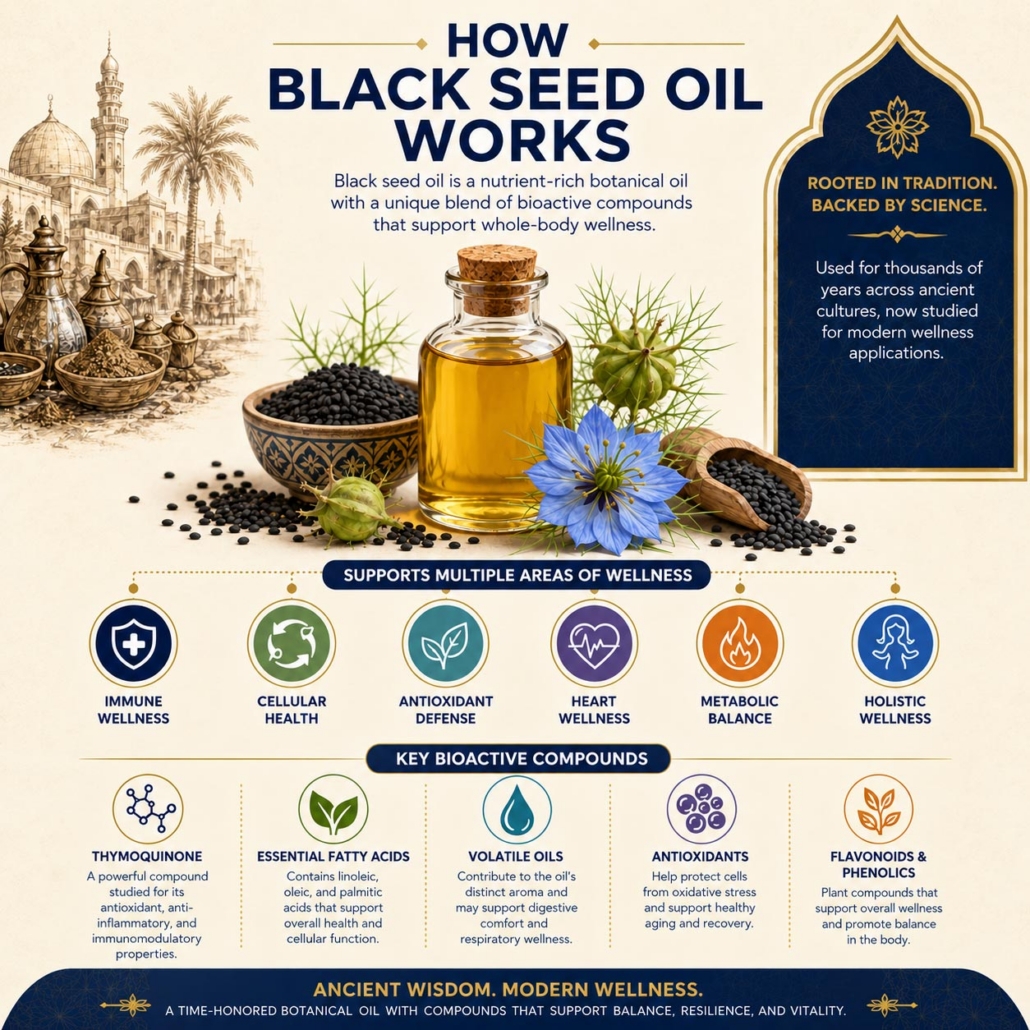
How Black Seed Oil Works

Black Cumin  |  Black Cumin Seed Oil  |  Nigella Oil  |  Kalonji Oil  |  Black Caraway  |  Fennel Flower  |  Roman Coriander   |  Seed of Blessing

Black seed oil contains a complex mixture of bioactive compounds that contribute to its growing scientific interest.

Among these compounds, thymoquinone receives the most attention from researchers. Thymoquinone is a naturally occurring phytochemical found within Nigella sativa seeds and is believed to contribute significantly to the ingredient’s biological activity.

In addition to thymoquinone, black seed oil contains:

  • Essential fatty acids
  • Volatile oils
  • Alkaloids
  • Flavonoids
  • Phenolic compounds
  • Antioxidant constituents

Together, these compounds create a multifaceted phytochemical profile that distinguishes black seed oil from many single-compound ingredients.

Multiple Wellness Benefits

Researchers continue to investigate how these constituents interact with biological pathways associated with oxidative stress, cellular health, metabolic function, and immune system activity.

Although research remains ongoing, interest in these mechanisms has expanded significantly over the past decade.

From a formulation perspective, black seed oil’s value lies in its ability to support multiple wellness narratives simultaneously.

Rather than relying on a single functional benefit, brands can position black seed oil within broader wellness strategies focused on resilience, balance, and long-term health.

This versatility helps explain why black seed oil is appearing in an increasingly diverse range of supplement formulations.

Key Takeaway: Black seed oil’s broad phytochemical profile, led by thymoquinone, supports growing scientific interest and contributes to its appeal as a multifunctional wellness ingredient.

INFOGRAPHIC: How Black Seed Oil Works

Beyond Immune Support

Why Black Seed Oil Is Becoming a Multi-Category Ingredient for Modern Supplement Brands

Historically, black seed oil has often been associated with immune wellness. While that category remains important, today’s supplement market presents a much larger opportunity.

Increasingly, formulators are recognizing black seed oil as a versatile ingredient capable of supporting multiple product categories.

Black Seed Oil For Immunity Supplement Formulations

Healthy Aging

Healthy aging continues to be a major focus for consumers across multiple generations.

Rather than concentrating solely on lifespan, many consumers now prioritize healthspan—the ability to remain active, resilient, and engaged throughout life. Consequently, ingredients associated with antioxidant activity and cellular wellness are receiving greater attention.

Black seed oil aligns naturally with this evolving healthy-aging narrative.

Black Seed Oil For Immunity Supplement Formulation

Sports Recovery

Athletes and active consumers increasingly favor natural ingredients that support recovery, resilience, and long-term performance goals.

Consequently, botanical ingredients are appearing in more active lifestyle formulations than ever before. Black seed oil’s broad wellness profile makes it a potential complement to recovery-focused product concepts.

Black Seed Oil For Immunity Supplement Formulation

Women’s Wellness

Women’s health remains one of the most dynamic opportunities within the nutraceutical industry.

Consumers increasingly seek natural solutions that support wellness throughout different life stages. Black seed oil’s long history of traditional use contributes to growing interest within women’s wellness formulations.

Black Seed Oil for Immunity Supplement Formulation

Metabolic Wellness

Metabolic health has become one of the fastest-growing segments within the supplement industry.

Consumers are increasingly interested in maintaining healthy blood sugar levels, supporting healthy body composition, and promoting overall metabolic resilience. As scientific interest in black seed oil expands, many brands are exploring opportunities within this rapidly growing category.

For brands seeking alternatives to heavily saturated metabolic ingredients, black seed oil may offer a compelling point of differentiation.

Black Seed Oil For Immunity Supplement Formulations

Immune Health

Immune support remains one of the most established applications for black seed oil.

Consumers already associate black seed oil with wellness maintenance, making it a natural fit within immune-focused formulations.

Furthermore, demand for immune support products remains elevated compared to pre-pandemic levels, creating continued opportunities for botanical ingredients with strong consumer recognition.

Black Seed Oil For Immunity Supplement Formulations

Beauty From Within

Nutricosmetics remains one of the fastest-growing areas within the supplement market.

Consumers increasingly understand that beauty outcomes may be influenced by nutrition, lifestyle, and overall wellness. As a result, brands are looking for ingredients capable of supporting comprehensive beauty-from-within strategies.

Black seed oil’s antioxidant profile and wellness positioning make it a potential candidate for innovative beauty formulations.

Holistic Wellness Formulations

Perhaps the greatest opportunity lies within holistic wellness.

Consumers no longer view health through isolated categories. Instead, they increasingly seek products that support overall well-being, balance, and quality of life.

Because black seed oil naturally bridges multiple categories, it fits exceptionally well within this emerging wellness framework.

Key Takeaway: Black seed oil is evolving from a traditional immune-support ingredient into a versatile platform ingredient capable of supporting multiple product categories and consumer needs.

Market Trends Driving Black Seed Oil Demand

Black seed oil’s resurgence is not happening in isolation. Instead, it reflects several broader shifts occurring across the global supplement industry.

Consumers increasingly seek products that align with a proactive approach to health. At the same time, botanical ingredients continue to gain momentum as consumers seek natural alternatives that complement healthy lifestyles.

Rising Expectations for Ingredient Quality

Additionally, consumers are becoming more selective about ingredient quality. Rather than choosing products based solely on price, many now evaluate ingredient sourcing, scientific support, transparency, and authenticity. Black seed oil performs well across these criteria because it combines a rich historical narrative with a growing body of scientific investigation.

Opportunities in Healthy Aging

Healthy aging represents another major opportunity. The global population continues to age, while younger consumers are becoming increasingly interested in longevity and preventative wellness. Consequently, ingredients associated with cellular wellness, antioxidant support, and long-term vitality are attracting growing attention.

Expansion of Beauty-from-Within

Furthermore, the beauty-from-within category continues to expand. Consumers increasingly recognize the connection between nutrition, wellness, and appearance. This trend creates additional opportunities for ingredients that fit both wellness and beauty narratives.

Growth in Herbal Supplements

The global herbal supplement market is projected to experience significant growth throughout the coming decade. Grand View Research estimates the herbal supplements market will exceed $100 billion globally before 2030, driven by increasing consumer preference for plant-based wellness solutions.

Demand for Multifunctional Supplements

Another trend supporting black seed oil is the rise of multifunctional supplements. Consumers increasingly prefer products that address multiple wellness goals simultaneously. As a result, brands are moving away from narrowly focused formulations and toward ingredients that can support broader wellness positioning.

Favorable Conditions for Innovation

For supplement brands, these converging trends create favorable conditions for black seed oil innovation. Rather than competing in a single category, brands can leverage black seed oil across multiple product platforms and consumer segments.

Key Takeaway: Black seed oil aligns with several powerful industry trends, including botanical wellness, healthy aging, preventive health, multifunctional supplements, and beauty-from-within formulations.

INFOGRAPHIC: Black Seed Oil Market Growth Outlook
INFOGRAPHIC: Broader Black Seed Oil Growth Outlook

Key Ingredients & Synergistic Pairings

Although black seed oil can function as a standalone ingredient, many brands achieve greater differentiation by combining it with complementary actives.

Ingredient Scientific Name Why It Pairs Well
Curcumin Curcuma longa Supports antioxidant-focused wellness positioning.
Ginger Zingiber officinale Creates a traditional botanical wellness blend.
Boswellia Boswellia serrata Commonly used in healthy aging and active lifestyle products.
Vitamin D3 Cholecalciferol Popular pairing in immune-support formulations.
Omega-3s EPA/DHA Supports comprehensive wellness positioning.
Ashwagandha Withania somnifera Complements stress and holistic wellness products.
Berberine Berberis aristata Frequently included in metabolic wellness formulations.
Quercetin Quercetin Popular in advanced botanical wellness formulas.
CoQ10 Coenzyme Q10 Supports healthy aging and active lifestyle concepts.
Magnesium Various forms Expands wellness and recovery positioning opportunities.

Flavoring & Sensory Experience

Like many botanical oils, black seed oil presents unique sensory challenges that formulators should address early in development.

The oil typically exhibits a peppery, earthy, slightly bitter flavor profile. Some consumers appreciate these characteristics because they reinforce perceptions of authenticity. However, others may find the taste unfamiliar or challenging.

Because of this sensory profile, delivery format selection becomes particularly important.

Capsules

Capsules remain one of the most common delivery formats because they effectively mask flavor while improving consumer compliance.

Powders

Powder applications may require advanced flavor systems, carrier ingredients, and careful ingredient selection to minimize bitterness and maintain consumer acceptance.

Flavor Profiles

Black seed oil often benefits from complementary flavor profiles such as:

  • Vanilla
  • Cinnamon
  • Chai spices
  • Cocoa
  • Honey-inspired flavors
  • Warm botanical blends

Consumer Expectations

Consumers purchasing black seed oil products often expect some degree of botanical character. Therefore, the goal is typically flavor management rather than complete flavor elimination.

Key Takeaway: Successful black seed oil products balance ingredient authenticity with consumer-friendly sensory experiences.

Formulation Considerations for Supplement Brands

The goal when formulating with black seed oil is to maximize quality, consistency, consumer acceptance, and shelf stability while preserving the ingredient’s unique characteristics.

Thymoquinone Standardization

  • Standardization helps create consistency across production lots.
  • Suppliers may offer varying thymoquinone concentrations.
  • Brands should define target specifications early in development.
  • Standardization can support product positioning and quality assurance efforts.

Sensory Management

  • Flavor masking may be required for certain delivery formats.
  • Product developers should evaluate bitterness, aroma, and aftertaste.
  • Consumer testing can help optimize acceptance.

Ingredient Authentication

  • Botanical verification is critical for maintaining consumer trust.
  • Supplier qualification programs should include identity testing.
  • Documentation should confirm species authenticity and quality standards.

Shelf Stability

  • Stability programs should evaluate potency retention over time.
  • Temperature and humidity conditions should reflect real-world storage environments.
  • Accelerated and real-time stability testing help establish product shelf life.

Oxidation Protection

  • Black seed oil contains fatty acids that may be vulnerable to oxidation.
  • Antioxidant systems may help protect product quality.
  • Packaging selection plays a critical role in maintaining freshness.
  • Oxygen exposure should be minimized throughout manufacturing.

Manufacturing Consistency

  • Oil quality can vary significantly among suppliers.
  • Standard operating procedures should define acceptable quality parameters.
  • Batch-to-batch consistency remains essential for long-term brand success.

On-Site Third-Party Testing

At Intermountain Nutrition, quality verification remains a critical component of product development. Comprehensive testing programs help support ingredient integrity, manufacturing consistency, and customer confidence.

Key Takeaway: Successful black seed oil products depend on thoughtful sourcing, standardization, stability planning, sensory management, and quality control.

Strategic Opportunities for Supplement Brands

As competition intensifies across the supplement industry, brands increasingly need ingredients that deliver both differentiation and consumer relevance.

Black seed oil offers a compelling opportunity because it combines three attributes rarely found in a single ingredient:

  • Historical credibility
  • Scientific interest
  • Multifunctional market potential

Many supplement categories have become crowded with similar formulations and repeated ingredient combinations. Consequently, brands that introduce unique but recognizable ingredients often gain a competitive advantage.

Black seed oil supports this strategy particularly well. It allows companies to leverage a powerful historical narrative while participating in several high-growth categories simultaneously.

For example, brands can position black seed oil within:

  • Immune wellness products
  • Healthy aging formulas
  • Women’s wellness solutions
  • Beauty-from-within supplements
  • Metabolic wellness products
  • Active lifestyle formulations
  • Holistic wellness programs

Additionally, black seed oil’s premium positioning potential may support stronger product differentiation and higher perceived value.

Looking ahead, consumers will likely continue seeking products that combine authenticity, transparency, and scientific credibility. Ingredients that satisfy all three requirements may be especially well positioned for long-term success.

Nigella Sativain Supplement Formulation

Black Seed Oil Formulation

For brands exploring next-generation botanical opportunities, black seed oil represents more than a trending ingredient. It represents a versatile platform capable of supporting multiple product categories while delivering a compelling story consumers can understand and trust.

At Intermountain Nutrition, we help supplement brands evaluate ingredient opportunities, develop differentiated formulations, and bring innovative wellness products to market with confidence.

Whether you are exploring a standalone black seed oil product or a more advanced botanical blend, our team can help navigate formulation, manufacturing, quality, and commercialization considerations.

Ready to explore black seed oil opportunities? Contact Intermountain Nutrition to discuss custom formulation and manufacturing solutions.

Frequently Asked Questions

Black seed oil is a botanical oil extracted from the seeds of Nigella sativa, a flowering plant native to Southwest Asia, the Middle East, and parts of the Mediterranean region. The ingredient has been used for thousands of years in traditional wellness systems and is commonly known by several names, including black cumin seed oil, nigella oil, kalonji oil, and black caraway.

Today, black seed oil is increasingly used in dietary supplements, functional wellness products, personal care applications, and beauty-from-within formulations. Much of the ingredient’s scientific interest centers around thymoquinone, one of its most researched bioactive compounds. However, black seed oil also contains fatty acids, volatile oils, antioxidants, and other phytochemicals that contribute to its broad wellness positioning.

For supplement brands, black seed oil offers a unique combination of historical credibility, consumer recognition, and emerging scientific interest, making it an increasingly attractive ingredient for premium formulations.

Supplement brands are increasingly interested in black seed oil because it aligns with several major consumer trends simultaneously. Consumers continue to seek natural wellness solutions, botanical ingredients, heritage-based products, and formulations supported by both traditional use and modern scientific investigation.

Additionally, black seed oil offers strong versatility. Rather than fitting into a single category, it can support product concepts focused on immune wellness, healthy aging, beauty-from-within, metabolic health, women’s wellness, active lifestyles, and holistic health positioning.

The ingredient also provides a compelling marketing narrative. Consumers are often drawn to ingredients with authentic histories, cultural significance, and recognizable stories. Black seed oil’s thousands of years of traditional use help differentiate it from many newer wellness ingredients that lack the same historical foundation.

As competition increases across the supplement industry, ingredients that combine storytelling, flexibility, and scientific relevance may offer valuable opportunities for brand differentiation.

Thymoquinone is one of the primary bioactive compounds naturally found in Nigella sativa seeds and black seed oil. It has become the focus of significant scientific interest because researchers believe it may contribute to many of the biological activities associated with black seed oil.

From a formulation perspective, thymoquinone often serves as an important quality marker. Some ingredient suppliers offer standardized black seed oil ingredients with defined thymoquinone concentrations, helping support consistency across manufacturing lots.

Because black seed oil contains numerous naturally occurring compounds, thymoquinone should not necessarily be viewed as the ingredient’s only important constituent. However, it remains one of the most widely studied and discussed compounds within the category.

As scientific research continues to evolve, thymoquinone will likely remain a central topic in conversations surrounding black seed oil quality, standardization, and formulation strategies.

Black seed oil works particularly well in categories that emphasize holistic wellness, natural ingredients, and multifunctional health support. Although immune support remains one of the most established applications, the ingredient is increasingly appearing in a much wider range of product concepts.

Some of the most promising categories include:

  • Immune wellness
  • Healthy aging
  • Beauty-from-within
  • Women’s wellness
  • Metabolic wellness
  • Active lifestyle products
  • Daily wellness supplements
  • Botanical wellness blends

Because black seed oil naturally supports multiple wellness narratives, it allows brands to create broader positioning strategies rather than focusing exclusively on a single health objective.

This flexibility may help brands maximize product differentiation while appealing to consumers who increasingly view wellness through a comprehensive lifestyle lens.

Like many botanical oils, black seed oil presents several important formulation considerations that should be addressed during product development.

One of the most significant concerns involves oxidation stability. Because the oil contains fatty acids and sensitive compounds, manufacturers must carefully manage oxygen exposure, packaging selection, and stability protocols.

Flavor is another important consideration. Black seed oil possesses a naturally earthy, peppery, and somewhat bitter profile. While some consumers associate this flavor with authenticity, others may prefer encapsulated formats that minimize sensory exposure.

Ingredient sourcing also plays a critical role. Quality can vary substantially among suppliers, making identity testing, supplier qualification, standardization, and quality verification essential components of product development.

Finally, brands should evaluate thymoquinone content, stability requirements, and batch-to-batch consistency when selecting ingredient partners.

Increasingly, the answer appears to be yes.

Although black seed oil has long been associated with immune wellness, supplement brands are now exploring much broader applications. Consumer interest in multifunctional products continues to rise, creating opportunities for ingredients that support multiple wellness narratives simultaneously.

Today, black seed oil appears in formulations targeting healthy aging, beauty-from-within, metabolic wellness, active lifestyles, and general wellness support. This broader positioning reflects changing consumer expectations as people increasingly seek products that support overall quality of life rather than isolated health concerns.

For supplement brands, this evolution may represent one of black seed oil’s greatest strengths. Instead of being limited to a single category, the ingredient can function as a versatile platform for innovation across several rapidly growing wellness segments.

References

Botanical Background, History, and Traditional Use

Salehi, B., et al. (2021). Nigella plants—Traditional uses, bioactive phytoconstituents, preclinical and clinical studies. Frontiers in Pharmacology, 12, 625386.

Ahmad, A., et al. (2013). A review on therapeutic potential of Nigella sativa: A miracle herb. Asian Pacific Journal of Tropical Biomedicine, 3(5), 337–352.

Yimer, E. M., et al. (2019). Nigella sativa L. (Black Cumin): A promising natural remedy for wide range of illnesses. Evidence-Based Complementary and Alternative Medicine, 2019, 1528635.

Hannan, M. A., et al. (2021). Nigella sativa L.: Uses in traditional and contemporary medicines—An overview. Acta Ecologica Sinica, 41(4), 253–258.

Bioactive Compounds, Mechanisms, and Clinical Evidence

Gholamnezhad, Z., et al. (2016). Preclinical and clinical effects of Nigella sativa and its constituent, thymoquinone: A review. Journal of Ethnopharmacology, 190, 372–386.

Tavakkoli, A., et al. (2017). Review on clinical trials of black seed (Nigella sativa) and its active constituent, thymoquinone. Journal of Pharmacopuncture, 20(3), 179–193.

Li, Z., et al. (2023). Nigella sativa and health outcomes: An overview of systematic reviews and meta-analyses. Frontiers in Nutrition, 10, 1107750.

Usmani, A., & Almoselhy, R. I. M. (2024). Current trends in Nigella sativa L. (Black seed) from traditional to modern medicine with advances in extraction, formulation, quality control, regulatory status, and pharmacology. International Journal of Pharmaceutical Chemistry and Analysis, 11(1), 11-24.

Market Size, Growth, and Commercial Opportunity

Grand View Research. (2026). Black Seed Oil Market Size, Share & Trends Analysis Report, 2025–2030.

Precedence Research. (2025). Nigella Sativa Extract Market Size, Share and Trends 2025–2034.

Industry Context and Emerging Interest

Adrien, C. (2026, May 11). Not a one-condition remedy: The legacy and promise of ‘blessed’ black seed oil. NutraIngredients.

Related Postings

Synbiotic Supplements for Seasonal Wellness + Immune Support
Andrographis for Immunity Support Supplements