Creatine for Women: The Market Opportunity Supplement Brands Are Missing

May 30, 2026 |

Creatine is no longer just a sports nutrition ingredient. It is becoming one of the most important opportunities in women’s health, healthy aging, cognitive wellness, and active lifestyle formulations.

At a Glance

  • Creatine is one of only two ingredients in the women’s supplement space exceeding 100,000 monthly U.S. searches.
  • According to CPG Radar data reported by NutraIngredients, creatine drives 253,000 monthly U.S. searches and is growing 155.5% year over year.
  • Social media analysis shows that 76% of relevant female creatine discussion centers on menopause and perimenopause.
  • The highest-volume searches, “creatine for females” and “creatine for women,” each generate 110,000 monthly searches.
  • Consumer expectations are shifting from muscle and performance toward brain function, energy, validation, sleep, recovery, and aging well.
  • The demand signal is already larger than many brands realize.

Why Creatine Is Becoming a Women’s Wellness Ingredient

For decades, creatine was positioned almost exclusively for athletes, bodybuilders, and performance-focused consumers. However, new market data suggests that this legacy positioning no longer matches consumer demand.

According to a NutraIngredients guest column by Afif Ghannoum, CEO of CPG Radar, creatine is now one of the largest untapped opportunities in women’s wellness. Across 544 ingredients analyzed in the women’s supplement space, only two ingredients exceeded 100,000 monthly U.S. searches: creatine and D-Mannose. Creatine generated 253,000 monthly searches and showed 155.5% year-over-year growth.

Anticipated Creatine Growth

That growth is especially notable because many established women’s wellness ingredients, including collagen, magnesium, and maca, were contracting in the same dataset. Creatine was also one of only seven ingredients showing more than 100% growth, and it was the only one operating at meaningful commercial scale.

For supplement brands, this matters. Creatine is not just gaining attention. It is gaining attention at scale, in a category where many brands still use outdated messaging.

The Buyer the Data Reveals

The creatine buyer many brands imagine is not the buyer showing up in the data.

According to the CPG Radar analysis, 76% of relevant social media discussion around female creatine appears in menopause and perimenopause conversations. This suggests that the dominant buyer is often a midlife woman, generally between ages 40 and 65, navigating changes in cognition, energy, strength, recovery, body composition, and overall vitality.

However, her search behavior does not always reveal that life stage. The two highest-volume queries, “creatine for females” and “creatine for women,” each generate 110,000 monthly searches. Menopause-specific searches are smaller, but they reveal more intent.

This creates a strategic challenge. If brands only optimize for broad “creatine for women” discovery terms, they may miss the emotional relevance of the menopause conversation. However, if they only focus on menopause messaging, they may miss high-volume category discovery.

The strongest strategy may combine both.

Key Takeaway

Women are searching broadly, but many are buying personally. Brands need both SEO visibility and life-stage relevance.

How Creatine Works for Women’s Health Positioning

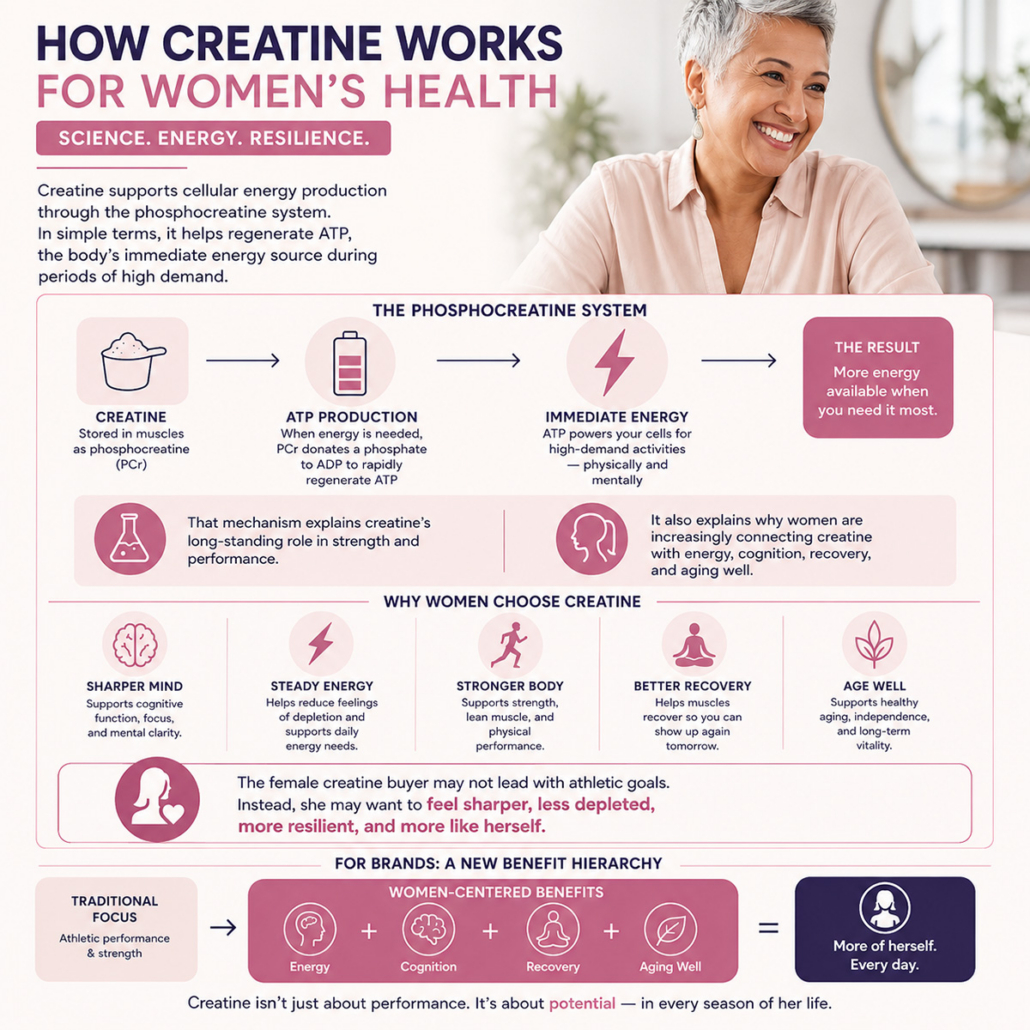
Creatine supports cellular energy production through the phosphocreatine system. In simple terms, it helps regenerate ATP, the body’s immediate energy source during periods of high demand.

That mechanism explains creatine’s long-standing role in strength and performance. However, it also explains why women are increasingly connecting creatine with energy, cognition, recovery, and aging well.

The female creatine buyer may not lead with athletic goals. Instead, she may want to feel sharper, less depleted, more resilient, and more like herself.

For brands, this reframes the product benefit hierarchy.

Creatine For Women Infographic

The Creatine Product Benefit Hierarchy

Consumer Priority Strategic Messaging Opportunity
Cognitive clarity Brain health, focus, daily mental performance
Energy restoration Daily vitality and fatigue support
Strength and recovery Active lifestyle and muscle support
Bone and aging support Healthy aging and longevity positioning
Trust and clarity Dosing, safety, and clinical authority

Market Trends: Why This Category Is Accelerating

Creatine’s growth is not happening in isolation. It is part of a broader shift toward women’s health, active aging, menopause support, and science-backed daily wellness.

The NutraIngredients article also highlights the role of media in accelerating demand. Brain-specific framing in creatine podcast titles nearly doubled between 2024 and 2026. In 2025 alone, 469 podcast episodes addressed creatine, which was more than the previous decade combined.

That matters because consumers often arrive at product listings already educated by podcasts, practitioners, influencers, and peer communities. They may not need brands to convince them that creatine is worth trying. Instead, they need a brand they trust to deliver it clearly, safely, and effectively.

This creates a different conversion challenge. Brands must not simply explain what creatine is. They must answer the buyer’s next questions:

  • How much should I take?
  • When should I take it?
  • Will it make me bloated?
  • Is it safe for kidneys?
  • Will it affect hair loss?
  • How long before I notice results?
  • Is this product genuinely formulated for women, or just packaged for women?

Key Takeaway

The market is being shaped by education-first media, not traditional supplement marketing. Brands that answer real consumer questions will earn trust faster.

Comparison Chart: Traditional vs. Female-Focused Creatine Positioning

ELEMENT TRADITIONAL CREATINE POSITIONING EMERGING WOMEN’S WELLNESS POSITIONING
Primary consumer Male athlete or bodybuilder Midlife woman, active adult, wellness consumer
Main benefit Muscle growth and performance Brain function, energy, strength, recovery, aging well
Messaging tone Performance-driven Reassuring, educational, science-forward
Purchase trigger Training goals Life-stage changes, fatigue, clarity, resilience
Common objection Taste or mixability Safety, bloating, hair loss, “will it work for me?”
Product trust driver Brand reputation Clinical authority, dosing clarity, realistic expectations
Format opportunity Bulk powder Stick packs, flavored powders, blends, daily wellness formats

Key Ingredient: Creatine Monohydrate for Women’s Health Formulations

Scientific name: Creatine monohydrate

Common names: Micronized creatine, pure creatine, creatine powder, CM, creatine supplement.

Creatine is a naturally occurring compound found in the body and in foods such as meat and fish. It plays a key role in helping cells produce energy, particularly during periods of high demand.

While it has long been associated with athletes and bodybuilders, growing research has expanded interest in creatine beyond sports performance and into broader health and wellness applications.

Creatine for Hormone Support Through Life Stages

For women, creatine may be especially relevant during life stages when changes in hormones can affect muscle mass, strength, recovery, and cognitive function. Emerging research suggests that creatine supplementation may help support healthy muscle maintenance, physical performance, and brain energy metabolism, making it an increasingly popular ingredient among women focused on long-term wellness rather than purely athletic goals.

Creatine for Healthy Aging & Resilience

This broader appeal has helped shift consumer perceptions of creatine. Many women are exploring the ingredient not to maximize athletic performance, but to support everyday energy, resilience, healthy aging, and overall quality of life. As awareness grows, brands have an opportunity to educate consumers about creatine’s role in whole-body wellness while grounding messaging in evidence-based benefits.

Formulation Considerations

Formulating creatine for women requires a balance of dose clarity, sensory performance, positioning, and trust.

Dose Optimization

Dose Optimization

The standard 3–5 gram daily dose was largely established in male subjects. Brands should communicate serving guidance clearly while staying aligned with current evidence and avoiding unsupported life-stage claims.

Dosing clarity is a major purchase criterion and discontinuation driver. Labels, product pages, and FAQs should clearly explain how much to take, when to take it, and what to expect.

Solubility & Dispersion

Solubility & Dispersion

Creatine does not behave like a highly soluble instant beverage ingredient. Therefore, micronized materials, blending strategy, and usage instructions can improve the consumer experience.

Taste & Mouthfeel

Taste & Mouthfeel

Since many consumers use creatine daily, the sensory profile must support repeat use. A gritty or bland product may hurt retention, even when the formula is scientifically sound.

Objection Handling

Objection Handling

The article identifies four major objections: kidney safety concerns, bloat and weight gain, hair loss anxiety, and skepticism that the product will work. Brands should answer these concerns responsibly without overclaiming.

Premium Justification

Premium Justification

“Made for women” language can help conversion, but it may also create skepticism if the product lacks a real formulation story. A premium product needs defensible differentiation.

Flavoring & Sensory Experience

Taste and mixability are not secondary details in this category. According to the NutraIngredients article, sensory performance is the floor, not a feature.

Review analysis found that taste and mixability dominate commentary in both high- and low-selling products. This means a product that clumps, tastes harsh, or creates a poor daily experience can lose repeat buyers and generate negative reviews.

For women’s creatine products, brands should consider:

  • Light fruit flavors
  • Smooth dispersion
  • Low-grit mouthfeel
  • Clean sweetness
  • Minimal aftertaste
  • Stick packs for daily routines
  • Powder systems that mix well in water, smoothies, or coffee

Powder currently dominates the category, partly because its failure points are easier to solve than gummies. However, as the market grows, format innovation will remain important.

Strategic Opportunities for Supplement Brands

The creatine opportunity in women’s health is not simply a packaging opportunity. It is a trust opportunity.

Female-specific framing may help consumers feel seen, but gender-coded branding alone will not be enough. Skepticism is already emerging around women-specific creatine products that appear to use female positioning mainly as a pricing mechanism.

For brands, the opportunity is stronger when the product offers substance:

  • Clear dose guidance
  • Practitioner-informed education
  • Relevant ingredient pairings
  • Better sensory performance
  • Responsible safety communication
  • Life-stage-aware positioning
  • Realistic timelines for expected outcomes

This is where formulation and brand strategy need to work together. A creatine product for women should not just say “for women.” It should show that the brand understands what women are actually asking.

At Intermountain Nutrition, we help supplement brands translate market signals into products consumers can understand, trust, and use consistently. For creatine, that means pairing evidence-informed formulation with practical manufacturing, thoughtful flavor systems, and claims-aware positioning.

The brands that win this next phase will not be the loudest. They will be the most credible, specific, and useful.

Frequently Asked Questions

Creatine is becoming popular with women because the conversation has expanded beyond sports performance. Many women now connect creatine with cognitive clarity, energy, strength maintenance, recovery, and healthy aging.

According to CPG Radar data reported by NutraIngredients, creatine generated 253,000 monthly U.S. searches in the women’s supplement space and grew 155.5% year over year. That level of demand shows that creatine is no longer a niche performance ingredient.

Not necessarily. The NutraIngredients article reports that 76% of relevant social media discussion around female creatine centers on menopause and perimenopause. This suggests that many buyers are midlife women seeking support for life-stage changes rather than athletic gains.

That does not mean athletic positioning is irrelevant. However, it does mean brands should consider broader language around energy, resilience, strength, cognition, and aging well.

Brain function is the most-discussed theme in social media commentary. Validation language, sleep, and energy also appear prominently, while strength ranks seventh and muscle ranks eighth.

This suggests that many women are looking for outcomes that feel personal and functional. They want to feel clearer, more energized, and more capable in daily life.

Brands should address kidney safety concerns, bloat and weight gain, hair loss anxiety, and skepticism that creatine will work. The article reports 22,500 combined monthly safety searches around creatine, with kidney damage concerns representing a major share of female consumer concern.

Brands should handle these topics carefully. Product pages should provide educational, claims-aware explanations and encourage consumers to consult healthcare professionals when appropriate.

A credible women’s creatine product needs more than pink packaging or gendered language. It should provide clear dosing, high-quality creatine, strong mixability, relevant ingredient pairings, and responsible education.

Authority signaling also matters. The article notes that purchase decisions are often attributed to doctors, nutritionists, personal trainers, or podcast hosts. Brands can build trust by using science-forward language and avoiding exaggerated claims.

Powder remains the dominant format in this category. Powder performs well partly because its failure points are simpler and more solvable than gummy formats.

However, brands can still innovate with flavored powders, stick packs, blends, and daily wellness formats. The key is to protect dose integrity, taste, and consumer experience.

References

Ghannoum, A. (2026, May 26). Creatine for women: What the data says about the industry’s most misread buyer. NutraIngredients.

Kreider, R. B., Kalman, D. S., Antonio, J., Ziegenfuss, T. N., Wildman, R., Collins, R., Candow, D. G., Kleiner, S. M., Almada, A. L., & Lopez, H. L. (2017). International Society of Sports Nutrition position stand: Safety and efficacy of creatine supplementation in exercise, sport, and medicine. Journal of the International Society of Sports Nutrition, 14, 18.

Smith-Ryan, A. E., Cabre, H. E., Eckerson, J. M., & Candow, D. G. (2021). Creatine supplementation in women’s health: A lifespan perspective. Nutrients, 13(3), 877.

Forbes, S. C., Candow, D. G., Ostojic, S. M., Roberts, M. D., Chilibeck, P. D., & Smith-Ryan, A. E. (2021). Meta-analysis examining the importance of creatine ingestion strategies on lean tissue mass and strength in older adults. Nutrients, 13(6), 1912.

Xu, C., Bi, S., Zhang, W., Luo, L., Chen, J., & Guo, Z. (2024). The effects of creatine supplementation on cognitive function in adults: A systematic review and meta-analysis. Frontiers in Nutrition, 11, 1424972.

Forbes, S. C., Candow, D. G., Cordingley, D. M., & Chilibeck, P. D. (2026). Creatine and cognition in aging: A systematic review of evidence in older adults. Nutrition Reviews, 84(2), 333–348.

Soler, M. B., & Stecker, R. A. (2025). Impact of creatine supplementation on menopausal women’s body composition, performance, cognition, mood, and sleep. Journal of Dietary Supplements.

European Food Safety Authority. (2024). Creatine and improvement in cognitive function: Evaluation of a health claim pursuant to Article 13(5) of Regulation (EC) No 1924/2006. EFSA Journal.

National Institutes of Health, Office of Dietary Supplements. (2024). Dietary supplements for exercise and athletic performance: Fact sheet for health professionals.

U.S. Food & Drug Administration. (2024). Dietary supplement products & ingredients.

Related Postings

older man smiling happily at the camera
man riding his bike on the way to work
Daily Resilience Gummies