The Dietary Supplements Access Act: How Will It Transform Supplement Purchasing?
June 2, 2026 | Supplement Industry Insights
How proposed HSA and FSA eligibility could expand supplement access and create new opportunities for brands

June 2, 2026 | Supplement Industry Insights
How proposed HSA and FSA eligibility could expand supplement access and create new opportunities for brands
The dietary supplement industry may be approaching one of its most significant policy developments in years.
In May 2026, bipartisan lawmakers introduced the Dietary Supplements Access Act in both the U.S. Senate and House of Representatives. If enacted, the legislation would allow consumers to use Health Savings Accounts (HSAs), Flexible Spending Accounts (FSAs), Health Reimbursement Arrangements (HRAs), and Archer Medical Savings Accounts (MSAs) to purchase qualifying dietary supplements using pre-tax dollars.
For consumers, the proposal could make supplements more affordable. For supplement brands, however, the implications may be much broader.
The legislation reflects a growing recognition of preventive health, consumer-directed wellness spending, and the role nutritional products can play in long-term health management.
While the bill must still move through the legislative process, it has already sparked discussion throughout the supplement industry about how reimbursement eligibility could influence purchasing behavior, product positioning, and market growth.
As healthcare costs continue to rise and consumers become increasingly proactive about their health, the Dietary Supplements Access Act may represent more than a reimbursement change — it may signal a shift in how supplements are viewed within the broader healthcare ecosystem.
For years, dietary supplements have occupied a unique position within consumer health. Millions of Americans use supplements as part of their wellness routines, yet most products remain separate from traditional healthcare reimbursement systems.
The Dietary Supplements Access Act could begin to bridge that gap.
If consumers gain the ability to purchase supplements using tax-advantaged healthcare accounts, supplements may increasingly be viewed alongside other preventive health products rather than solely as discretionary wellness purchases.
This distinction matters because reimbursement eligibility often influences consumer perception, purchasing behavior, and category credibility.
The legislation also aligns with larger healthcare trends. Employers, insurers, healthcare providers, and policymakers continue to explore ways to reduce long-term healthcare costs through prevention and early intervention.
While supplements are not intended to diagnose, treat, cure, or prevent disease, many consumers view nutritional support as an important component of their overall wellness strategy.
For supplement brands, the legislation could create opportunities to strengthen positioning around quality, education, and science-backed formulations while reaching consumers who may have previously viewed supplements as an optional expense.
This bill is about more than reimbursement. It reflects the growing integration of dietary supplements into broader preventive health conversations.
One of the most immediate effects of the legislation would be improved affordability.
Today, consumers purchase most dietary supplements using after-tax dollars. Under the proposed legislation, qualifying supplements could be purchased with funds already designated for healthcare expenses.
For consumers, this may create several benefits:
As inflation and healthcare costs continue to affect household budgets, consumers are increasingly looking for ways to maximize the value of their wellness spending.
HSA and FSA eligibility could reduce some of the financial friction associated with routine supplement purchases.
By reducing out-of-pocket costs, the legislation could make supplements more accessible to consumers already investing in preventive health.
The Dietary Supplements Access Act arrives at a time when preventive health has become a major focus for consumers, healthcare organizations, and employers.
According to CRN’s 2024 Consumer Survey, 75% of U.S. adults report using dietary supplements, and 91% of supplement users express confidence in the safety, quality, and effectiveness of dietary supplements. At the same time, McKinsey’s Future of Wellness research found that 82% of U.S. consumers consider wellness a top or important priority in their daily lives.
Several trends continue to drive demand:
As healthcare spending continues to rise, policymakers and employers increasingly seek solutions that encourage proactive health management before more costly interventions become necessary.
Consumers want greater control over their health. Simultaneously, healthcare systems are becoming more focused on prevention, wellness, and long-term outcomes. As these trends converge, supplements may play a more prominent role within the overall healthcare landscape.
The legislation reflects larger shifts toward prevention, consumer empowerment, and proactive wellness management.
If the Dietary Supplements Access Act advances, supplement brands may need to think differently about product development.
Products purchased with healthcare account funds may face higher expectations around scientific support, transparency, quality assurance, and regulatory compliance. As a result, brands should design products that clearly align with preventive wellness positioning while supporting long-term consumer confidence.
The legislation itself does not establish new formulation requirements. However, products that are perceived as credible, evidence-based, and compliant may be better positioned to benefit if eligibility expands.
Therefore, formulation strategy should extend beyond ingredient selection and include documentation, substantiation, manufacturing quality, and consumer communication.
Products should clearly align with the federal definition of a dietary supplement. Brands should avoid formats that could be interpreted as conventional foods, beverages, soft drinks, or energy drinks if those categories remain excluded under final legislation. Product positioning should reinforce supplemental use rather than meal replacement or beverage consumption.
Every active ingredient and excipient should be reviewed for regulatory status, intended use, and labeling suitability. In addition, brands should verify that formulations support structure/function positioning rather than disease-treatment claims. Maintaining compliance today may reduce future challenges if eligibility guidance evolves.
Healthcare-related purchasing decisions often place greater emphasis on scientific substantiation. Therefore, brands should prioritize ingredients supported by published human research, clinically relevant dosages, and a clear rationale for inclusion. Consumers may increasingly expect healthcare-account purchases to be grounded in science rather than marketing trends.
Underdosed formulations may become more difficult to justify if supplements are viewed through a healthcare lens. Whenever possible, brands should formulate at doses supported by published research and communicate serving recommendations clearly.
Labels, websites, product pages, and retail materials should avoid overstating HSA/FSA eligibility or implying reimbursement certainty before final implementation guidance exists. Likewise, claims should remain compliant with FDA and FTC requirements and avoid disease-treatment language.
Consumers may increasingly associate eligible supplements with healthcare products. Therefore, brands should maintain robust documentation for identity, potency, purity, microbial safety, heavy metals, and stability. Strong quality systems can help differentiate products in a more competitive marketplace.
Independent verification programs can strengthen consumer confidence and support retailer acceptance. As healthcare spending becomes more closely connected to supplement purchasing, third-party validation may become an increasingly valuable differentiator.
Products should maintain potency and performance throughout their labeled shelf life. Stability testing, moisture management, packaging selection, and ingredient compatibility assessments become particularly important for products intended for routine long-term use.
Consumers may have questions regarding ingredient purpose, dosage rationale, product quality, and potential eligibility requirements. Brands that provide clear educational content can help reduce confusion while strengthening trust and repeat purchasing behavior.
Expanded eligibility could increase demand in key categories such as foundational nutrition, healthy aging, metabolic health, and gut health. Brands should evaluate sourcing strategies, inventory management, lead times, and manufacturing capacity to ensure they can respond effectively if demand increases.
Retailers and ecommerce platforms may eventually create dedicated HSA/FSA merchandising programs or eligibility filters. Brands should ensure product data, category information, supplement facts, and supporting documentation are organized and accessible to support future retail opportunities.
If HSA and FSA eligibility expands, the most successful products may not simply be those that qualify. Instead, they will likely be products that combine scientific credibility, clinically meaningful formulations, transparent labeling, robust quality systems, and strong consumer education.
| Category | Popular Ingredients | Strategic Opportunity |
|---|---|---|
| Foundational Nutrition | Multivitamins, Vitamin D3, Magnesium, Zinc | Everyday wellness support |
| Healthy Aging | CoQ10, NMN, Nicotinamide Riboside | Active aging positioning |
| Metabolic Health | Berberine, Chromium, Fiber Systems | Growing consumer demand |
| Gut Health | Probiotics, Prebiotics, Postbiotics | Digestive wellness |
| Cognitive Wellness | Lion’s Mane, Citicoline, Bacopa | Focus and brain health |
| Immune Support | Vitamin C, Zinc, Beta Glucans | Preventive wellness |
While the Dietary Supplements Access Act has received strong support from many industry organizations, several implementation details remain uncertain.
As lawmakers continue to evaluate the proposal, supplement brands should monitor several developments.
Healthcare-related purchasing decisions often involve greater scrutiny. Consumers may place increased emphasis on ingredient quality, clinical substantiation, and transparency.
Retailers may need systems that identify eligible products and support healthcare-account transactions.
Many consumers remain unfamiliar with HSA and FSA reimbursement processes. Educational resources may become increasingly important.
Additional guidance may be needed regarding qualification criteria, reimbursement procedures, and product categorization.
Brands must continue communicating responsibly while avoiding disease claims or misleading reimbursement messaging.
The bill must still move through Congress before becoming law, and provisions could change during the legislative process.
| Industry Development | Brand Opportunity |
|---|---|
| Potential HSA/FSA eligibility | Evaluate portfolio positioning |
| Growing preventive-health focus | Strengthen science-backed messaging |
| Increased accessibility | Improve demand forecasting |
| Healthcare-adjacent purchasing | Enhance quality documentation |
| Greater consumer scrutiny | Invest in transparency and substantiation |
The Dietary Supplements Access Act represents more than a policy discussion. It highlights the continued convergence of healthcare, nutrition, and preventive wellness.
Forward-thinking brands should view this legislation as an opportunity to evaluate how their products fit within evolving consumer health priorities.
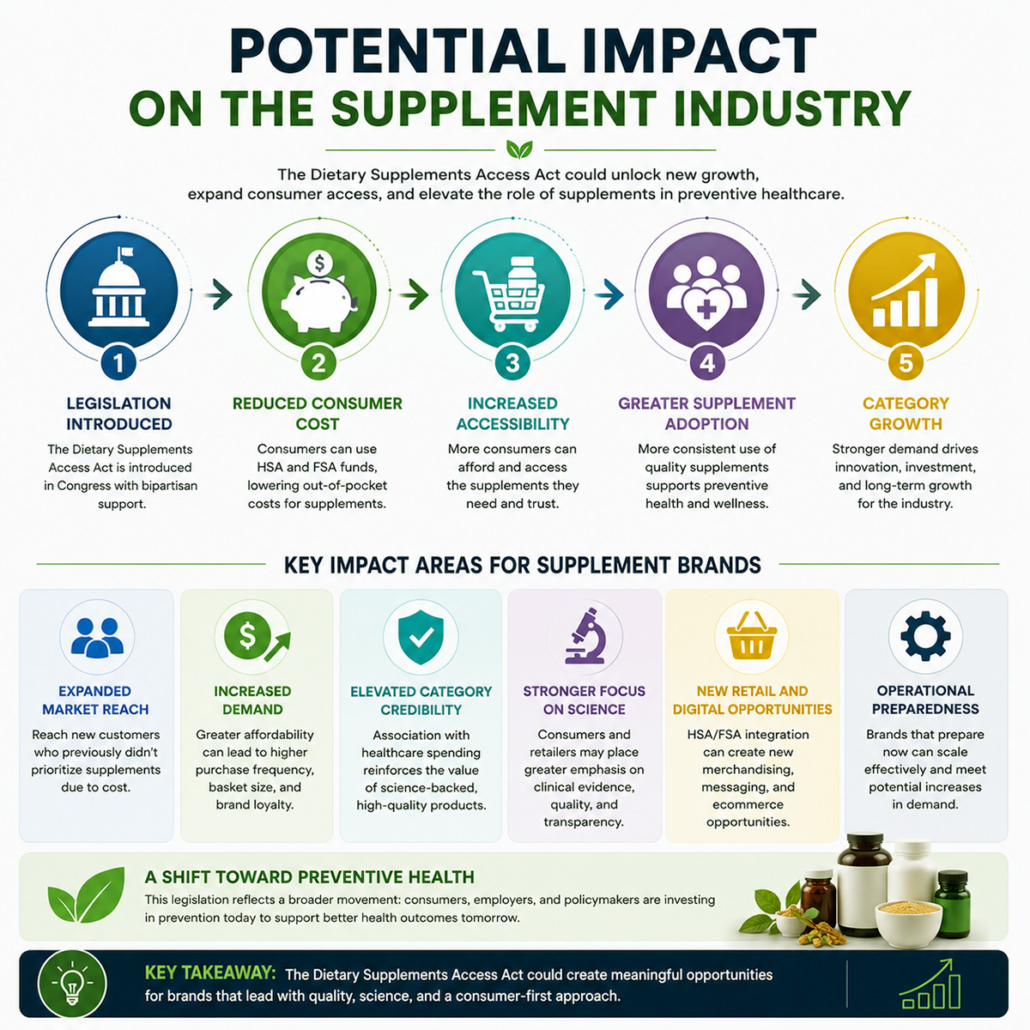
At Intermountain Nutrition, we help brands develop innovative supplement solutions designed for today’s wellness consumer while preparing for tomorrow’s market opportunities.
As preventive health continues to gain momentum, brands that combine credibility, quality, and consumer-focused innovation will be best positioned to grow.
The Dietary Supplements Access Act is proposed federal legislation that would allow qualifying dietary supplements to be purchased using tax-advantaged healthcare accounts such as Health Savings Accounts (HSAs), Flexible Spending Accounts (FSAs), Health Reimbursement Arrangements (HRAs), and Archer Medical Savings Accounts (MSAs).
Currently, most dietary supplements must be purchased using after-tax dollars, even when consumers use them as part of a broader wellness or preventive health strategy.
If enacted, the legislation could make supplements more accessible by allowing consumers to use funds already designated for healthcare expenses. Supporters of the bill argue that the proposal aligns with growing consumer interest in preventive health, healthy aging, metabolic wellness, immune support, and nutrition-based self-care.
While the legislation has generated significant attention within the supplement industry, it must still move through the congressional process before becoming law. As a result, brands should view the bill as an important development to monitor rather than an immediate market change.
The legislation is intended to apply to products that meet the federal definition of a dietary supplement under the Dietary Supplement Health and Education Act (DSHEA). However, final eligibility requirements may depend on how the legislation is implemented and whether additional guidance is issued by regulatory agencies.
In general, categories that support preventive health and wellness may be positioned to benefit if the bill advances. These could include multivitamins, vitamin D, magnesium, omega-3s, probiotics, fiber products, healthy aging supplements, metabolic health formulations, and cognitive wellness products.
However, brands should avoid assuming that every supplement or delivery format will automatically qualify. Final implementation details could affect product eligibility, reimbursement procedures, and retail merchandising requirements.
Therefore, supplement companies should closely monitor legislative developments and prepare for potential guidance regarding formulation, labeling, and consumer communication.
One of the most significant potential impacts of the legislation is reduced consumer purchasing friction. When consumers can use pre-tax healthcare dollars rather than after-tax income, the effective cost of many products decreases. As a result, consumers may be more willing to purchase supplements consistently or invest in premium formulations supported by clinical research and higher-quality ingredients.
The legislation could also elevate the perceived credibility of dietary supplements by positioning them closer to other healthcare-related purchases. For supplement brands, this may create opportunities to strengthen science-backed product positioning, improve consumer education, and expand into growing preventive health categories.
While no one can predict the exact market impact, expanded access to healthcare spending accounts could encourage broader supplement adoption and increase demand in foundational wellness, healthy aging, gut health, metabolic health, and cognitive support categories.
Potentially yes. The proposed legislation focuses on products that meet the federal definition of a dietary supplement rather than limiting eligibility based on delivery format alone. Therefore, gummies, capsules, powders, stick packs, chewables, and other supplement formats may qualify if they are marketed and regulated as dietary supplements.
That said, final implementation guidance may influence how certain products are categorized. Brands should be mindful that products positioned too closely to candy, snacks, beverages, or conventional foods could face additional scrutiny depending on how eligibility standards evolve.
From a formulation perspective, companies should prioritize clear dietary supplement positioning, compliant labeling, transparent ingredient disclosure, and strong quality documentation. As the industry awaits additional details, gummies remain one of the most popular supplement formats among consumers and may represent a significant opportunity if eligibility expands.
Although the Dietary Supplements Access Act has not yet become law, forward-thinking brands can begin preparing for potential changes today.
First, companies should evaluate their product portfolios to identify formulations that align with preventive health categories likely to benefit from expanded healthcare-account eligibility. Foundational nutrition, healthy aging, gut health, metabolic wellness, and cognitive support are all areas worth reviewing.
Additionally, brands should strengthen clinical substantiation, quality systems, testing documentation, and regulatory compliance practices. As supplements become more closely associated with healthcare spending, consumers may place greater emphasis on scientific credibility and transparency.
Companies should also ensure their manufacturing partners can support scalable growth if demand increases. Finally, brands should avoid making premature claims regarding eligibility while monitoring legislative developments closely. Preparation today may create a competitive advantage if the legislation ultimately advances.
There is currently no guaranteed timeline for passage. Like all federal legislation, the Dietary Supplements Access Act must proceed through multiple stages before becoming law. These stages typically include committee review, congressional debate, votes in both the House and Senate, reconciliation of any differences between versions, and final presidential approval.
During this process, provisions may be modified, expanded, or removed. Therefore, the final legislation could differ from the version that was originally introduced. For supplement brands, the most practical approach is to monitor developments while focusing on long-term market trends that support preventive health and consumer wellness.
Regardless of the legislative outcome, demand for proactive health solutions continues to grow. Brands that invest in science-backed products, quality manufacturing, and consumer education are likely to remain well-positioned as the healthcare and wellness landscapes continue to converge.
Council for Responsible Nutrition. (2026). CRN applauds introduction of Dietary Supplements Access Act.
Curtis, J. (2026). Dietary Supplements Access Act bill text.
GovInfo. (2026). S. 4587 — Dietary Supplements Access Act.
LaHood, D. (2026). LaHood, Gottheimer, Tenney, Boyle reintroduce legislation to cover dietary supplements under flex/health spending accounts.
Natural Products Association. (2026). Natural Products Association applauds introduction of the Dietary Supplement Access Act.
Council for Responsible Nutrition. (2024). CRN survey shows consistent supplement usage with increase of specialty product use over time.
Devenir. (2025). 2024 year-end Devenir HSA research report.
HSA Research. (2025). 2024 year-end Devenir HSA research report.
McKinsey & Company. (2024). The trends defining the $1.8 trillion global wellness market in 2024.
U.S. Food & Drug Administration. (n.d.). Questions and answers on dietary supplements.
U.S. Food & Drug Administration. (n.d.). Guidance for industry: Substantiation for dietary supplement claims.
Federal Trade Commission. (2022). Health products compliance guidance.
National Institutes of Health Office of Dietary Supplements. (n.d.). Dietary supplement fact sheets.
National Institutes of Health Office of Dietary Supplements. (1994). Dietary Supplement Health and Education Act of 1994.
 https://intermountainnutrition.com/wp-content/uploads/2026/10/creatine-for-healthy-aging-04.jpg
1200
1200
Larisa Graham
https://intermountainnutrition.com/wp-content/uploads/2026/01/IMN-gradient-logo-NEW.png
Larisa Graham2026-10-16 08:00:002026-10-15 08:32:40Creatine for Healthy Aging
https://intermountainnutrition.com/wp-content/uploads/2026/10/creatine-for-healthy-aging-04.jpg
1200
1200
Larisa Graham
https://intermountainnutrition.com/wp-content/uploads/2026/01/IMN-gradient-logo-NEW.png
Larisa Graham2026-10-16 08:00:002026-10-15 08:32:40Creatine for Healthy Aging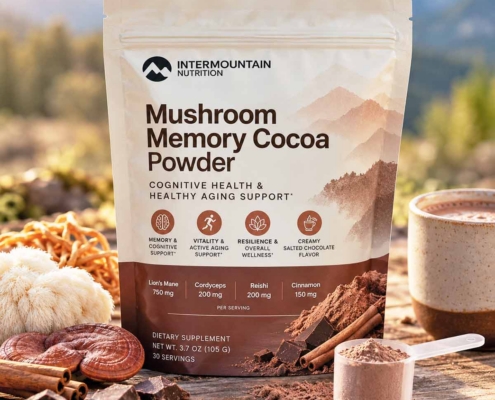 https://intermountainnutrition.com/wp-content/uploads/2026/10/mushroom-memory-powder-cocoa-23.jpg
1200
1200
Larisa Graham
https://intermountainnutrition.com/wp-content/uploads/2026/01/IMN-gradient-logo-NEW.png
Larisa Graham2026-10-15 09:00:002026-10-08 16:17:36STOCK FORMULA: Mushroom Memory Powder for Cognitive Health & Healthy Aging
https://intermountainnutrition.com/wp-content/uploads/2026/10/mushroom-memory-powder-cocoa-23.jpg
1200
1200
Larisa Graham
https://intermountainnutrition.com/wp-content/uploads/2026/01/IMN-gradient-logo-NEW.png
Larisa Graham2026-10-15 09:00:002026-10-08 16:17:36STOCK FORMULA: Mushroom Memory Powder for Cognitive Health & Healthy Aging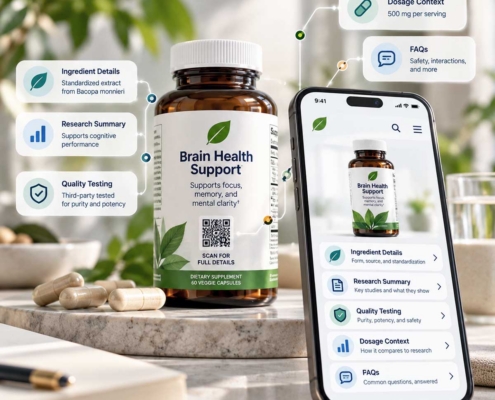 https://intermountainnutrition.com/wp-content/uploads/2026/10/evidence-economy-08.jpg
1200
1200
Larisa Graham
https://intermountainnutrition.com/wp-content/uploads/2026/01/IMN-gradient-logo-NEW.png
Larisa Graham2026-10-14 08:00:002026-10-14 00:57:25The Evidence Economy
https://intermountainnutrition.com/wp-content/uploads/2026/10/evidence-economy-08.jpg
1200
1200
Larisa Graham
https://intermountainnutrition.com/wp-content/uploads/2026/01/IMN-gradient-logo-NEW.png
Larisa Graham2026-10-14 08:00:002026-10-14 00:57:25The Evidence Economy

 Mucuna Pruriens Extract for Men’s Health