STOCK FORMULA: Nerve Support Capsules for Healthy Aging Supplement Brands

August 21, 2026 |

Nerve Support Capsules give supplement brands a strategic way to enter the growing nerve health and healthy aging market with a convenient once-daily formula.

STOCK FORMULATION  |  CAPSULES  |  MOQ 10,000

At a Glance

  • Nerve Support Capsules are designed for brands targeting healthy aging, neurological wellness, and everyday nerve health.
  • Benfotiamine anchors the nerve-health and carbohydrate-metabolism positioning.
  • Vitamin B12 supports normal neurological function, myelination, and nerve-cell health.
  • Turmeric extract provides complementary antioxidant and healthy inflammatory-response support.
  • A one-capsule daily serving and 60-day supply create a convenient format for long-term wellness routines.
  • Nerve support can complement product portfolios focused on healthy aging, metabolic wellness, mobility, cognitive health, and active aging.
  • Market research estimates indicate continued growth in both nerve-support supplements and the broader healthy-aging supplement category.

Nerve Health Is Emerging as a Healthy Aging Opportunity

Healthy aging is no longer limited to joints, bones, heart health, and cognition. Increasingly, consumers want products that help them maintain how they move, feel, and function over time.

As a result, nerve health represents an increasingly relevant opportunity for supplement brands.

Peripheral nerves influence sensation, movement, coordination, and communication between the central nervous system and the rest of the body. Therefore, maintaining normal nerve function fits naturally within a broader strategy focused on mobility, independence, metabolic wellness, and long-term quality of life.

Peripheral Nerve Changes Become More Common With Age

Research shows that peripheral neuropathy becomes substantially more common with advancing age. One U.S. population analysis reported an age-, sex-, and race-adjusted prevalence of 10.4% among adults ages 40–69 and 26.8% among adults age 70 and older. Among adults age 40 and older overall, prevalence was estimated at 13.5%.

Importantly, peripheral nerve concerns are not confined to one consumer population. They can arise in connection with aging, metabolic health, nutritional deficiencies, medication use, injury, and other factors.

For supplement brands, the opportunity is not to position products as treatments for neuropathy. Instead, brands can address the broader consumer interest in healthy nerve function, normal neurological wellness, antioxidant support, and healthy aging.

Market Demand for Nerve Support Supplements

Several structural trends are converging to support demand for nerve-health products.

1. The Consumer Population Is Aging

As consumers enter their 50s, 60s, and beyond, wellness priorities often expand from short-term performance toward maintaining mobility, independence, cognition, cardiovascular health, energy, and everyday function.

Nerve health fits directly into that transition.

2. Supplement Use Increases With Age

Supplement adoption rises sharply among older consumers. CDC data show use increasing from 46.3% among adults ages 20–39 to 60.3% among adults ages 40–59 and 75.9% among adults age 60 and older.

That matters commercially because brands do not need to create an entirely new supplementation behavior. Instead, nerve support can become another targeted component within an established wellness routine.

3. Nerve-Support Supplements Represent a Growing Market

Third-party market research suggests that consumer demand is translating into measurable category growth.

DataIntelo estimates the global peripheral neuropathy support supplement market at approximately $2.88 billion in 2025, with projected growth to $5.45 billion by 2034, representing a 7.2% compound annual growth rate. The same report identifies North America as the largest regional market and vitamins as the largest product segment.

Because this is commercial market-research data rather than government or peer-reviewed evidence, brands should treat the figures as directional market intelligence. However, the trend aligns with broader healthy-aging growth.

4. Healthy Aging Is Becoming a Defined Supplement Category

The Business Research Company estimates the global healthy-aging supplement market at $1.77 billion in 2026, with projected growth to $2.36 billion by 2030.

Nutrition Business Journal also identifies healthy aging as a particularly strong supplement growth category and expects category sales to exceed $2 billion by 2029.

Together, these trends support a broader conclusion: consumers are increasingly willing to build supplement routines around maintaining function as they age.

Key Takeaway: Nerve support benefits from two overlapping growth stories—rising interest in targeted nerve-health products and accelerating investment in healthy-aging supplement routines.

Why Supplement Brands Should Enter the Nerve Health Market Now

Timing matters when brands evaluate a new category.

Nerve health currently offers an interesting balance. Consumer need is recognizable, yet the category remains less saturated than established segments such as sleep, probiotics, joint health, or basic multivitamins.

That creates room for brands to establish authority before nerve support becomes a standard component of healthy-aging portfolios.

The Demand Drivers Are Structural

Several of the drivers behind nerve-health demand are unlikely to disappear:

  • The population is aging.
  • Older adults are among the most frequent supplement users.
  • Metabolic wellness remains a major consumer priority.
  • Consumers increasingly build targeted supplement stacks rather than relying exclusively on multivitamins.
  • Healthy aging is shifting toward maintaining function, mobility, and independence.

These factors give nerve support relevance beyond short-lived ingredient trends.

The Category Creates Cross-Selling Opportunities

Nerve health also offers strong adjacency to products consumers already understand.

A nerve-support SKU can sit beside joint support, cognitive support, blood-sugar support, magnesium, vitamin D, bone-health products, or active-aging supplements.

Therefore, brands can enter the category without repositioning their entire portfolio.

Nerve Support Can Strengthen Customer Lifetime Value

For established brands, the opportunity extends beyond new-customer acquisition.

A relevant nerve-health SKU can create:

  • Cross-sell opportunities
  • Bundled healthy-aging systems
  • Subscription programs
  • Multi-SKU merchandising
  • Metabolic-health bundles
  • Active-aging product systems
  • Practitioner or specialty-channel programs

For brands with an established 40+ or 50+ consumer base, this can increase portfolio depth while serving existing customers more comprehensively.

Key Takeaway: Nerve health offers brands an opportunity to expand into a growing category while leveraging customers and product lines they may already have.

Where Nerve Support Fits in a Product Portfolio

Nerve Support Capsules can complement several established supplement categories rather than compete with them.

Consumer Need Existing Product Category Role of Nerve Support
Healthy aging Joint, bone, cardiovascular, cognitive support Adds peripheral neurological wellness to a broader longevity portfolio
Metabolic wellness Blood-sugar support, berberine, chromium Extends the portfolio toward nutritional nerve support and carbohydrate metabolism
Mobility Joint, muscle, bone support Adds a neurological dimension to movement and everyday function
Neurological wellness Cognitive, stress, mood, sleep products Expands neurological positioning beyond the brain
Active aging Protein, electrolytes, joint support Supports a broader “stay active and independent” product system
Foundational wellness Multivitamins, omega-3s, vitamin D Adds a targeted solution for consumers building personalized supplement stacks

Key Takeaway: Nerve Support Capsules can serve as a bridge product across healthy aging, metabolic wellness, mobility, and neurological health.

Consumer Segments for Nerve Support Capsules

an older man and woman working in the garden together

Adults 50+

Adults in their 50s, 60s, and beyond represent the clearest target market.

This audience is already highly engaged with supplements and increasingly focused on staying active, independent, and functional over time.

Relevant positioning includes:

  • Everyday nerve health
  • Healthy aging
  • Normal neurological function
  • Long-term wellness
  • Mobility-supporting routines
  • Complementary use alongside joint, bone, cognitive, or metabolic products

For this group, messaging should emphasize maintaining function rather than focusing on decline.

two older women walking for exercise in the park to maintain health as they age

Active Aging Consumers

Active-aging consumers tend to prioritize what they can continue doing: walking, exercising, traveling, gardening, working, and maintaining independence.

Nerve health can fit alongside joint, muscle, and bone support because peripheral nerves play an important role in normal sensation and movement.

This audience may respond particularly well to messaging around:

  • Everyday function
  • Healthy movement
  • Active living
  • Long-term neurological wellness
  • Maintaining an active lifestyle with age
diabetic man checking his blood sugar at the kitchen table

Metabolic Wellness Consumers

Metabolic-health consumers represent another important segment.

Population research has found substantially greater peripheral neuropathy prevalence among people with diabetes than among those without diabetes. However, supplement brands must be careful not to imply that a nerve-support dietary supplement treats or prevents diabetic neuropathy.

Instead, Nerve Support Capsules can complement an existing metabolic portfolio through messaging around:

  • Healthy nerve function
  • Normal carbohydrate metabolism
  • Neurological wellness
  • Antioxidant support

This creates a natural cross-sell opportunity for brands already serving consumers interested in blood-sugar and metabolic wellness.

a middle-aged man and woman checking out healthy aging supplements at the store

Proactive Healthy-Aging Consumers

The opportunity is not limited to consumers experiencing nerve-related concerns.

Many consumers in their 40s and 50s increasingly build targeted wellness stacks before problems arise. Their goal is often to maintain current function rather than react to decline.

For these consumers, nerve health can become another pillar alongside brain health, heart health, mobility, sleep, and metabolic wellness.

This preventive mindset also creates opportunities for products that fit naturally into established daily routines. Consumers may be more receptive to nerve-health offerings when they are presented as part of a broader approach to maintaining energy, comfort, mobility, and independence over time.

Education will be especially important in this segment. Clear explanations of how nerve health relates to everyday function can help consumers understand the category without relying on fear-based messaging or waiting for a serious concern to develop.

INFOGRAPHIC: Three Pathways To Everyday Nerve Support

How Nerve Support Capsules Work

Nerve Support Capsules combine three ingredients with complementary roles in neurological nutrition, carbohydrate metabolism, antioxidant support, and healthy aging. Together, these ingredients are selected to support the body’s natural processes that help maintain normal nerve function and overall cellular health.

The formula is designed for individuals seeking nutritional support for everyday wellness, particularly as part of a balanced approach to healthy aging. By bringing these complementary nutrients into one convenient capsule, Nerve Support Capsules offer a simple way to support neurological nutrition and antioxidant defenses as part of a consistent wellness routine.

Used consistently alongside a balanced diet and healthy lifestyle, Nerve Support Capsules can help provide nutritional support for the body’s everyday wellness needs. This convenient formula is intended to complement regular self-care practices while supporting normal nerve function, cellular health, and antioxidant protection.

Benfotiamine

A Lipid-Soluble Thiamine Derivative

Benfotiamine is a lipid-soluble derivative of thiamine, or vitamin B1.

Compared with standard thiamine salts, benfotiamine has different pharmacokinetic characteristics and has been studied for its ability to increase circulating thiamine-related metabolites.

Supporting Thiamine-Dependent Metabolism

Thiamine functions as a cofactor in several enzymes involved in carbohydrate and cellular-energy metabolism. Because nerve cells have substantial metabolic demands, adequate thiamine status is relevant to normal nervous-system function.

Benfotiamine has also been investigated in connection with metabolic pathways affected by sustained glucose exposure.

Formula Differentiation

Benfotiamine adds a differentiated thiamine derivative to the formula, supporting normal thiamine-dependent metabolic pathways involved in carbohydrate metabolism and cellular energy production. As a lipid-soluble form of thiamine, it is included to provide targeted nutritional support within a balanced formulation.

Its inclusion complements the formula’s focus on nutritional support for normal nerve function and everyday cellular metabolism. The ingredient is intended to support normal physiological processes without positioning it as a treatment for neuropathy.

Methylcobalamin

Supports Normal Neurological Function

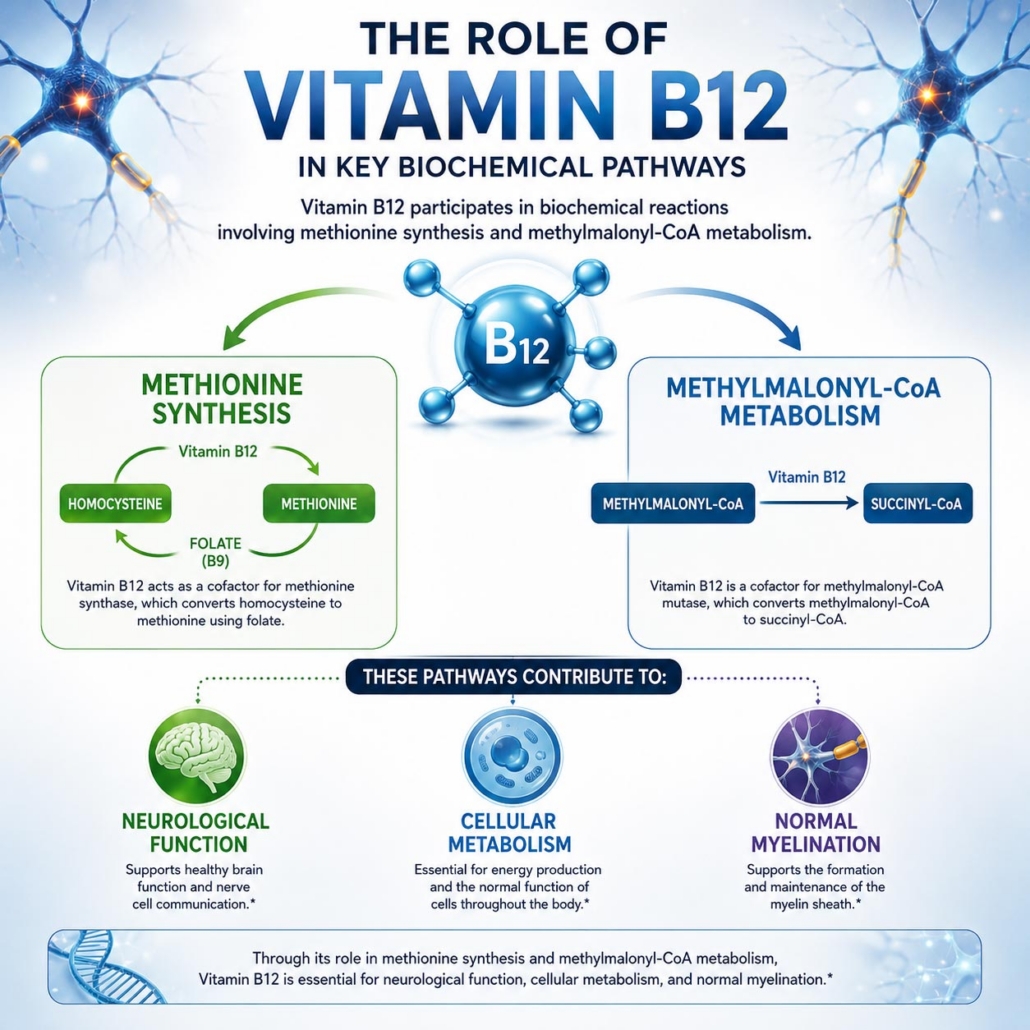
Vitamin B12 is required for development, myelination, and normal function of the central nervous system. It also contributes to healthy red blood cell formation and DNA synthesis.

Methylcobalamin is one of the metabolically active forms of vitamin B12. However, supplemental B12 forms still undergo absorption, transport, and intracellular processing, so brands should avoid overly simplistic claims that methylcobalamin requires no biological processing.

Supporting Myelin & Cellular Metabolism

Vitamin B12 participates in biochemical reactions involving methionine synthesis and methylmalonyl-CoA metabolism. These pathways contribute to neurological function, cellular metabolism, and normal myelination.

B12 deficiency can also affect the nervous system and may cause numbness or tingling in the hands and feet.

Relevance for Older Adults

Vitamin B12 becomes particularly relevant within healthy-aging products because some older adults have difficulty releasing and absorbing food-bound B12 due to reduced stomach acid.

The 500 mcg amount used in Nerve Support Capsules is also consistent with amounts commonly found in standalone or B-complex supplements. NIH notes that supplemental B12 at 500–1,000 mcg is common, although only a small percentage of high doses is absorbed.

Turmeric Extract

Antioxidant Support for Healthy Aging

Turmeric comes from the root of Curcuma longa. Curcuminoids, including curcumin, are its most extensively researched bioactive compounds.

Curcumin has been investigated for its effects on oxidative-stress and inflammatory signaling pathways.

Turmeric for Nerve Support Supplement Formulation

Supporting a Healthy Inflammatory Response

Research suggests that curcumin can interact with multiple molecular signaling pathways associated with oxidative balance and normal inflammatory responses.

However, clinical outcomes vary considerably depending on dose, extraction method, bioavailability technology, and population.

Therefore, turmeric’s role in this formula is complementary.

It strengthens the product’s antioxidant and healthy-aging positioning rather than functioning as a direct treatment for nerve conditions.

Key Takeaway: The formula combines nutritional neurological support, thiamine-dependent metabolism, and antioxidant support in a format that naturally fits healthy-aging and metabolic-wellness portfolios.

Competitive Category Landscape

Consumers shopping for nerve-health products currently encounter a wide range of formulation approaches.

Common category ingredients include:

  • B vitamins
  • Benfotiamine
  • Vitamin B12
  • Alpha-lipoic acid
  • Magnesium
  • Acetyl-L-carnitine
  • Turmeric or curcumin
  • Botanical extracts
  • Antioxidant compounds

For brands, this creates several possible positioning strategies.

Premium clinical-style formulations may use multiple high-dose actives. Conversely, mass-market products frequently rely heavily on B-complex positioning.

Nerve Support Capsules provide another option: a recognizable nerve-health platform built around benfotiamine, methylcobalamin, and standardized turmeric.

That ingredient story supports several brand narratives without locking the product into one narrow audience.

Potential positioning territories include:

  • Everyday nerve health
  • Healthy aging
  • Active aging
  • Neurological wellness
  • Metabolic wellness
  • Antioxidant support

This versatility can be especially valuable for brands seeking a stock formula that must work across different audiences and merchandising strategies.

Flavoring & Sensory Experience

Although capsule products do not require traditional flavor development, sensory experience still influences repeat use.

Consumers interact with the capsule every day. Therefore, capsule size, odor, appearance, swallowability, and bottle experience all contribute to perceived product quality.

For Nerve Support Capsules, development should prioritize:

  • Comfortable swallowing
  • Minimal noticeable aroma
  • Consistent capsule appearance
  • No objectionable aftertaste
  • Appropriate moisture protection

Because turmeric naturally contributes yellow-orange coloration, opaque HPMC capsules can help create a clean and consistent finished appearance.

For brands targeting older adults, capsule size and ease of swallowing deserve particular attention during pilot production.

Strategic Opportunities for Supplement Brands

Nerve support offers brands an opportunity to expand into a category that complements several strong wellness platforms.

Build a More Complete Healthy Aging Portfolio

For healthy-aging brands, nerve support fills an important gap between mobility and cognitive health.

A consumer already taking products for joints, bones, heart health, cognition, or sleep may view nerve support as another logical component of maintaining long-term function.

Create Metabolic Wellness Cross-Sells

Brands already serving metabolic-health consumers can use Nerve Support Capsules as an adjacent product rather than trying to incorporate every benefit into a blood-sugar formula.

That separation keeps each SKU’s positioning clear while creating natural bundling opportunities.

Develop Active-Aging Systems

Nerve support can also strengthen active-aging collections alongside:

  • Joint health
  • Muscle support
  • Bone health
  • Protein
  • Electrolytes
  • Omega-3 products

This allows brands to communicate a broader strategy centered on maintaining movement and everyday function.

Support Subscription & Bundle Strategies

Because Nerve Support Capsules provide a 60-day supply and are designed for daily use, they can work well within:

  • Healthy-aging subscriptions
  • Metabolic wellness bundles
  • Active-aging systems
  • Practitioner programs
  • Multi-product starter kits
  • Loyalty programs

Expand Without Building a Formula From Scratch

Stock formulations can also reduce the product-development burden for brands that want to enter an adjacent category.

Intermountain Nutrition can support brands through formulation guidance, cGMP manufacturing, packaging, commercialization support, and on-site third-party testing.

For brands already serving consumers interested in healthy aging, neurological wellness, metabolic health, or active living, nerve support can be a natural next addition.

Interested in adding Nerve Support Capsules to your product line? Contact Intermountain Nutrition to discuss stock-formula availability, packaging, minimum order requirements, positioning, and customization opportunities.

Frequently Asked Questions

Several indicators suggest increasing commercial interest in the nerve-health category. Peripheral nerve concerns become more prevalent with age, while older adults also represent one of the most supplement-engaged consumer groups in the United States.

Third-party market research estimates the global peripheral neuropathy support supplement category at approximately $2.88 billion in 2025 and projects continued growth through 2034.

At the same time, the broader healthy-aging supplement market is expanding. These trends suggest that nerve health can increasingly function as part of a proactive healthy-aging strategy rather than remaining a narrowly specialized category. Brands should still avoid making claims that a dietary supplement treats, prevents, or mitigates neuropathy.

Healthy-aging consumers represent one of the strongest opportunities, particularly adults in their 50s and older who are already building daily supplement routines.

However, the target market is broader than older adults. Active-aging consumers, metabolic-wellness shoppers, consumers interested in neurological health, and individuals building personalized healthy-aging stacks may also find nerve-support positioning relevant.

For brands, this allows a nerve-support SKU to work across several product architectures. Messaging should focus on healthy nerve function, normal neurological wellness, antioxidant support, and healthy aging rather than targeting consumers based on a diagnosed neurological condition.

Nerve support fills an important position between neurological wellness and physical function.

Many healthy-aging portfolios already include cognitive formulas, joint products, bone health, cardiovascular support, sleep, and metabolic wellness. However, peripheral nerve health is often less represented.

A nerve-support supplement can therefore expand the portfolio without duplicating those products. Brands can merchandise it beside cognitive health, joint and mobility support, or metabolic-wellness formulas. It can also be bundled into broader active-aging or healthy-aging systems, creating opportunities for cross-selling, subscriptions, and higher customer lifetime value.

Benfotiamine is a lipid-soluble derivative of thiamine, or vitamin B1. Thiamine plays an important role in carbohydrate metabolism and cellular-energy pathways, including pathways relevant to nervous-system function.

Researchers have also studied benfotiamine in people with diabetic polyneuropathy. Findings have been mixed, with some shorter studies showing selected improvements while longer-term studies have not consistently demonstrated structural or functional nerve benefits.

Therefore, benfotiamine should not be positioned as a treatment for neuropathy. Within a dietary supplement, it provides a differentiated ingredient associated with thiamine nutrition, carbohydrate metabolism, and normal nerve-health positioning.

Vitamin B12 is required for normal neurological function, myelination, DNA synthesis, and healthy red blood cell formation. NIH specifically identifies B12 as necessary for development, myelination, and function of the nervous system.

Deficiency can also result in neurological symptoms, including numbness and tingling. In addition, some older adults absorb food-bound B12 less efficiently because stomach-acid production decreases with age.

Nerve Support Capsules provide 500 mcg as methylcobalamin, one of the metabolically active forms of B12. Brands should still avoid implying that the product diagnoses or treats B12 deficiency or neurological disease.

Turmeric broadens the formulation beyond B-vitamin nutrition by adding antioxidant and healthy inflammatory-response support.

Its primary researched compounds, curcuminoids, interact with several pathways related to oxidative balance and inflammatory signaling. This makes turmeric particularly relevant to healthy-aging positioning.

However, research on turmeric varies considerably according to dose, extract, bioavailability technology, and population. Therefore, the 150 mg standardized extract in this formulation should not be presented as equivalent to higher-dose clinical curcumin protocols.

Its role is complementary: it strengthens the antioxidant and healthy-aging story alongside benfotiamine and methylcobalamin.

Dietary supplements should not be marketed as products that diagnose, treat, mitigate, cure, or prevent peripheral neuropathy.

FDA permits dietary supplements to use appropriately substantiated structure/function claims, which describe how an ingredient may support the normal structure or function of the body. However, claims that explicitly or implicitly refer to treatment of a disease can cause a product to be regulated as a drug.

Appropriate positioning may include language such as “supports healthy nerve function,” “supports normal neurological function,” “supports healthy carbohydrate metabolism,” or “provides antioxidant support,” assuming the final claims are properly substantiated and reviewed.

References

Hicks, C. W., et al. (2021). Prevalence of peripheral neuropathy defined by monofilament insensitivity in middle-aged and older adults in two U.S. cohorts. Scientific Reports.

National Center for Health Statistics. (2026). Dietary Supplement Use: United States, August 2021–August 2023.

National Institutes of Health, Office of Dietary Supplements. Vitamin B12 Fact Sheet for Health Professionals.

National Institute of Neurological Disorders and Stroke. Peripheral Neuropathy.

National Institute on Aging. Vitamins and Minerals for Older Adults.

Stracke, H., et al. (2008). Benfotiamine in diabetic polyneuropathy (BENDIP): Results of a randomized, double-blind, placebo-controlled clinical study. Experimental and Clinical Endocrinology & Diabetes.

Haupt, E., et al. (2005). Benfotiamine in the treatment of diabetic polyneuropathy—A three-week randomized, controlled pilot study. International Journal of Clinical Pharmacology and Therapeutics.

Ziegler, D., et al. (2026). Effects of benfotiamine treatment over 12 months on morphometric, neurophysiological and clinical measures in type 2 diabetes patients with symptomatic polyneuropathy.

National Center for Complementary and Integrative Health. Turmeric: Usefulness and Safety.

U.S. Food and Drug Administration. Dietary Supplements and Structure/Function Claims.

The Business Research Company. (2026). Healthy Aging Supplement Market Report 2026.

DataIntelo. (2026). Peripheral Neuropathy Support Supplements Market Research Report 2034.

Related Postings

Akkermansia Muciniphila For Metabolic Health Support Supplement on a shelf at the store
GRAS documentation on a countertop of a lab
Adaptogens for Wellness Supplements