
RFK Jr.’s New Dietary Guidelines
January 8, 2026 | Announcements
What the Federal Nutrition Reset Means for The Supplement Industry
At a Glance
The new U.S. Dietary Guidelines for Americans represent one of the most significant nutrition policy shifts in decades.
- The new Dietary Guidelines for Americans, released January 7, 2026, mark a major federal nutrition policy reset emphasizing whole, nutrient-dense foods, higher protein intake, reduced highly processed foods, and real food first. Food and Nutrition Service
- These guidelines were spearheaded by HHS Secretary Robert F. Kennedy Jr. as part of the “Make America Healthy Again” initiative, returning protein, dairy, and healthy fats to central roles in the American diet. Food and Nutrition Service
- For the supplements industry, the shift opens both opportunities and challenges, especially around protein, gut health, micronutrient supplementation, and consumer education on processed vs. whole food nutrition.
Introduction: The Policy Shift
On January 7, 2026, the U.S. Departments of Health and Human Services and Agriculture released the Dietary Guidelines for Americans (DGAs) for 2025–2030—the most significant update in decades. According to the official release, it puts real food back at the center of health and targets what policymakers describe as a national health emergency driven by diet-related chronic disease. Food and Nutrition Service
Secretary Kennedy stated:
“American households must prioritize whole, nutrient-dense foods—protein, dairy, vegetables, fruits, healthy fats, and whole grains—and dramatically reduce highly processed foods.” Food and Nutrition Service
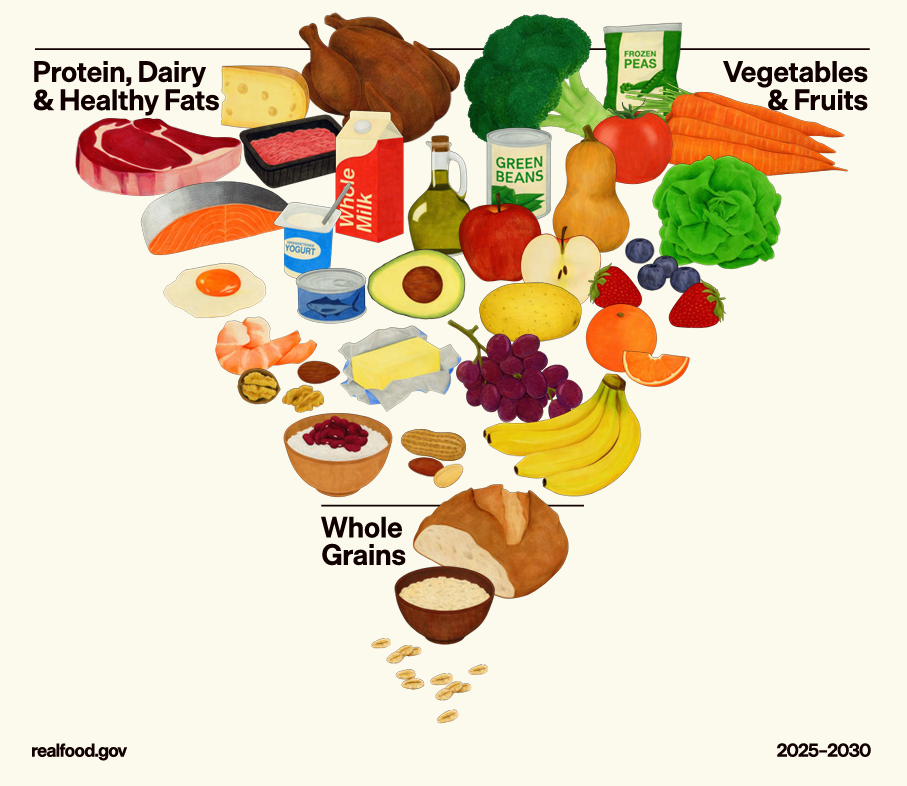
The updated guidelines depart from the more grain-heavy MyPlate model, introducing an inverted food pyramid that places meat, dairy, and healthy fats alongside fruits and vegetables at the base of the dietary pattern. The Guardian
Key New Recommendations (With Supplement Industry Implications)

Higher Protein Requirements
The 2025–2030 DGAs recommend 1.2–1.6 grams of protein per kilogram of body weight daily, a substantial increase over the traditional 0.8 g/kg RDA. Real Food
This shift will have direct implications for protein supplement demand:
- Opportunity: Increased consumer focus on protein could accelerate sales of protein powders and amino acid supplements, especially for segments like athletes, aging populations, and general wellness consumers seeking muscle maintenance.
- Differentiation: Brands can differentiate by emphasizing quality, bioavailability, and real-food compatible formulations to align with the “real food” ethos.
Market Insight: Many consumers already struggle to meet daily protein needs through diet alone, especially older adults and women. This gap presents a growth opportunity for targeted protein supplementation products.
Gut Health & Fermented Foods
The DGAs explicitly promote fermented foods (e.g., kefir, kimchi) and fiber-rich plants as part of a healthy microbiome. Real Food
Where Supplements Fit In:
- Probiotic & Prebiotic Supplements: Reinforced interest in microbiome-focused formulas, especially those supporting digestion and immune health.
- Synbiotics & Fermentation-Aligned Products: Opportunities for products that combine probiotics with prebiotic fibers, aligning with the nutritional science spotlighted in the guidelines.
In this area, NutraIngredients notes the guidelines present an “opportunity for gut health” emphasis in mainstream nutrition discourse.

Emphasis on Dairy (Including Full-Fat)
The guidelines uniquely encourage full-fat dairy with no added sugars and position dairy as a key protein and nutrient source. Real Food
Industry Impact
- Innovation in Dairy-Based Supplements: Expect growth potential in whey and casein proteins, fortified dairy powders, probiotic yogurts, and calcium-rich products optimized for health benefits.
- Shift from Low-Fat Messaging: Traditional low-fat positioning may become less compelling, requiring reformulation or repackaging strategies emphasizing nutrient density over fat avoidance.
Reduced Ultra-Processed Foods & Added Sugars
The DGAs call for significant reduction of highly processed foods, refined carbohydrates, artificial additives, and added sugars. Real Food
Supplements Industry Response:
- Clean Label Advantage: Consumers focused on real foods may gravitate toward supplements with transparent, recognizable ingredients.
- Education is Key: Brands that help consumers distinguish between “whole-food inspired” ingredients and highly processed or additive-heavy products can gain trust and market share.
What Thought Leaders are Saying
Supportive Views
- American Heart Association: The revised guidelines “jump-start important conversations about what we eat” and support healthy eating patterns, though they stress the need for nuance. American Hospital Association
Critical Perspectives
- Christopher Gardner, Stanford Nutrition Expert: He expressed concern that prioritizing red meat at the top of the pyramid goes against longstanding evidence linking saturated fat and cardiovascular risk. KPBS Public Media
- Some nutrition scientists and advocates worry the visual food pyramid may miscommunicate relative intake proportions, especially regarding grains and saturated fats. Reddit
These differing viewpoints show the guidelines’ potential to spark debate within both public health and industry circles—an important consideration for supplement brand communicators and product strategists.
How This Shapes Supplement Industry Innovation & Strategy
Product Reformulation Aligned with “Real Food”
- Fortified Proteins: Focus on amino acid completeness, dairy-free alternatives, and fermentation-derived proteins.
- Clean, Whole-Food Ingredients: Move away from highly processed bases to real-food derived nutrients.
Consumer Education & Brand Messaging
- Brands will need to educate consumers on the differences between supplementation and whole food intake, especially where guidelines emphasize whole food first but recognize nutrient gaps.
Tailored Solutions for Special Populations
- Senior Nutrition: Supplements addressing muscle loss (sarcopenia) could gain prominence given higher protein targets.
- Women & Pregnancy: Nutrient density (iron, calcium, vitamin D) remains critical—even if food is prioritized.
- Plant-Based Consumers: Opportunity for plant protein blends that meet or exceed proposed protein targets.
Conclusion
The Dietary Guidelines for Americans represent a major pivot in national nutrition philosophy—one that elevates protein, embraces gut health, and challenges industries centered on ultra-processed products. For the supplements industry, this shift is both an opportunity and a responsibility:
- Innovate with clean, nutrient-dense formulations that complement whole-food strategies.
- Lead in consumer education about achieving nutritional targets sustainably and scientifically.
- Align offerings with evolving science and policy trends to meet new consumer expectations.
To discuss how Intermountain Nutrition can help you develop custom solutions that align with these emerging guidelines, contact us today.
References
Champion Bio. (2025, October 30). Traceability technologies: Ensuring authenticity & transparency.
Emergen Research. (2025, April 9). Dietary supplements market size worth USD 402.2 billion in 2033 [Press release].
Emergen Research, & GlobeNewswire. (2025, July 8). Specialized nutrition market size worth USD 206.79 billion by 2034, driven by elderly, sports, and medical innovations.
GlobalGrowthInsights. (n.d.). Dietary supplements for the elderly market size & forecast [2025‑2033].
GlobeNewswire. (2025, September 8). Global nutritional supplements market size to reach USD 743.51 billion by 2032.
GlobeNewswire. (2024, November 25). Dietary supplement market is evaluated to expand at 8% CAGR to reach a value of 410.46 billion by 2034.
Grand View Research. (2024). Dietary supplements market size, share & trends analysis report, 2024–2033.
Grand View Research. (2025). Personalized nutrition and supplements market report, 2025–2033: Size, share & trends analysis.
PMR Market Research. (2024). Worldwide nutrition & dietary supplements market research 2024 by type, application, participants and countries — Forecast to 2030.
MarketsandMarkets. (2025, May). Plant‑based supplements market by product type, form, age group, end‑use, distribution channel & region — Global forecast to 2030 (Report No. FB 9394).
Reinson, E. (2022, August 1). Transparency in nutraceutical manufacturing. Nutrition Industry Executive Magazine.
Related Postings
 https://intermountainnutrition.com/wp-content/uploads/2026/10/creatine-for-healthy-aging-04.jpg
1200
1200
Larisa Graham
https://intermountainnutrition.com/wp-content/uploads/2026/01/IMN-gradient-logo-NEW.png
Larisa Graham2026-10-16 08:00:002026-10-15 08:32:40Creatine for Healthy Aging
https://intermountainnutrition.com/wp-content/uploads/2026/10/creatine-for-healthy-aging-04.jpg
1200
1200
Larisa Graham
https://intermountainnutrition.com/wp-content/uploads/2026/01/IMN-gradient-logo-NEW.png
Larisa Graham2026-10-16 08:00:002026-10-15 08:32:40Creatine for Healthy Aging https://intermountainnutrition.com/wp-content/uploads/2026/10/mushroom-memory-powder-cocoa-23.jpg
1200
1200
Larisa Graham
https://intermountainnutrition.com/wp-content/uploads/2026/01/IMN-gradient-logo-NEW.png
Larisa Graham2026-10-15 09:00:002026-10-08 16:17:36STOCK FORMULA: Mushroom Memory Powder for Cognitive Health & Healthy Aging
https://intermountainnutrition.com/wp-content/uploads/2026/10/mushroom-memory-powder-cocoa-23.jpg
1200
1200
Larisa Graham
https://intermountainnutrition.com/wp-content/uploads/2026/01/IMN-gradient-logo-NEW.png
Larisa Graham2026-10-15 09:00:002026-10-08 16:17:36STOCK FORMULA: Mushroom Memory Powder for Cognitive Health & Healthy Aging https://intermountainnutrition.com/wp-content/uploads/2026/10/evidence-economy-08.jpg
1200
1200
Larisa Graham
https://intermountainnutrition.com/wp-content/uploads/2026/01/IMN-gradient-logo-NEW.png
Larisa Graham2026-10-14 08:00:002026-10-14 00:57:25The Evidence Economy
https://intermountainnutrition.com/wp-content/uploads/2026/10/evidence-economy-08.jpg
1200
1200
Larisa Graham
https://intermountainnutrition.com/wp-content/uploads/2026/01/IMN-gradient-logo-NEW.png
Larisa Graham2026-10-14 08:00:002026-10-14 00:57:25The Evidence Economy

