STOCK FORMULA: Elderberry Gummies for Immune Support

September 13, 2026 |

Intermountain Nutrition’s new Elderberry Immune Support Gummy combines elderberry extract with vitamins C and D3 and zinc in a convenient two-gummy serving designed for daily immune support.

STOCK FORMULATION  |  GUMMIES  |  MOQ 10,000

At a Glance

  • Elderberry remains a recognizable ingredient in immune wellness, with growing use in supplements designed for both daily and seasonal support.
  • Intermountain Nutrition’s new Elderberry Immune Support Gummy delivers 200 mg of elderberry extract with vitamin C, vitamin D3, and zinc per 2-gummy serving.
  • An elderberry-forward berry flavor profile uses blackberry and blueberry notes to create a more approachable daily gummy experience.
  • Ingredient quality matters. Elderberry extracts can differ in species, plant part, extraction method, concentration, standardization, and sensory characteristics.
  • Gummies create formulation challenges beyond the active dose, including flavor masking,
  • pH control, moisture management, color stability, and potency throughout shelf life.
  • The stock formula provides supplement brands with a ready-to-scale platform for daily immune support and seasonal wellness positioning.

Elderberry Gummies Offer Supplement Brands a Familiar Immune-Support Platform

Immune health has evolved beyond a short seasonal purchasing window. Consumers increasingly incorporate immune-support supplements into broader everyday wellness routines, creating opportunities for products that are convenient enough for regular use and familiar enough to require little explanation.

Elderberry (Sambucus nigra) fits particularly well within that strategy. The dark purple berry has a long history of traditional use and has become a recognizable botanical in modern immune-support supplements.

Its familiarity is an advantage for supplement brands. Elderberry can serve as the botanical centerpiece of a formula while established nutrients provide a complementary nutritional foundation.

Intermountain Nutrition developed its new Elderberry Immune Support Gummy around that principle: keep the formula focused, provide meaningful amounts of recognizable ingredients, and make the finished product enjoyable enough to support daily use.

A Focused Four-Ingredient Formula

Each two-gummy serving provides:

Functional Ingredient Amount per 2 Gummies Formulation Role
Vitamin C 150 mg Immune function + antioxidant support
Vitamin D3 20 mcg (800 IU) Normal immune system function
Zinc 7 mg Normal immune function and cellular processes
Elderberry Extract 200 mg Botanical foundation for immune and seasonal wellness positioning

Rather than adding botanicals simply to increase the ingredient count, the formula intentionally focuses on four complementary and easily understood ingredients.

That simplicity matters for a stock product. It gives brands room to develop their own positioning while preserving a clean Supplement Facts panel and a straightforward consumer message.

Why Elderberry Works for Modern Immune Support Formulation

Elderberries contain several naturally occurring plant compounds, including anthocyanins, flavonols, phenolic acids, and other polyphenols. Anthocyanins are particularly notable because they contribute to the berry’s characteristic deep purple color and antioxidant activity.

For supplement formulation, however, elderberry’s value extends beyond its phytochemistry.

Elderberry Pairs Naturally With Foundational Nutrients

The stock formula combines elderberry with three nutrients that have well-established physiological roles related to normal immune function.

Vitamin C contributes to normal immune defenses and also functions as an antioxidant. At 150 mg per serving, it has a meaningful presence without unnecessarily dominating the formula.

Vitamin D3 has important roles in normal immune function. The formula provides 20 mcg, or 800 IU, per serving.

Zinc is required for numerous cellular processes and normal immune function. At 7 mg, the formula provides a useful amount while remaining practical for a gummy, where higher mineral loads can create undesirable metallic or astringent sensory notes.

Together, these ingredients create a formula that is easy to communicate:

A recognizable botanical supported by three foundational immune nutrients.

Familiarity Reduces the Education Barrier

Some emerging botanicals require substantial consumer education before their benefits or purpose become clear. Elderberry already has substantial recognition within the immune-support category.

That can make it particularly useful for brands developing products for broad consumer audiences. Instead of asking consumers to understand an unfamiliar ingredient, brands can build around a botanical they may already associate with seasonal and immune wellness.

Elderberry Extract Market Trends Point to Continued Opportunity

Elderberry is not simply a legacy seasonal botanical.

Market forecasts indicate continued growth for elderberry extracts across nutraceutical and other applications.

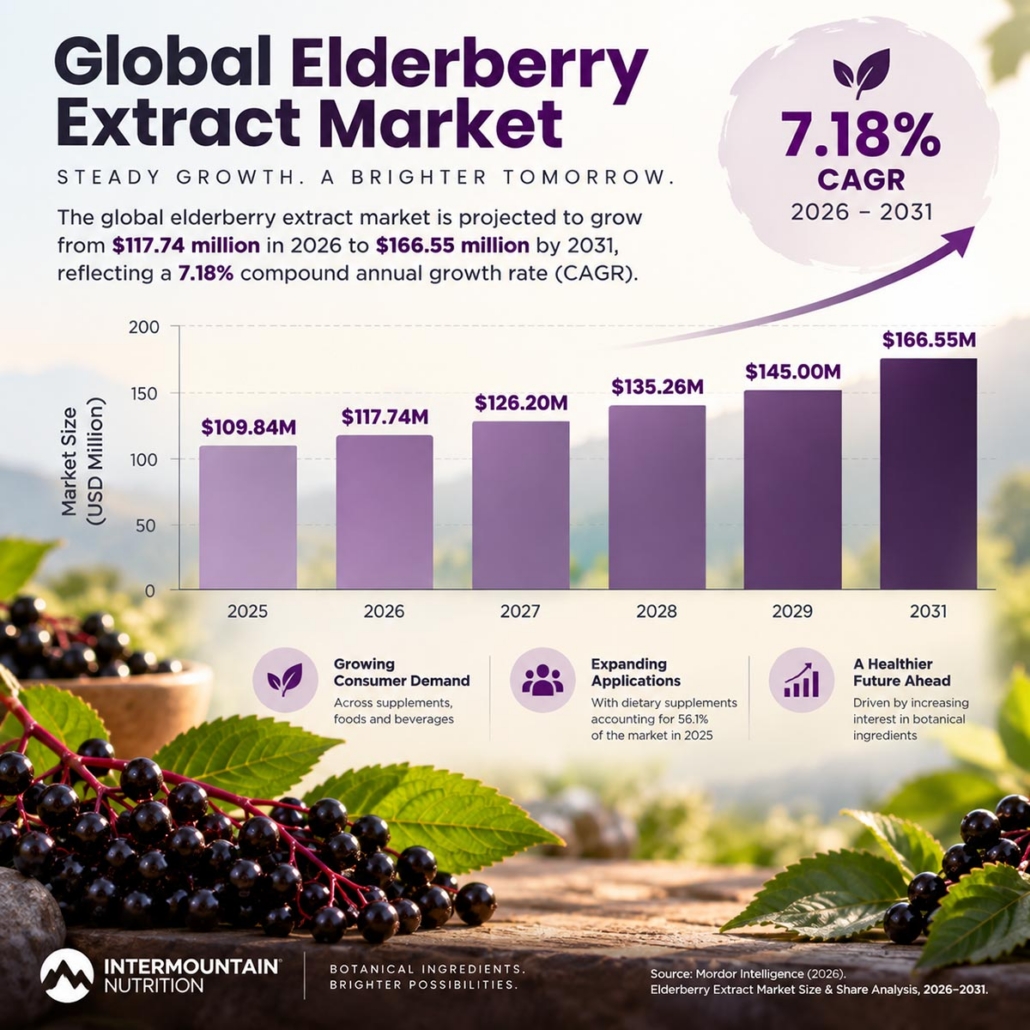
According to Mordor Intelligence, the global elderberry extract market is estimated at $117.74 million in 2026 and is projected to reach $166.55 million by 2031. That represents a 7.18% compound annual growth rate.

Perhaps more relevant for supplement brands, dietary supplements accounted for 56.1% of the elderberry extract market in 2025, making supplements the largest application segment reported in the analysis.

INFOGRAPHIC: Global Elderberry Extract Market

What the Growth Means for Supplement Brands

The important takeaway is not simply that the market is getting larger. It is that elderberry appears to have maintained commercial relevance after the extraordinary immune-product demand of the pandemic period.

Mordor Intelligence specifically characterizes current growth as following the pandemic-era spike in immunity purchasing, with continued demand reflecting broader interest in botanical ingredients across supplements, foods, beverages, and personal care.

For supplement brands, that changes the opportunity.

Elderberry does not necessarily need to be positioned only as a winter or cold-season product. Pairing it with foundational nutrients such as vitamin C, vitamin D3, and zinc creates a credible platform for daily immune wellness, while still preserving the seasonal relevance consumers already associate with elderberry.

That broader positioning is one reason we designed the new stock formula around a simple, everyday two-gummy serving rather than building a highly complex botanical blend.

Flavor Matters in Elderberry Gummy Formulation

A strong ingredient story may attract consumers, but the sensory experience helps determine whether they want to take a gummy every day.

Elderberry presents an interesting flavor opportunity. Its naturally dark-fruit identity fits immune wellness well, but concentrated elderberry ingredients can contribute tart, earthy, astringent, or slightly bitter notes. Zinc can introduce an additional metallic character that becomes noticeable if the flavor system is not carefully balanced.

For Intermountain Nutrition’s Elderberry Immune Support Gummy, we developed an elderberry-forward berry profile supported by blackberry and blueberry flavors.

Building a Layered Berry Profile

Rather than relying on a single elderberry flavor, the profile uses complementary dark berries to create greater depth.

Blackberry adds a rich, slightly tart dark-fruit character that complements elderberry’s natural profile. Blueberry provides a softer, familiar berry note that helps round out the flavor.

Acid balance is also important. Citric acid can provide brightness while supporting the pectin system, while malic acid may be evaluated during development when additional tartness or flavor persistence is desirable.

The objective is not simply to cover undesirable notes. It is to create a cohesive berry experience in which the functional ingredients and flavor system work together.

For brands, that distinction matters. A gummy designed for daily immune wellness needs to deliver both functional value and repeat-use appeal.

Product Positioning Opportunities for Elderberry Gummies

Elderberry has strong recognition in seasonal wellness, but limiting it exclusively to winter may leave opportunities on the table.

Combining elderberry with vitamin C, vitamin D3, and zinc allows brands to build a broader immune-wellness story around the formula. The same stock product can support several positioning strategies depending on branding, packaging, messaging, and target audience.

STOCK FORMULA: Elderberry Gummies for Immune Support

Daily Immune Support

Position the gummy as an easy addition to an everyday wellness routine rather than something consumers reach for only when seasonal concerns arise.

This approach can appeal to health-conscious adults who already use vitamins or functional supplements regularly. Messaging can emphasize daily immune function, antioxidant support, convenience, and consistency.

STOCK FORMULA: Elderberry Gummies for Immune Support

Seasonal Wellness

Elderberry’s established association with seasonal wellness makes this the most intuitive positioning platform.

Brands can emphasize proactive immune support during periods when consumers are particularly focused on maintaining wellness. Vitamin C, vitamin D3, and zinc reinforce the familiar immune-support story without requiring a highly complex formula.

STOCK FORMULA: Elderberry Gummies for Immune Support

Healthy Aging & Foundational Wellness

Immune resilience is also relevant to consumers focused on maintaining health as they age.

For this audience, brands could position elderberry alongside the formula’s foundational vitamins and mineral as part of a broader daily wellness routine rather than emphasizing short-term seasonal use.

STOCK FORMULA: Elderberry Gummies for Immune Support

Family-Lifestyle Wellness

The approachable gummy format and familiar berry flavor can also support lifestyle-oriented branding aimed at busy households and adults who prefer gummies over capsules.

Any age-specific positioning should, however, match the finished product’s formulation, serving instructions, labeling, and regulatory review. This stock formula is currently developed around an adult two-gummy serving.

Formulation Considerations for Elderberry Gummies

Developing an elderberry gummy requires balancing active loading, stability, flavor, texture, color, and processing conditions. The objective is to maintain an appealing and consistent product throughout its intended shelf life.

Key considerations include:

  • Elderberry extract selection: Extract ratio, carrier system, color, flavor, identity, and standardization can differ substantially among suppliers.
  • Vitamin stability: Vitamin C can be sensitive to processing and storage conditions, while vitamin D3 requires appropriate dispersion and uniformity.
  • Mineral masking: Zinc can introduce metallic notes, making flavor architecture and acid balance particularly important.
  • pH management: Acidity affects pectin gelation, flavor perception, botanical color, and ingredient stability.
  • Moisture and water activity: Proper control helps minimize sticking, sweating, crystallization, microbial concerns, and undesirable texture changes.
  • Color stability: Elderberry-derived pigments and complementary color systems can be affected by pH, light, heat, and oxygen.
  • Potency overages: Appropriate overages should be established from manufacturing and stability data rather than applied arbitrarily.
  • Packaging: Moisture and oxygen protection should be evaluated alongside gummy texture and active stability.

The current stock specification uses a pectin gummy system and calls for packaging that provides an appropriate moisture barrier, tight closure, and induction seal. Desiccant use should be determined through water-activity and texture studies because excessive drying can also adversely affect gummies.

Selecting the Right Elderberry Extract

Not every elderberry extract behaves the same way in a gummy.

Brands and manufacturers should evaluate the botanical identity and plant part, extraction characteristics, carriers, sensory properties, color, and relevant marker specifications.

If an extract is marketed as standardized, that standardization should be supported by supplier documentation and appropriate quality controls.

For supplements, consistency is particularly important. A repeatable elderberry specification can help control flavor, color, processing behavior, cost, and finished-product appearance from production run to production run.

Manufacturing Elderberry Gummies at Commercial Scale

A successful bench sample is only the beginning. Commercial gummy manufacturing requires the formula to perform consistently through cooking, active addition, depositing, setting, curing, finishing, packaging, and storage.

Pectin gummies are especially sensitive to the interaction between pH, soluble solids, acid addition, temperature, moisture, and timing. Small changes can affect gel formation and finished texture.

Active ingredients add another layer of complexity. Vitamin C exposure to heat should be controlled, vitamin D3 needs uniform distribution, zinc requires sensory management, and the elderberry extract needs to maintain acceptable color and organoleptic characteristics.

Finished products should also be evaluated for weight uniformity, potency, microbial quality, heavy metals where appropriate, pH, moisture, water activity, appearance, texture, and stability.

This is where designing for scale from the beginning becomes important. A commercially viable gummy has to do more than taste good. It must remain manufacturable and consistent across repeated production runs.

A Ready-to-Scale Elderberry Gummy for Supplement Brands

Intermountain Nutrition developed the Elderberry Immune Support Gummy as a stock formulation for brands looking to enter or expand within the immune-wellness category without beginning formulation development from zero.

Each two-gummy serving provides elderberry extract, vitamin C, vitamin D3, and zinc.

The pectin gummy pairs that functional profile with an elderberry-forward flavor supported by blackberry and blueberry notes.

Because it is being developed as a stock product, the formula is intended to provide a more efficient path from product concept to commercial production while retaining opportunities for customer-specific branding, positioning, packaging, and other customization within manufacturing constraints.

Intermountain Nutrition supports supplement brands with formulation and R&D, flavor development, scale-up, manufacturing, quality, packaging, and commercialization support.

Looking for an elderberry gummy to add to your supplement portfolio? Contact Intermountain Nutrition to discuss the Elderberry Immune Support Gummy stock formula and available customization options.

Frequently Asked Questions

Elderberry gummies are dietary supplements containing elderberry, typically from the fruit of European black elderberry (Sambucus nigra). They provide elderberry in a convenient chewable format and are commonly formulated for immune and seasonal wellness support. Many products combine elderberry with nutrients such as vitamin C, vitamin D, and zinc.

Elderberries contain anthocyanins and other polyphenols with antioxidant and biological activity. Research has explored how elderberry preparations may interact with pathways involved in immune response, oxidative stress, and inflammatory signaling.

However, elderberry should not be described as preventing or treating colds, flu, or other infections. For supplement brands, immune support and seasonal wellness are more appropriate positioning territories.

Elderberry gummies can be formulated for daily wellness rather than only seasonal use. Combining elderberry with established immune nutrients such as vitamin C, vitamin D, and zinc creates a product platform that can fit naturally into a daily supplement routine.

The specific value of a product depends on its elderberry ingredient, dose, supporting nutrients, formulation quality, and intended positioning.

There is no single established Daily Value or universally recommended dose for elderberry extract. Products can also use substantially different elderberry materials, including powders, juices, concentrates, and extracts with different extraction ratios or standardizations.

For that reason, milligrams alone do not always provide a meaningful comparison between elderberry supplements. Brands should evaluate the ingredient specification, plant part, extraction method or ratio, carrier system, standardization where applicable, and the amount delivered per serving.

Neither format is inherently better. They serve different product strategies.

Capsules can accommodate botanical ingredients without requiring extensive flavor masking and generally contain fewer sensory-driven formulation components. Gummies offer a more approachable and enjoyable consumer experience, which can be valuable for brands targeting convenience, daily routines, and consumers who prefer alternatives to pills.

Vitamin C, vitamin D, and zinc all have established roles in normal immune function. Combining these nutrients with elderberry allows formulators to pair a recognizable botanical ingredient with foundational immune nutrients.

This creates a straightforward product story while allowing each nutrient to be included at a meaningful amount rather than relying on a long list of low-dose ingredients.

No. Seasonal wellness remains an intuitive application for elderberry, but the category can extend into year-round immune wellness.

That creates opportunities for supplement brands to position elderberry gummies as part of a proactive daily wellness routine while retaining the botanical’s strong association with seasonal immune support.

Elderberry extracts can contribute bitterness, tartness, astringency, and strong color, depending on the ingredient specification. Additional immune ingredients can introduce their own sensory challenges; zinc, for example, can contribute metallic notes.

Successful gummy development therefore requires attention to flavor masking, sweetness, acidity, pH, color stability, active stability, moisture, water activity, and texture. The elderberry extract itself should also be evaluated for compatibility with the gummy system.

Dark and complementary berry profiles work particularly well with elderberry. Blackberry and blueberry can add depth and familiarity while supporting elderberry’s naturally dark-fruit character.

Other potential directions include raspberry, black cherry, mixed berry, pomegranate, and berry-citrus profiles. The best system depends on the elderberry extract, supporting actives, sweetener system, and desired consumer experience.

References

Market Trends & Consumer Demand

Mordor Intelligence. (2026). Elderberry extract market size & share analysis—growth trends and forecasts (2026–2031).

Cai, Z., Stubblefield, K., Thomas, A. L., & Aguilar, F. X. (2024). From niche to mainstream: US consumer trends and preferences for elderberry products. HortScience, 59(12), 1723–1729.

Elderberry Composition, Anthocyanins & Formulation

Uhl, K., & Mitchell, A. E. (2024). Elderberry, an ancient remedy: A comprehensive study of the bioactive compounds in three Sambucus nigra L. subspecies. Annual Review of Food Science and Technology, 15, 27–51.

Liu, D., He, X.-Q., Wu, D.-T., Li, H.-B., Feng, Y.-B., Zou, L., & Gan, R.-Y. (2022). Elderberry (Sambucus nigra L.): Bioactive compounds, health functions, and applications. Journal of Agricultural and Food Chemistry, 70(14), 4202–4220.

Młynarczyk, K., Walkowiak-Tomczak, D., & Łysiak, G. P. (2018). Bioactive properties of Sambucus nigra L. as a functional ingredient for food and pharmaceutical industry. Journal of Functional Foods, 40, 377–390.

Domínguez, R., Zhang, L., Rocchetti, G., Lucini, L., Pateiro, M., Munekata, P. E. S., & Lorenzo, J. M. (2021). Potential use of elderberry (Sambucus nigra L.) as natural colorant and antioxidant in the food industry. Foods, 10(11), 2713.

Lee, J., & Finn, C. E. (2007). Anthocyanins and other polyphenolics in American elderberry (Sambucus canadensis) and European elderberry (S. nigra) cultivars. Journal of the Science of Food and Agriculture, 87(14), 2665–2675.

Elderberry & Immune/Respiratory Wellness

Wieland, L. S., Piechotta, V., Feinberg, T., Ludeman, E., Hutton, B., Kanji, S., Seely, D., & Garritty, C. (2021). Elderberry for prevention and treatment of viral respiratory illnesses: A systematic review. BMC Complementary Medicine and Therapies, 21, 112.

Hawkins, J., Baker, C., Cherry, L., & Dunne, E. (2019). Black elderberry (Sambucus nigra) supplementation effectively treats upper respiratory symptoms: A meta-analysis of randomized, controlled clinical trials. Complementary Therapies in Medicine, 42, 361–365.

Osman, A. G., Avula, B., Katragunta, K., Ali, Z., Chittiboyina, A. G., & Khan, I. A. (2023). Elderberry extracts: Characterization of the polyphenolic chemical composition, quality consistency, safety, adulteration, and attenuation of oxidative stress- and inflammation-induced health disorders. Molecules, 28(7), 3148.

Related Postings

Andrographis for Immunity Support Supplements
Bees Using Propolis As a to Build the Honeycomb Structure of Their Hive
ingredients used for formulating and manufacturing nutritional supplements for immunity support