Creatine and Cellular Energy: Why It’s More Than a Sports Supplement

July 27, 2026 |

From ATP production to cognitive performance and healthy aging, creatine is emerging as one of the most important ingredients for supporting cellular energy throughout the body.

At a Glance

  • Creatine is one of the most extensively researched dietary ingredients, with decades of evidence supporting its safety and effectiveness.
  • Although it is best known for improving athletic performance, creatine’s primary biological role is maintaining cellular energy.
  • Creatine helps regenerate adenosine triphosphate (ATP), the body’s universal energy currency, allowing cells to sustain energy during periods of high demand.
  • Tissues with the greatest energy requirements—including skeletal muscle, the brain, heart, and nervous system—contain the highest concentrations of creatine.
  • Growing research is expanding creatine’s role beyond sports nutrition into cognitive health, healthy aging, metabolic wellness, and everyday performance.
  • Modern supplement brands are increasingly incorporating creatine into products targeting active lifestyles, longevity, women’s health, healthy aging, and cognitive support.

More Than a Sports Supplement

For more than three decades, creatine has been associated with athletes seeking greater strength, power, and muscle growth. It has become one of the most recognizable ingredients in sports nutrition, supported by hundreds of clinical trials and millions of consumers worldwide.

However, this narrow perception overlooks creatine’s most important biological function.

The Body’s Rapid Energy Reserve

Creatine is fundamentally a cellular energy molecule. Long before it contributes to a better workout or improved athletic performance, it serves as one of the body’s primary systems for rapidly regenerating adenosine triphosphate (ATP) — the molecule that powers virtually every cellular process.

Every heartbeat, every muscle contraction, every nerve impulse, and every thought requires ATP. Because the body stores only a few seconds’ worth of ATP, cells must continuously replenish it throughout the day.

Creatine functions as a rapid energy reserve that helps restore ATP almost instantly whenever energy demand suddenly increases.

Why Cellular Energy Matters Beyond Exercise

This role extends far beyond the gym. The brain, heart, immune system, skeletal muscle, and other metabolically active tissues all rely on efficient ATP regeneration to function optimally.

As scientific understanding of cellular bioenergetics continues to evolve, creatine is increasingly being recognized as a foundational nutrient for overall human performance rather than simply a bodybuilding supplement.

A New Opportunity for Supplement Brands

For supplement brands, this shift represents an important opportunity. Consumers are becoming more interested in ingredients that support energy production at the cellular level instead of relying solely on stimulants that temporarily mask fatigue.

Creatine fits naturally within this broader movement toward metabolic health, healthy aging, cognitive performance, and sustained vitality.

What Is Creatine?

Creatine is a naturally occurring nitrogen-containing compound synthesized primarily in the liver, kidneys, and pancreas from three amino acids: glycine, arginine, and methionine.

The human body produces approximately one to two grams of creatine each day, while additional amounts are obtained through foods such as red meat, poultry, seafood, and dietary supplements.

After synthesis or consumption, creatine enters the bloodstream and is transported into cells through specialized creatine transport proteins.

Approximately 95% of the body’s creatine is stored within skeletal muscle, while the remaining 5% is distributed throughout the brain, heart, liver, kidneys, retina, immune cells, and other tissues with substantial energy requirements.

Creatine In Two Forms

Inside cells, creatine exists in two forms:

  • Free creatine, which serves as the available substrate for energy metabolism.
  • Phosphocreatine (PCr), which stores high-energy phosphate groups that can rapidly regenerate ATP during periods of increased energy demand.

Rather than functioning as a stimulant or metabolic accelerator, creatine acts as an intracellular energy buffer.

It stores chemical energy when ATP is abundant and rapidly releases that stored energy whenever ATP production cannot immediately keep pace with cellular demand.

This phosphocreatine system is especially important during activities that require immediate energy, including muscle contraction, rapid cognitive processing, cardiac function, and countless other biological processes that depend on uninterrupted ATP availability.

How Creatine Supports Cellular Energy

The Phosphocreatine System

The Phosphocreatine Energy System

Creatine’s primary physiological function is maintaining ATP availability through what scientists refer to as the phosphocreatine energy system.

ATP serves as the body’s universal energy currency, but there is one significant limitation: cells can store only a very small amount. During periods of intense activity, ATP reserves can begin to decline within seconds.

To prevent an energy shortage, the body relies on phosphocreatine as its fastest ATP-regeneration pathway.

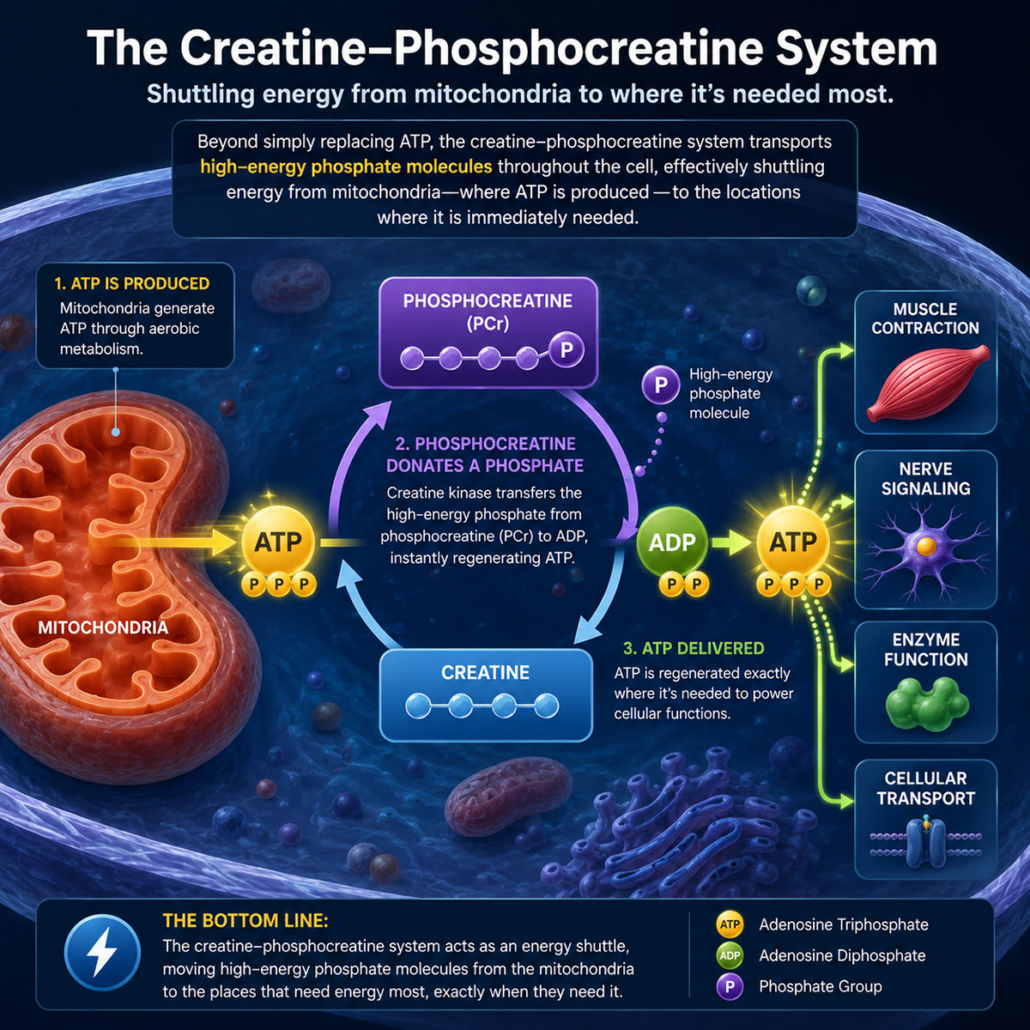
When ATP is broken down to release energy, it loses one phosphate group and becomes adenosine diphosphate (ADP).

Phosphocreatine immediately donates its stored phosphate to ADP through an enzyme called creatine kinase, rapidly converting ADP back into ATP.

This reaction occurs in fractions of a second and allows cells to continue functioning without interruption.

Energy Transportation

As a result, creatine supports:

  • Rapid regeneration of ATP during periods of increased energy demand
  • Sustained muscular power and physical performance
  • Efficient energy delivery within brain cells
  • Healthy cardiac muscle function
  • Cellular resilience during metabolic stress
  • Recovery between repeated bouts of high-energy activity

Beyond simply replacing ATP, the creatine-phosphocreatine system also helps transport high-energy phosphate molecules throughout the cell, effectively shuttling energy from mitochondria — where ATP is produced — to the locations where it is immediately needed.

Phosphocreatine Energy Transport

A Central Role In Cellular Bioenergetics

Because nearly every cell depends on ATP, creatine’s influence extends well beyond exercise performance. Its central role in cellular bioenergetics explains why researchers continue investigating its potential applications in healthy aging, cognitive function, neurological health, metabolic wellness, and other areas where efficient energy metabolism is essential.

As our understanding of cellular energy continues to expand, creatine is increasingly viewed not merely as an exercise ingredient but as one of the body’s most important energy-support nutrients.

Why Creatine Is No Longer Just for Athletes

For years, creatine marketing focused almost exclusively on bodybuilders, powerlifters, and competitive athletes. While these populations continue to benefit from creatine supplementation, modern research has broadened our understanding of where creatine fits within human health.

Every cell that requires rapid energy can benefit from an efficient phosphocreatine system — not just muscle cells.

This realization has fueled growing interest in creatine across several wellness categories, including healthy aging, cognitive performance, women’s health, active lifestyles, and metabolic health. Consumers are increasingly seeking supplements that improve how the body produces energy rather than simply providing temporary stimulation.

Unlike caffeine and other stimulants, creatine does not increase heart rate or stimulate the central nervous system. Instead, it supports the body’s natural ability to regenerate ATP, helping cells meet energy demands more efficiently.

This distinction is important as consumer preferences continue shifting toward foundational health and long-term performance.

Several demographic groups are driving renewed interest in creatine:

Active Lifestyle Consumers

Many consumers exercise for overall wellness rather than athletic competition. They want ingredients that support consistent performance, recovery, and daily energy. Creatine aligns well with this objective by helping replenish ATP during resistance training, recreational sports, and physically demanding lifestyles.

Healthy Aging

Muscle mass naturally declines with age, and maintaining strength becomes increasingly important for mobility and independence. Research suggests creatine supplementation, particularly when combined with resistance exercise, may help support healthy muscle function and physical performance in older adults.

Cognitive Performance

The brain consumes approximately 20% of the body’s resting energy despite representing only about 2% of total body weight. Researchers continue investigating how creatine may support ATP availability within brain tissue, particularly during periods of increased cognitive demand, sleep deprivation, or mental fatigue.

Women’s Health

Historically, creatine research emphasized male athletes. Today, growing interest surrounds its potential role throughout women’s lives, including support for exercise performance, lean body mass, recovery, and healthy aging. Researchers are also exploring how changing hormonal environments may influence creatine metabolism and requirements.

For supplement brands, this evolution significantly expands the market opportunity. Creatine is increasingly appearing in wellness formulations that extend well beyond traditional sports nutrition, creating opportunities for differentiated products that appeal to broader consumer audiences.

Emerging Market Trends

The creatine category has entered a new phase of growth as consumers increasingly recognize its broader health applications beyond athletic performance.

Several market trends are contributing to renewed demand.

Functional Wellness Is Replacing Single-Purpose Sports Nutrition

Consumers increasingly favor multifunctional ingredients that support overall health while providing measurable benefits. Creatine fits this trend because it addresses a fundamental biological process — cellular energy production — that influences physical performance, cognitive function, and healthy aging.

Industry analysts project strong long-term growth for the creatine category as consumer interest expands beyond traditional sports nutrition into preventive wellness and everyday performance.

Grand View Research estimates the global creatine supplements market will reach $8.7 billion by 2033, driven by broader consumer adoption and increasing awareness of creatine’s benefits beyond muscle building.

Education Is Changing Consumer Perception

Healthcare professionals, sports nutrition organizations, and researchers have helped reshape public understanding of creatine. Rather than viewing it solely as a bodybuilding supplement, consumers increasingly recognize creatine as a foundational ingredient that supports ATP regeneration—the body’s primary cellular energy system.

This shift is supported by the International Society of Sports Nutrition (ISSN), whose position stand concludes that creatine monohydrate remains the most effective nutritional supplement currently available for increasing high-intensity exercise capacity and lean body mass, while ongoing research continues to explore benefits for cognitive function, healthy aging, injury recovery, and clinical populations.

Women Represent a Significant Growth Opportunity

Historically underrepresented in creatine marketing, women are becoming one of the fastest-growing consumer segments.

Researchers are increasingly investigating creatine’s potential role in supporting strength, recovery, cognitive performance, healthy aging, and menopause-related health. At the same time, manufacturers are introducing products specifically formulated and marketed for women’s wellness.

Grand View Research projects continued expansion of the women’s creatine market through 2033, while emerging clinical research continues to evaluate creatine’s role during perimenopause and menopause.

Everyday Performance Is Driving Innovation

Consumers increasingly define performance as having enough physical and mental energy to stay productive throughout the day — not simply improving athletic performance.

This broader definition aligns naturally with creatine’s biological role in supporting ATP regeneration. As a result, brands are increasingly positioning creatine within categories such as cognitive wellness, workplace performance, healthy aging, and metabolic health instead of limiting it to pre-workout products.

Delivery Format Innovation Continues

While creatine powders remain the dominant delivery format because they provide clinically relevant dosages and cost-effective daily use, manufacturers continue expanding into formats that improve convenience and consumer accessibility.

These include:

  • Capsules
  • Gummies
  • Stick packs
  • Ready-to-mix beverage powders
  • Functional hydration products
  • Protein powders with added creatine
  • Daily wellness blends
  • Cognitive support formulations

Grand View Research notes that powders continue to account for the largest share of the market, while capsules, tablets, ready-to-drink products, and other convenient formats are among the fastest-growing segments as brands seek to reach new consumer audiences.

As the category continues to mature, brands that educate consumers about creatine’s central role in cellular energy production — rather than focusing exclusively on gym performance — will be well positioned to differentiate themselves in an increasingly competitive marketplace.

Flavoring & Sensory Experience

Creatine monohydrate is naturally neutral in flavor, making it one of the easiest functional ingredients to formulate into a wide variety of delivery formats.

Unlike many botanical extracts or amino acids, it contributes very little bitterness or lingering aftertaste, allowing brands to focus on creating an enjoyable consumer experience rather than masking unpleasant flavors.

Its greatest sensory challenge is not taste but solubility. Creatine monohydrate dissolves slowly in cold water and may leave a small amount of sediment if consumed immediately after mixing.

While this does not affect efficacy, consumers often perceive complete dissolution as an indicator of product quality. Formulators can improve the drinking experience by optimizing particle size, blending techniques, and flavor system design, while providing clear mixing instructions on the label.

Flavor Profiles That Pair Well with Creatine

Because creatine has a clean, neutral flavor profile, it works well with virtually any flavor direction, including:

  • Citrus Lemonade
  • Orange Mango
  • Fruit Punch
  • Blue Raspberry
  • Watermelon
  • Mixed Berry
  • Strawberry Kiwi
  • Peach Mango
  • Tropical Punch
  • Grape
  • Green Apple
  • Cherry Limeade

These bright fruit flavors naturally complement hydration and performance positioning while providing excellent consumer appeal.

Expanding Beyond Sports Nutrition

As creatine moves into healthy aging, cognitive wellness, and everyday performance categories, brands have an opportunity to differentiate themselves with more sophisticated flavor profiles, such as:

  • Blood Orange
  • Yuzu Citrus
  • Blackberry Lemon
  • White Peach
  • Raspberry Hibiscus
  • Pineapple Coconut
  • Dragon Fruit
  • Cucumber Lime
  • Watermelon Mint
  • Pink Lemonade

These premium flavor profiles help reposition creatine from a traditional bodybuilding ingredient to a modern wellness supplement.

Sweetener Systems

Because creatine contributes minimal off-notes, formulators can employ relatively simple sweetener systems.

Common options include:

  • Sucralose + Acesulfame Potassium: Provides a clean sweetness with excellent stability and is the most common system for sports nutrition powders.
  • Stevia Reb M or Reb D: Suitable for naturally positioned products with careful flavor balancing.
  • Monk Fruit Extract: Often paired with stevia to improve sweetness quality while maintaining a natural label.
  • Sugar or Dextrose: Occasionally used in performance or recovery products where carbohydrates are already part of the formulation.

Sensory Best Practices

To maximize consumer acceptance, formulators should consider:

  • Using instantized creatine monohydrate to improve dispersion.
  • Providing mixing directions of 10–16 fl oz of water for improved mouthfeel.
  • Selecting flavor systems that complement hydration and performance positioning.
  • Avoiding excessive acidity, which can accelerate creatine degradation in ready-to-drink beverages during extended storage.
  • Matching flavor intensity to the intended use occasion, whether pre-workout, post-workout, hydration, or everyday wellness.

With its neutral taste, excellent formulation flexibility, and compatibility with a wide range of flavor systems, creatine provides product developers with significant freedom to create supplements that deliver both strong scientific credibility and an enjoyable consumer experience.

Formulation Considerations for Creatine Supplements

Although creatine is a relatively straightforward ingredient, successful product development requires thoughtful formulation decisions that balance efficacy, stability, sensory performance, and cost.

Creatine Monohydrate Remains the Clinical Standard

Among the numerous creatine ingredients available, creatine monohydrate continues to serve as the benchmark for efficacy. It is the form used in the overwhelming majority of published clinical studies and consistently demonstrates excellent safety, bioavailability, and effectiveness.

While alternative forms — including creatine hydrochloride (HCl), buffered creatine, creatine nitrate, magnesium creatine chelate, and creatine ethyl ester — are commercially available, current evidence has not demonstrated consistent advantages over creatine monohydrate for most applications.

Clinically Relevant Dosages

Most research supports daily supplementation in the range of 3–5 grams of creatine monohydrate for long-term maintenance following saturation. Higher intakes may be used during optional loading phases, but many modern formulations emphasize steady daily use without a loading protocol.

Selecting the Right Delivery Format

Delivery format should reflect the target consumer.

  • Powders remain ideal for higher-dose products and active lifestyle consumers.
  • Stick packs provide convenience for travel and on-the-go supplementation.
  • Capsules appeal to consumers seeking simplicity and precise dosing.
  • Gummies continue gaining popularity, although delivering clinically meaningful creatine doses can be technically challenging because of serving size limitations.
  • Functional beverage mixes create opportunities to combine hydration, electrolytes, and cellular energy support in a single product.

Ingredient Synergies

Because creatine supports ATP regeneration, it pairs naturally with ingredients that address complementary aspects of energy metabolism or physical performance, including:

  • Electrolytes
  • Magnesium
  • Taurine
  • Beta-alanine
  • Citrulline
  • Protein
  • Essential amino acids
  • Carbohydrates (for post-exercise recovery products)
  • B vitamins that support energy metabolism

Formulation goals should always reflect the intended consumer rather than simply combining trending ingredients.

Quality Matters

Creatine is widely available, making ingredient quality and manufacturing standards important differentiators. Brands should prioritize reputable ingredient suppliers, robust identity testing, contaminant screening, and manufacturing partners that follow current Good Manufacturing Practices (cGMPs).

Clear education around dosage, quality, and scientific support can further differentiate products in a crowded marketplace.

Why Creatine Represents The Future of Cellular Energy

Few dietary ingredients have accumulated as much scientific evidence as creatine, yet public perception has often lagged behind the research.

Today, that perception is changing.

As consumers become more educated about cellular bioenergetics, they increasingly recognize that sustainable energy begins inside the cell — not in a stimulant blend. Creatine exemplifies this shift by supporting one of the body’s most fundamental biological processes: the rapid regeneration of ATP.

This science-first narrative aligns with several of the supplement industry’s fastest-growing categories, including healthy aging, cognitive wellness, active lifestyles, metabolic health, and everyday vitality.

Rather than being confined to the sports nutrition aisle, creatine is emerging as a foundational ingredient for products designed to support long-term health and performance.

For supplement brands, this represents an opportunity to move beyond legacy marketing centered on muscle growth and instead tell a broader story about cellular resilience, energy efficiency, and whole-body performance.

As research continues to evolve, creatine is increasingly positioned not simply as a performance enhancer, but as one of the most compelling ingredients for supporting human energy at its source.

Conclusion

Creatine has earned its reputation as one of the most effective sports nutrition ingredients ever studied. Yet its greatest strength extends far beyond improving athletic performance.

At its core, creatine is a cellular energy nutrient. By helping regenerate ATP, it supports one of the body’s most fundamental biological processes — the continuous production of usable energy that powers every heartbeat, every muscle contraction, every nerve impulse, and every thought.

This broader understanding is reshaping the marketplace.

Consumers increasingly seek ingredients that support long-term health rather than simply delivering short-term stimulation. As a result, creatine is moving into categories such as cognitive wellness, healthy aging, women’s health, metabolic support, and everyday vitality.

For supplement brands, this shift presents an opportunity to reposition creatine through the lens of cellular bioenergetics rather than athletic performance alone.

Products that educate consumers about ATP regeneration, mitochondrial function, and sustained cellular energy can differentiate themselves while appealing to a much broader audience.

With decades of clinical research, an outstanding safety profile, and expanding applications across multiple health categories, creatine is poised to remain one of the most important foundational ingredients in the future of evidence-based nutrition.

Frequently Asked Questions

No. Creatine and caffeine work through entirely different mechanisms.

Caffeine stimulates the central nervous system by blocking adenosine receptors, temporarily reducing the perception of fatigue and increasing alertness.

Creatine, by contrast, does not stimulate the nervous system. Instead, it supports the body’s natural ability to regenerate ATP—the universal energy currency used by every cell. Rather than creating a temporary feeling of energy, creatine helps cells maintain energy production during periods of increased demand.

Because they work through different pathways, creatine and caffeine are often included together in performance formulations.

Not anymore.

While athletes remain one of the largest consumer groups, researchers now recognize that creatine supports cellular energy production throughout the body. Because ATP is required for virtually every biological process, creatine is increasingly being studied for its role in healthy aging, cognitive performance, neurological health, muscle maintenance, and overall wellness.

This expanding body of research has encouraged many supplement brands to incorporate creatine into products designed for everyday health — not just sports performance.

Creatine monohydrate remains the gold standard.

It has been studied in hundreds of clinical trials and consistently demonstrates excellent bioavailability, safety, effectiveness, and value. Although numerous alternative forms have entered the market — including creatine hydrochloride (HCl), buffered creatine, creatine nitrate, magnesium creatine chelate, and creatine ethyl ester — current evidence has not shown these forms to be consistently superior to creatine monohydrate for most healthy adults.

For most formulations, creatine monohydrate offers the strongest combination of scientific support, manufacturing simplicity, and cost efficiency.

Most research supports a daily intake of 3–5 grams of creatine monohydrate to maintain elevated muscle creatine stores after saturation.

Some individuals choose an optional loading protocol of approximately 20 grams per day (divided into multiple servings) for five to seven days before transitioning to a maintenance dose. However, many consumers successfully achieve muscle saturation through consistent daily supplementation without a loading phase.

Yes. Creatine is among the most extensively studied dietary supplements available. Decades of clinical research have demonstrated that creatine monohydrate is safe for healthy individuals when consumed at recommended dosages.

The International Society of Sports Nutrition (ISSN) states that there is no compelling scientific evidence that recommended creatine supplementation negatively affects kidney function in healthy individuals. As with any dietary supplement, consumers with pre-existing medical conditions should consult their healthcare provider before beginning supplementation.

Developing a successful creatine supplement requires more than selecting an ingredient. Brands must also balance clinical efficacy, ingredient quality, flavor, manufacturing efficiency, packaging, regulatory compliance, and cost of goods.

Intermountain Nutrition helps brands transform evidence-based concepts into scalable commercial products.

Our turnkey manufacturing capabilities include:

  • Custom formulation and product development
  • Stock formulations for faster market entry
  • Flavor development and sensory optimization
  • Powder blending, encapsulation, gummies, stick packs, and pouch packaging
  • Regulatory and label guidance
  • On-site third-party analytical testing
  • Quality systems aligned with current Good Manufacturing Practices (cGMPs)
  • Flexible production capabilities designed to support growing brands

Whether you’re developing a traditional sports nutrition product or a next-generation cellular energy formula, our team works closely with customers to create differentiated products backed by science and manufactured to the highest quality standards.

As consumer understanding of creatine continues to evolve, manufacturers with deep formulation expertise and scalable production capabilities will be well positioned to help brands capitalize on one of the supplement industry’s fastest-growing ingredient categories.

References

Antonio J, Candow DG, Forbes SC, et al. Common questions and misconceptions about creatine supplementation: what does the scientific evidence really show? Journal of the International Society of Sports Nutrition. 2021;18:13.

Kreider RB, Candow DG, Forbes SC, et al. International Society of Sports Nutrition Position Stand: Creatine Supplementation and Exercise. Journal of the International Society of Sports Nutrition. 2025.

Buford TW, Kreider RB, Stout JR, et al. International Society of Sports Nutrition Position Stand: Creatine Supplementation and Exercise. Journal of the International Society of Sports Nutrition. 2007.

National Institutes of Health Office of Dietary Supplements. Dietary Supplements for Exercise and Athletic Performance.

Grand View Research. Creatine Supplements Market Size, Share & Trends Analysis Report (2026–2033).

Grand View Research. U.S. Creatine Supplements Market Report.

Grand View Research. Women’s Wellness Products Market – Creatine.

Wall Street Journal. Creatine Isn’t Just for Bodybuilders Anymore.

Related Postings

Akkermansia Muciniphila For Metabolic Health Support Supplement on a shelf at the store
GRAS documentation on a countertop of a lab
Adaptogens for Wellness Supplements