Marine Collagen: The Next Frontier in Beauty & Longevity
May 12, 2026 | Focus on Formulation
Marine collagen delivers highly bioavailable structural proteins that support skin, joints, and connective tissue.

May 12, 2026 | Focus on Formulation
Marine collagen delivers highly bioavailable structural proteins that support skin, joints, and connective tissue.
Marine collagen has quickly become a driver in the supplement market. While bovine collagen still dominates volume, marine collagen is carving out a high-value segment — especially in beauty-from-within and longevity-focused formulations.
Consumers increasingly associate marine-derived ingredients with:
As a result, marine collagen is now a core ingredient in premium ingestible beauty products and next-generation healthy aging stacks.
According to Grand View Research, the global collagen market is expected to reach $16.7 billion by 2030, with marine collagen experiencing some of the fastest growth due to rising demand for clean-label and sustainable ingredients.
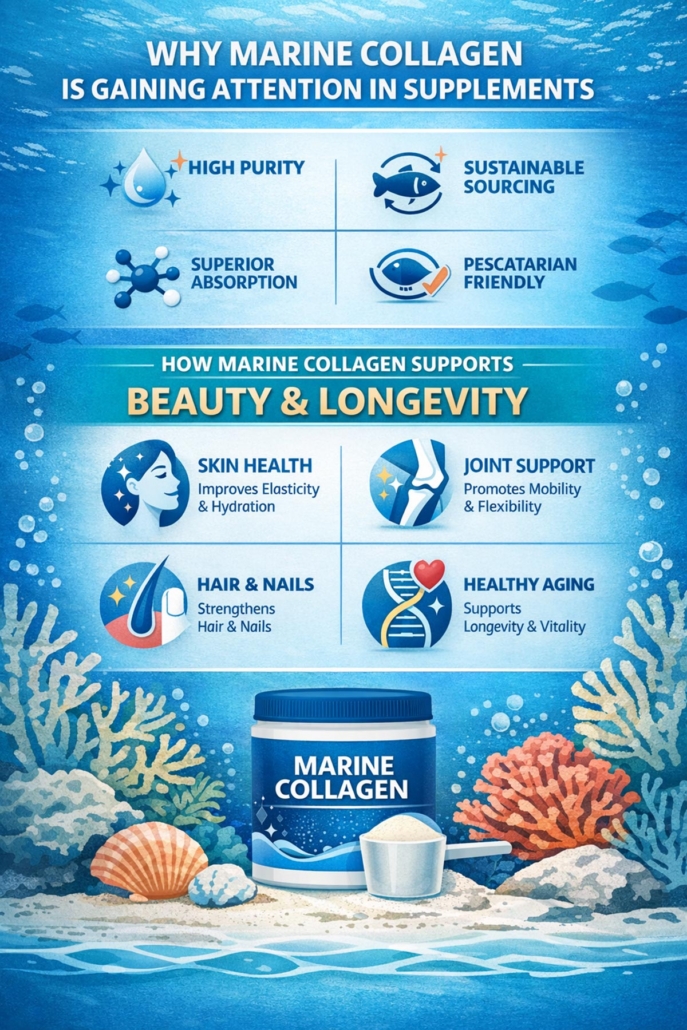
Marine collagen is primarily composed of Type I collagen, the most abundant collagen in the human body and the key structural protein in skin, tendons, and bones.
Because marine collagen peptides are typically smaller, they demonstrate faster gastrointestinal absorption and higher bioavailability compared to some other sources.
A study published in Journal of Cosmetic Dermatology found that oral collagen peptides significantly improved skin elasticity, hydration, and dermal density after 8–12 weeks of supplementation.
Marine collagen directly supports dermal matrix integrity. It stimulates fibroblast activity, which drives collagen and elastin production.
As collagen declines with age (approximately 1% per year after age 20), supplementation helps:
Collagen peptides contribute amino acids necessary for cartilage repair and connective tissue resilience. This makes marine collagen relevant beyond beauty—especially for active aging populations.
Marine collagen provides structural proteins that support keratin production, improving nail strength and hair thickness.
Collagen plays a foundational role in maintaining tissue integrity across multiple systems. Increasingly, it is positioned as part of a broader longevity stack, alongside antioxidants, NAD+ precursors, and anti-inflammatory compounds.

The ingestible beauty market is projected to exceed $9.4 billion by 2030, driven by demand for skin health supplements.
Marine collagen sits at the center of this category.
Marine collagen is often sourced from fish byproducts (skin, scales), aligning with circular economy principles and reducing waste.
Marine collagen appeals to:
Brands increasingly highlight:
Marine collagen performs exceptionally well in multi-ingredient blends targeting premium consumers.
Designing high-performance marine collagen products requires careful attention to functionality, stability, and consumer experience.

Marine collagen peptides typically dissolve well in cold and hot liquids. However, particle size and hydrolysis level influence clarity and mouthfeel. Optimizing dispersion ensures a smooth consumer experience in powders and stick packs.

Although marine collagen is relatively neutral, slight marine notes can emerge at higher doses. Flavor systems, masking agents, and complementary ingredients (like citrus or berry profiles) improve palatability.

Clinically relevant doses typically range from 2.5g to 10g daily. Brands must balance efficacy with serving size, especially in capsules vs. powders.

Marine collagen is hygroscopic. Therefore, moisture control, packaging selection, and anti-caking strategies are critical for maintaining product integrity.

Vitamin C enhances collagen synthesis. Additionally, hyaluronic acid, biotin, and antioxidants improve overall efficacy in beauty formulations.

Structure/function claims must align with FDA guidelines. Claims like “supports skin elasticity” are acceptable, while disease claims must be avoided.

Marine collagen is not just another ingredient. It’s a category-defining premium signal.
Brands that successfully leverage marine collagen can:
As consumers continue to prioritize both aesthetics and long-term health, marine collagen sits at the intersection of both demands.
Marine collagen represents a powerful opportunity for supplement brands looking to lead in beauty and longevity innovation. However, success depends on more than ingredient selection. It requires thoughtful formulation, quality assurance, and strategic positioning.
At Intermountain Nutrition, we partner with brands to develop science-forward, premium marine collagen formulations designed for performance, differentiation, and scalability.
If you’re exploring marine collagen for your next product, our team can help you bring it to market with confidence.
What is marine collagen made from?
Marine collagen is derived from fish skin, scales, and bones, typically from species like cod, haddock, or tilapia. These materials are rich in Type I collagen, which is enzymatically hydrolyzed into smaller peptides for improved absorption.
Because it uses fish byproducts, marine collagen also supports sustainability initiatives by reducing waste in the seafood industry.
Is marine collagen better than bovine collagen?
Marine collagen is often considered superior for skin-focused formulations due to its high concentration of Type I collagen and smaller peptide size, which may improve bioavailability.
However, bovine collagen contains both Type I and Type III collagen, making it more versatile for joint and connective tissue support. The choice ultimately depends on the product’s positioning and target consumer.
How long does it take to see results from marine collagen?
Clinical studies suggest that visible improvements in skin elasticity and hydration typically occur within 8 to 12 weeks of consistent supplementation.
However, results depend on dosage, formulation, and individual physiology. Products that include synergistic ingredients like vitamin C may accelerate outcomes.
Can marine collagen support joint health?
Yes, marine collagen provides key amino acids that contribute to cartilage and connective tissue health. While it is more commonly associated with skin benefits, it can still play a role in joint support formulations, especially when combined with ingredients like MSM or glucosamine.
Is marine collagen safe?
Marine collagen is generally recognized as safe (GRAS) when sourced from reputable manufacturers and properly processed.
However, quality is critical. Brands should ensure rigorous testing for contaminants such as heavy metals and allergens, along with full traceability of raw materials.
Grand View Research. (2024). Collagen market size, share & trends analysis report.
Future Market Insights. (2026). Collagen supplement market outlook (2026–2036).
Future Market Insights. (n.d.). Beauty supplement market.
Farooq, S., Ahmad, M. I., Zheng, S., Ali, U., Li, Y., Zhang, C., & Shixiu, H. (2024). A review on marine collagen: Sources, extraction methods, and applications. Collagen and Leather.
International Journal of Dermatology. (2021). Oral collagen supplementation and skin health outcomes.
Nature Portfolio. (2025). Advances in collagen research and longevity applications.
PubMed. (2016). Marine collagen peptides and antioxidant supplementation study.
PubMed. (2024). Clinical insights on collagen supplementation and health outcomes.
Wiley. (2023). Marine collagen: Structure, function, and applications. In Biopolymers and biomaterials.
Everyday Health. (n.d.). What is marine collagen and should you try it?
 https://intermountainnutrition.com/wp-content/uploads/2026/06/flavoring-trends-for-2026-15.jpg
1200
1200
Larisa Graham
https://intermountainnutrition.com/wp-content/uploads/2026/01/IMN-gradient-logo-NEW.png
Larisa Graham2026-06-09 09:00:002026-06-03 13:04:56The Hottest Supplement Flavors of 2026
https://intermountainnutrition.com/wp-content/uploads/2026/06/flavoring-trends-for-2026-15.jpg
1200
1200
Larisa Graham
https://intermountainnutrition.com/wp-content/uploads/2026/01/IMN-gradient-logo-NEW.png
Larisa Graham2026-06-09 09:00:002026-06-03 13:04:56The Hottest Supplement Flavors of 2026 https://intermountainnutrition.com/wp-content/uploads/2026/05/nutritional-supplements-for-gamers-09.jpg
1200
1200
Larisa Graham
https://intermountainnutrition.com/wp-content/uploads/2026/01/IMN-gradient-logo-NEW.png
Larisa Graham2026-06-08 05:50:022026-06-08 05:50:09Nutritional Supplements for Gamers
https://intermountainnutrition.com/wp-content/uploads/2026/05/nutritional-supplements-for-gamers-09.jpg
1200
1200
Larisa Graham
https://intermountainnutrition.com/wp-content/uploads/2026/01/IMN-gradient-logo-NEW.png
Larisa Graham2026-06-08 05:50:022026-06-08 05:50:09Nutritional Supplements for Gamers https://intermountainnutrition.com/wp-content/uploads/2026/05/testosterone-supplements-09.jpg
1200
1200
Larisa Graham
https://intermountainnutrition.com/wp-content/uploads/2026/01/IMN-gradient-logo-NEW.png
Larisa Graham2026-06-05 09:30:002026-06-09 16:09:43The Rise of Testosterone Support in Men’s Health Supplements
https://intermountainnutrition.com/wp-content/uploads/2026/05/testosterone-supplements-09.jpg
1200
1200
Larisa Graham
https://intermountainnutrition.com/wp-content/uploads/2026/01/IMN-gradient-logo-NEW.png
Larisa Graham2026-06-05 09:30:002026-06-09 16:09:43The Rise of Testosterone Support in Men’s Health Supplements

 STOCK FORMULA: Feminine Balance Capsules