Women’s Stress & Cortisol Support
May 1, 2026 | Focus on Formulation
The Hidden Hormone Crisis
Cortisol dysregulation is emerging as a key driver behind fatigue, weight gain, sleep disruption, and hormonal imbalance.

May 1, 2026 | Focus on Formulation
Cortisol dysregulation is emerging as a key driver behind fatigue, weight gain, sleep disruption, and hormonal imbalance.
Stress is no longer just a lifestyle concern. It’s a physiological disruptor with measurable consequences on women’s hormonal health, metabolic function, and long-term wellness outcomes.
Increasingly, research shows that chronic cortisol dysregulation is one of the most overlooked drivers behind fatigue, weight gain, mood instability, and sleep disruption in women.
At the same time, consumer awareness is accelerating. Women are actively seeking targeted, science-backed solutions that address stress at a hormonal level — not just symptom relief.
This shift represents a major opportunity for supplement brands to lead with clinically relevant, differentiated formulations.
Stress is not evenly distributed — and women are disproportionately affected.
According to the American Psychological Association, women consistently report higher stress levels than men, with 27% of women reporting “extreme stress” compared to 20% of men (APA, 2023).
Meanwhile, the World Health Organization recognizes stress-related conditions as a major contributor to global disease burden.
Even more concerning, chronic stress is no longer episodic. It’s persistent. This leads to sustained cortisol elevation or dysregulation, which disrupts:
From a product development standpoint, this positions cortisol as a central biomarker — not just a side effect.

Cortisol is often labeled the “stress hormone,” but its role is far more nuanced. It regulates energy availability, inflammation, and circadian rhythm.
However, when dysregulated, it becomes a key driver of systemic imbalance.
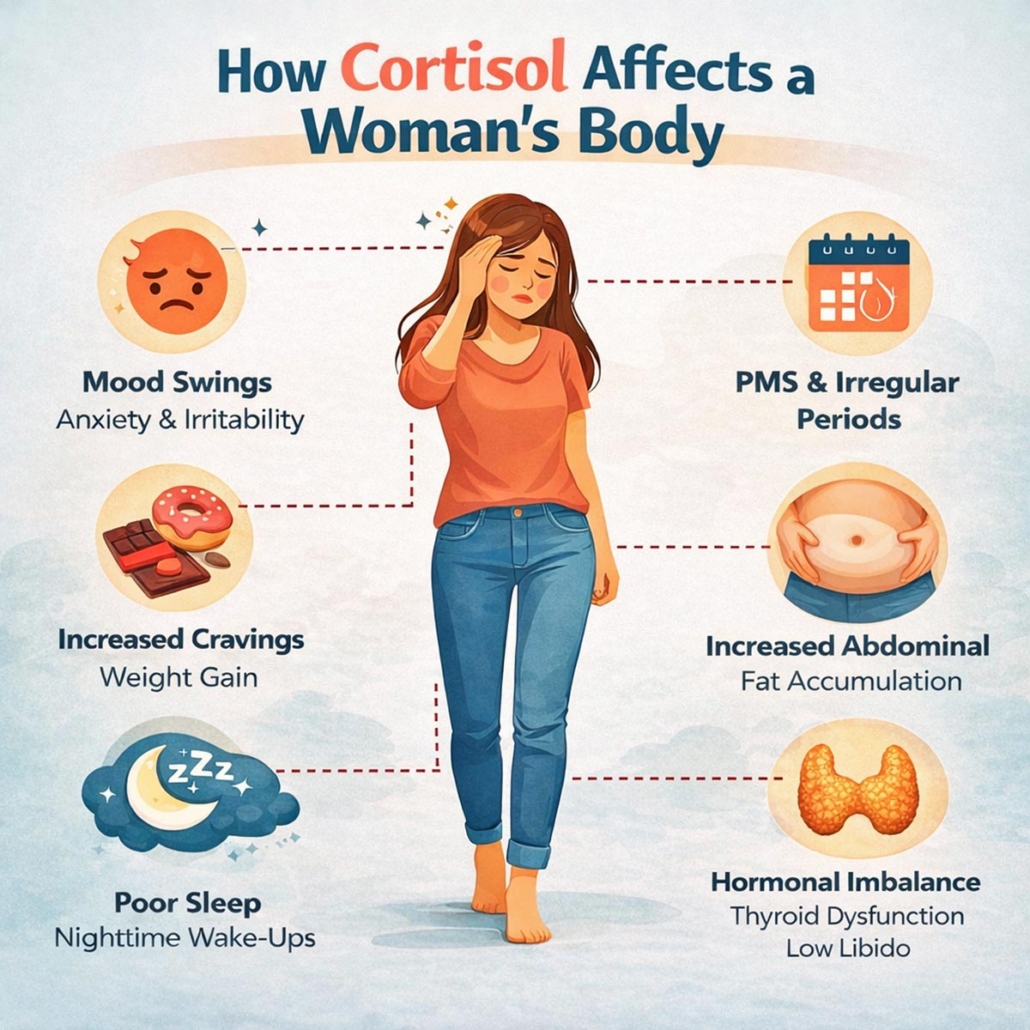
Women’s hormonal systems are inherently cyclical and sensitive to stress signals. Cortisol interacts directly with:
As a result, stress often manifests differently in women:
This creates a compelling case for gender-specific formulations rather than generic stress products.
Understanding symptom clustering is critical for positioning and messaging.
These symptoms are often misattributed to lifestyle alone. However, they frequently indicate underlying HPA axis dysregulation.

To meet evolving consumer expectations, brands are moving toward multi-pathway formulations that combine adaptogens, micronutrients, and functional botanicals.
(HPA Axis Modulation)
The stress-support category is evolving rapidly, with women’s health leading the charge.
Importantly, consumers are no longer satisfied with generic “calm” claims. They want:
This shift creates a clear opportunity for brands that can combine scientific credibility with targeted positioning.
Effective cortisol-support products require strategic formulation that balances efficacy, sensory experience, and compliance.

Clinically relevant dosing is critical for adaptogens like ashwagandha and rhodiola. Sub-therapeutic dosing weakens consumer trust and product performance.
Use highly absorbable forms such as magnesium glycinate or liposomal delivery systems to enhance efficacy.
Combining adaptogens with micronutrients and calming amino acids creates multi-pathway support for HPA axis regulation.
Botanical ingredients often carry bitter notes; flavor systems are essential for powders and stick packs targeting female consumers.
Capsules, powders, and stick packs each serve different use cases — daily stress support vs. acute stress response.

Adaptogens and botanicals require careful handling to maintain potency across shelf life, especially in moisture-sensitive formats.
Cortisol dysregulation is not just a symptom. It’s a root cause of many of the health challenges women face today. As awareness grows, so does demand for targeted, science-backed solutions.
For supplement brands, this represents more than a trend. It is a strategic category with long-term relevance and strong consumer demand.
Intermountain Nutrition partners with brands to develop clinically grounded, market-ready formulations that address real physiological needs—like cortisol balance and women’s stress resilience.
Cortisol is a steroid hormone produced by the adrenal glands in response to stress. It plays a critical role in regulating metabolism, inflammation, and circadian rhythm.
However, in women, cortisol has an even broader impact due to its interaction with reproductive hormones such as estrogen and progesterone. When cortisol levels remain elevated for extended periods, it can disrupt hormonal balance, leading to symptoms such as irregular cycles, fatigue, mood swings, and weight gain.
Additionally, cortisol influences insulin sensitivity and sleep quality, making it a central hormone in overall metabolic and endocrine health. Understanding and managing cortisol is therefore essential for supporting both short-term well-being and long-term hormonal stability in women.
Chronic stress activates the hypothalamic–pituitary–adrenal (HPA) axis, leading to sustained cortisol production. Over time, this can disrupt the balance of key reproductive hormones.
One common mechanism is the “pregnenolone steal,” where the body prioritizes cortisol production over progesterone synthesis. This can contribute to symptoms such as PMS, irregular cycles, and fertility challenges.
Additionally, elevated cortisol can suppress estrogen levels and interfere with thyroid function, further compounding hormonal imbalance. These disruptions often manifest as fatigue, mood instability, sleep disturbances, and metabolic changes.
For supplement brands, addressing stress at the hormonal level provides a more comprehensive solution than targeting symptoms alone.
Several ingredients have demonstrated efficacy in supporting healthy cortisol levels. Adaptogens such as ashwagandha and rhodiola are among the most well-researched, with clinical studies showing reductions in cortisol and perceived stress.
Magnesium, particularly in glycinate or threonate forms, supports nervous system regulation and relaxation. Phosphatidylserine has been shown to blunt cortisol spikes, especially in response to physical stress.
Additionally, L-theanine promotes a calm yet focused mental state without sedation. Emerging ingredients like saffron extract and reishi mushroom are also gaining traction for their role in mood and stress support.
The most effective formulations typically combine multiple ingredients to address stress through different physiological pathways.
The optimal delivery format depends on the intended use case and target consumer. Capsules remain the most common format due to convenience and precise dosing. However, powders and stick packs are gaining popularity, particularly among women seeking a daily wellness ritual.
These formats allow for functional beverage integration and can enhance perceived value. Gummies are also widely used, though they may present challenges with dosing and sugar content. For cortisol support specifically, formats that align with daily routines, such as morning powders or evening capsules, tend to perform well.
Ultimately, successful products balance efficacy, convenience, and sensory experience.
Effective positioning requires a shift from generic stress relief to hormone-focused wellness. Brands should emphasize the connection between cortisol and key concerns such as energy, weight management, mood, and sleep.
Educational content plays a critical role in helping consumers understand why cortisol matters and how it affects their daily lives. Additionally, highlighting clinically studied ingredients and transparent dosing builds trust and credibility. Messaging that speaks directly to women’s experiences, such as cycle support or “wired but tired” fatigue, resonates strongly.
By combining scientific validation with relatable benefits, brands can differentiate themselves in an increasingly competitive market.
American Psychological Association. (n.d.). Stress in America.
Benenden Hospital. (n.d.). Understanding high cortisol levels in females.
British Broadcasting Corporation. (2021, September 28). Why women are more burned out than men.
Chrousos, G. P. (2009). Stress and disorders of the stress system. Nature Reviews Endocrinology, 5, 374–381.
Data Bridge Market Research. (n.d.). Global stress relief supplements market report.
DataM Intelligence. (2025). Stress relief supplements market report.
Fact.MR. (2023). Stress relief supplements market analysis report.
Fortune Business Insights. (2026). Stress supplements market size, share & trends.
Future Market Insights. (2024). Stress relief supplement market outlook.
HTF Market Intelligence. (n.d.). Global stress management supplements market report.
Market Research Future. (2024). Stress relief supplements market report.
Medichecks. (n.d.). Are women more stressed than men?
National Institutes of Health, Office of Dietary Supplements. (n.d.). Ashwagandha: Fact sheet for health professionals.
Office on Women’s Health. (2025). Stress and your health.
Prado, R. C. R., et al. (2025). Effects of the menstrual cycle phase on cortisol responses. Endocrines, 6(1), 14.
Reschke-Hernández, A. E., et al. (2017). Sex differences in cortisol response to stress. Journal of Neuroscience Research.
Strategic Market Research. (n.d.). Stress relief supplements market report.
The Business Research Company. (2026). Stress supplements market report.
 https://intermountainnutrition.com/wp-content/uploads/2026/06/shilajit-for-supplement-formulations-01.jpg 1200 1200 Larisa Graham https://intermountainnutrition.com/wp-content/uploads/2026/01/IMN-gradient-logo-NEW.png Larisa Graham2026-06-26 20:00:322026-06-26 20:00:38Supplement Product Opportunities with Shilajit https://intermountainnutrition.com/wp-content/uploads/2026/06/biohacking-supplement-support-14.jpg 1200 1200 Larisa Graham https://intermountainnutrition.com/wp-content/uploads/2026/01/IMN-gradient-logo-NEW.png Larisa Graham2026-06-24 09:00:002026-06-22 21:24:41Biohacking Supplements https://intermountainnutrition.com/wp-content/uploads/2026/06/mens-sexual-wellness-supplements-03.jpg 1200 1200 Larisa Graham https://intermountainnutrition.com/wp-content/uploads/2026/01/IMN-gradient-logo-NEW.png Larisa Graham2026-06-22 09:00:002026-06-19 13:29:49Men’s Sexual Wellness Supplements
 The Growth of Women’s Performance Nutrition